Protein therapeutics in sports drug testing
Protein therapeutics in sports drug testing - Doping analysis

New publication
13th February 2026
Walpurgis K, Sakellariou P, Thomas A, Thevis M. Protein therapeutics in sports drug testing: past, present and future. Expert Rev Proteomics. 2026 Jan-Feb;23(1-2):21-39. doi: 10.1080/14789450.2026.2629979. Epub 2026 Feb 13. PMID: 41668562
download abstract
Abstract
Introduction: Protein drugs comprising - among others - recombinantly produced analogues of endogenous hormones as well as genetically or chemically modified long-acting derivatives, therapeutic antibodies, and recombinant fusion proteins are not only promising therapeutic means for the treatment of numerous diseases but can also be relevant as performance-enhancing agents in sports.
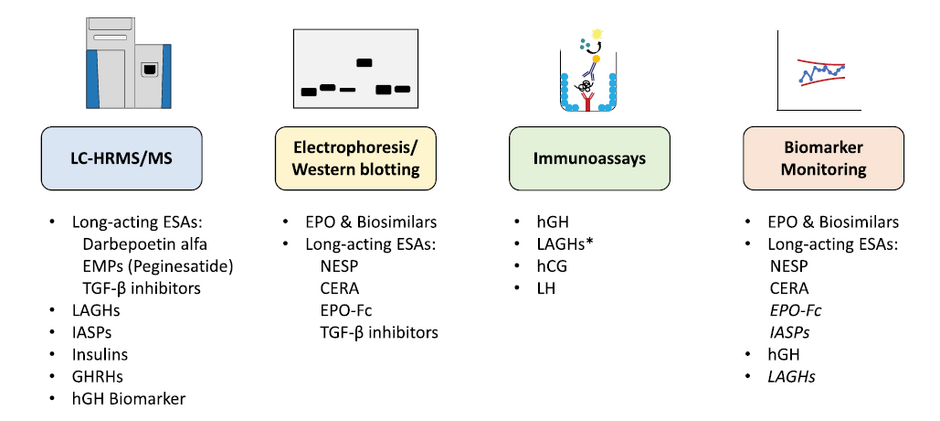
Areas covered: Within this review, classical and emerging protein-therapeutics with (presumed) effects on muscle growth and erythropoiesis will be described and both established and potential strategies for their detection in doping control samples will be discussed.
Expert opinion: The detection of protein drugs in doping control samples is associated with numerous challenges as not only a sufficient analytical sensitivity but also unambiguous identification and differentiation from endogenous analogues have to be ensured. Moreover, the structural complexity of proteins in general and, especially, when post-translational modifications such as glycosylations are present, necessitates the use of sophisticated technologies as for instance immunoassays and liquid chromatography interfaced with high-resolution tandem mass spectrometry. Consequently, it is of utmost importance to continuously improve the existing sports drug testing assays and also search for novel/improved biomarkers indicative of protein doping.
Keywords: Doping; erythropoiesis-stimulating agents (ESAs); fusion protein; growth hormone; inhibitors of the activin receptor signaling pathways (IASPs); protein drug; therapeutic antibody; transforming growth factor beta (TGF-β) signaling inhibitors.