Meldonium (metabolic modulator)

Meldonium (Mildronate®)
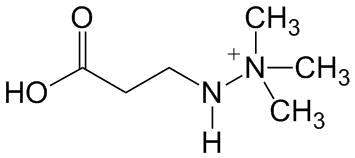
Meldonium is an active ingredient that is not approved as a medication in Germany. The substance is currently marketed by the company Grindeks (Latvia) as a medication under the name Mildronate® in the Baltic states and Russia.
Meldonium is said to counteract reduced blood flow and is therefore considered suitable as a medication for angina pectoris and heart disease.
Doping
Based on a monitoring program by the World Anti-Doping Agency (WADA) for the active ingredient meldonium, widespread abuse of the substance was detected in various sports in 2014.
It is presumed that athletes use the substance to exploit its potential effects on improved oxygen utilization and physical performance. Since its use was predominantly for non-medical reasons to enhance performance, WADA decided to ban meldonium in sports effective January 1, 2016. The substance is classified in Group S4: Hormones and Metabolic Modulators.
Lit.: Christian Görgens, Sven Guddat, Josef Dib, Hans Geyer, Wilhelm Schänzer, and Mario Thevis: Mildronate® (Meldonium) in professional sports – monitoring doping control urine samples using hydrophilic interaction liquid chromatography – high resolution/high accuracy mass spectrometry. Drug Test Anal, April 5, 2015, DOI: 10.1002/dta.1788
see abstract
Information from Grindeks (Riga, Latvia) on the effects of Meldonium
Mildronate® is the leading agent in the cardiovascular group of anti-ischemic agents with metabolic action:
"Acts as an anti-ischemic cell protector in patients with angina pectoris, chronic heart failure, and cerebral circulation disorders."
"Improves physical capacity and mental function in cases of ischemia and in healthy people." "
Due to its unique mechanism of action, Mildronate®, depending on the prescribed dose, is widely used for the treatment of various heart and vascular diseases, as well as for improving the work capacity of healthy people during physical and mental stress and during the rehabilitation period.
In February 2010, "Grindeks" successfully completed a clinical trial on the effect of the brand-name product Mildronate® on the treatment of angina. Publication in "Seminars in Cardiovascular Medicine, 2010; 16:3" on the results of the clinical trial "Mildronate® improves exercise tolerance in patients with stable angina: results of a long-term clinical trial."
Unusual excretion profile of meldonium
As mentioned, meldonium was banned by the World Anti-Doping Agency (WADA) as of January 1, 2016. Some athletes who tested positive for meldonium during doping controls in January or February 2016 stated that they had taken the substance before January 1, 2016, when it was not yet banned, and therefore no doping violation had occurred.
At that time, it was not known whether the use of meldonium was actually detectable in urine samples over several weeks. Therefore, a study (see publication) was initiated to compare the elimination kinetics following a single dose (5 subjects, 1x500 mg) and multiple doses (5 subjects, 2x500 mg daily for 6 days). The results showed that meldonium was detectable for up to 65 days (single dose) and up to 117 days (multiple doses).
These results were taken into account in the subsequent evaluation of doping violations involving meldonium.
Görgens C, Guddat S, Bosse C, Geyer H, Pop V, Schänzer W, Thevis M. The atypical excretion profile of meldonium: Comparison of urinary detection windows after single- and multiple-dose administration in healthy volunteers. J Pharm Biomed Anal. 2017 May 10;138:175-179.
See abstract
Institute of Biochemistry at DSHS Cologne, Oct. 1, 2015, last updated July 9, 2017