Psychology in Sport and Exercise
Master of Science (M.Sc.)
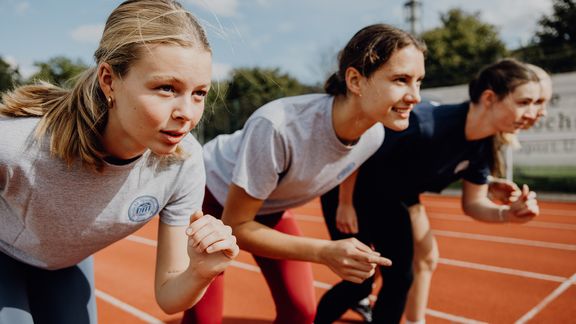
The M.Sc. Psychology in Sport and Exercise (PSE) combines psychology and sport science. The programme aims to provide scientific knowledge and research skills that are relevant both for an academic career and for applied professional fields. PSE is suitable for graduates in psychology and sport science who enjoy scientific work, conducting experiments, and applying research in practice, for example in athlete coaching. It is an English-taught, full-time programme lasting four semesters and comprising a total of 120 credit points. The curriculum includes research methods, statistics, diagnostics, intervention, and evaluation, as well as theoretical and applied topics. The research projects and the master’s thesis are completed at the end of the programme and serve as the final assessment of the competences acquired. Possible career perspectives include research, doctoral studies or teaching in fields related to movement science, neuroscience, health science or cognitive science, as well as sport psychological counselling, diagnostics, intervention and evaluation.
Key facts
Duration of study
4 semesters
Commencement of studies
Winter semester
Workload
120 Credit Points
Application deadline
- 31st of May (Non-EU)
- 15th of July (GER & EU)
Qualification
Master of Science (M.Sc.)
Language of instruction
English
Fees
approx. 335€ (Semester fee)
University places
30 places per cohort
Does Psychology in Sport and Exercise match your interests?
Are you considering applying for the M.Sc. Psychology in Sport and Exercise? Use the MasterCheck to find out whether the programme matches your interests and expectations.
Admission Requirements
Admission requirements for this Master's Degree course is a successfully completed Bachelor's Degree, in which at least 180 credits according to European Credit Transfer System (ECTS) have been acquired or an equivalent successfully passed University degree. The following requirements will also be imposed according to Para. 1 of the Admissions Regulations of the GSU:
Bachelor's Degree program oriented in sports science or psychology. The curriculum of the Bachelor’s Degree program must have covered one of each of the following three study units of a minimum of 10 credits:
- Life science, sports science or kinesiology bases (for example, functional anatomy and physiology, kinesiology and biomechanics, training science, neuroscience),
- Psychological bases (for example, general psychology, social psychology, clinical psychology, health psychology, educational psychology) and
- Statistics / Methodology.
- Your personal and professional suitability is assessed based on your CV and a letter of motivation.
- As the programme is taught entirely in English, you must provide proof of English language proficiency through one of the following:
- TOEFL iBT (minimum 95 points)
- IELTS Academic (minimum 7.0)
- Cambridge Certificate (CAE) at C1 level
This requirement is waived for native English speakers and for applicants who have completed a Bachelor’s degree in English within the EU or in an English-speaking country. German language skills are not mandatory for admission, but basic knowledge of German is recommended.
Eligibility Form
-
save_altEligibility Form PSEDownload "Eligibility Form PSE"Pdf, 349 KB
Guidelines & Regulations
-
save_altEU-Application Guideline WiSe 26/27Download "EU-Application Guideline WiSe 26/27"Pdf, 742 KB
-
save_altNon-EU-Application Guideline WiSe 26/27Download "Non-EU-Application Guideline WiSe 26/27"Pdf, 734 KB
-
save_altAdmissions RegulationsDownload "Admissions Regulations"Pdf, 210 KB


Degree Structure and Content
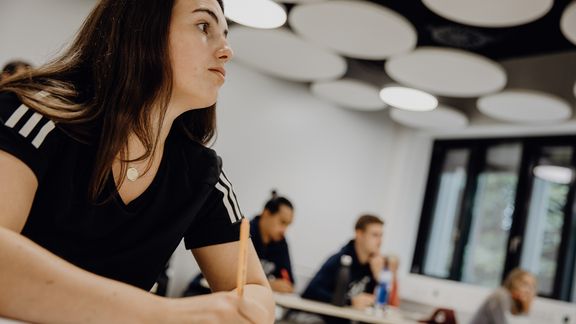
The M.Sc. PSE is a modular, full-time programme completed over four semesters. Each module is a self-contained unit with defined objectives, content, teaching formats and assessments, such as written or oral exams.
Throughout the programme, you will earn a total of 120 Credit Points, reflecting your overall workload. Teaching formats primarily include lectures, seminars and tutorials, complemented by study projects and application-oriented learning in professional contexts. In addition to scheduled classes, a significant amount of independent study is expected.
The programme is taught entirely in English and includes some courses with mandatory attendance. You will complete 11 modules in total. The first module serves as a foundation, ensuring that all students share a common level of knowledge in sport science and psychology.
Subsequent modules focus on developing advanced research skills as well as theoretical and applied knowledge across key topics in sport and exercise psychology. In the final phase of the programme, you will conduct independent research projects and complete your Master’s thesis, allowing you to specialise in an area of personal interest.
Programme-specific documents
-
save_altModule handbook PSEDownload "Module handbook PSE"Pdf, 2 MB
-
save_altCurriculum schedule PSEDownload "Curriculum schedule PSE"Pdf, 205 KB
-
save_altModule prerequisites PSEDownload "Module prerequisites PSE"Pdf, 147 KB
Career Opportunities and Professional Perspectives
Here are your options at GSU and your career prospects after graduation.
Further options at GSU


Graduates of PSE are well prepared for careers in both academic and applied settings. The programme qualifies you for further academic pathways, such as pursuing a PhD or working in research and teaching, particularly in fields like movement science, neuroscience, health science or cognitive science.
If you aim to work in applied contexts, you may pursue a career as a sport psychology expert, supporting athletes or other target groups in performance development, mental health and personal growth. Potential employers include sports federations, clubs, training centres and organisations in competitive and recreational sport. The demand for qualified sport psychology professionals is steadily increasing.
Your research-oriented training also opens up opportunities in roles that require expertise in diagnostics, intervention and evaluation, for example in consulting, quality management or programme development.
Please note that in Germany the professional title “psychologist” is legally protected. Graduates of this programme may use this title if they also hold a Bachelor’s degree in psychology. Otherwise, they may work under the designation of sport psychology expert.