Nandrolone (19-nortestosterone) - 'active' urine
Spontaneous formation of norandrosterone in "unstable" or "active" urine
Formation of norandrosterone from the testosterone metabolite androsterone
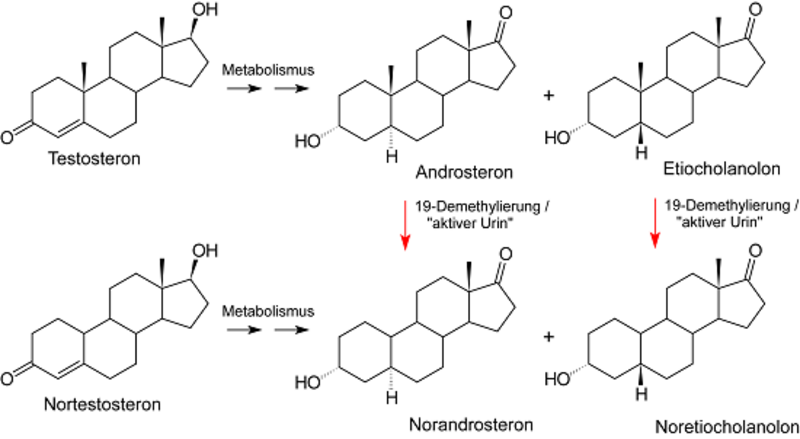
In March 2004, Thieme et al. [2] first demonstrated the spontaneous formation of norandrosterone in urine from the main metabolite of testosterone, androsterone, at the Manfred Donike Workshop on Doping Analysis in Cologne. This conversion occurs only rarely in urine samples. The cause of this is not yet known. It is assumed that 19-demethylation occurs via previously unknown microorganisms (Fig. 7). However, Thieme et al. [2] reported only "spontaneously" formed norandrosterone levels below the threshold of 2 ng/ml urine.
Fig. 7 Metabolism of testosterone and nortestosterone (nandrolone) – illustration of the major metabolites and rare formation of norandrosterone and noretiocholanolone in urine via 19-demethylation
For the first time in September 2004, the Institute of Biochemistry at the German Sport University Cologne was able to attribute a urine finding of 5.2 ng norandrosterone per ml of urine in a competition control sample to “active urine” [3]. Further investigations using isotope ratio mass spectrometry showed that the isotopic composition of the norandrosterone in this urine sample matched the values of androsterone (a metabolite of testosterone) and could therefore be attributed to an endogenous source rather than an external (exogenous) source resulting from doping via the use of nandrolone or one of its banned prohormones [3].
Further information on the phenomenon of "active urine":
How can "active urine" be detected? (Analytical methods)
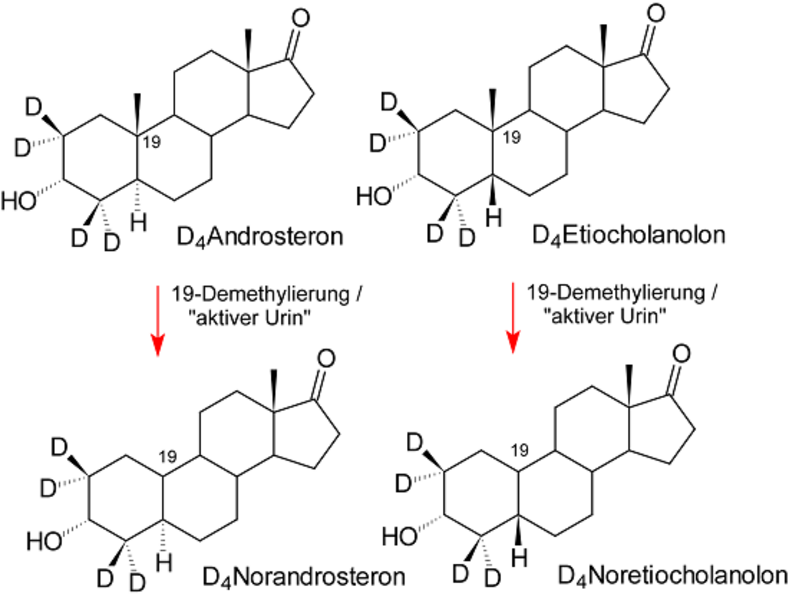
A urine sample suspected of containing norandrosterone is spiked with deuterated androsterone and/or etiocholanolone and incubated for over 10 hours at 37°C. If this results in the formation of deuterated norandrosterone or noretiocholanolone (Fig. 8), the urine is “active,” and the finding is not classified as a doping violation. In this conversion, a higher percentage of noretiocholanolone is typically produced from etiocholanolone than norandrosterone from androsterone. This results in the ratio of the testosterone metabolites androsterone (A) to etiocholanolone (E) being greater than the ratio of norandrosterone (NA) to noretiocholanolone (NE). Example with an "active sample": If the A/E ratio is equal to 1, then the NA/NE ratio is less than 1 (see also table below). Following exogenous administration of nandrolone or its prohormones, this ratio is typically reversed.
Fig. 8 Test for "active urine" – conversion, e.g., of deuterated androsterone to deuterated norandrosterone
What is known about this "activity"?
The scientific data on the above phenomenon is "scant." It is not known which microorganisms might cause 19-demethylation in steroids. The formation of norandrosterone from the testosterone metabolite androsterone occurs only to a maximum extent of approximately 0.1–0.2%. Why the conversion to norandrosterone is not greater remains the subject of scientific investigation. Whether this conversion occurs within the human body or only in the submitted urine sample is also unclear.
In which samples can “activity” be the cause of the norandrosterone finding?
To date, this rare phenomenon of spontaneous formation of norandrosterone has only been detected in samples that exhibited turbidity (sediment) and had a urine specific gravity of > 1.020 g/ml. In the "active samples," the ratio of norandrosterone to noretiocholanolone is generally lower than the ratio of androsterone to etiocholanolone, indicating that etiocholanolone is demethylated to a greater extent than androsterone. Example: The following concentrations are determined in a urine sample: androsterone 2000 ng/ml and etiocholanolone 2000 ng/ml, with an A/E ratio of 1.0; norandrosterone 2.4 ng/ml and noretiocholanolone 3.6 ng/ml, with an NA/NE ratio of 0.67.
| Androsterone ng/ml | Etiocholanolone ng/ml | A/E ratio | Norandrosterone ng/ml | Noretiocholanolone ng/ml | NA/NE ratio | Activity | |
| Sample 1 | 3191 | 1136 | 2.8 | 3.2 | 1.7 | 1.65 | yes |
| Sample 2 | 3010 | 1650 | 1.8 | 3.4 | 0.5 | 6.8 | no |
Example of an "active" (Sample 1) and an "inactive" (Sample 2) sample
How can isotope ratio mass spectrometry (IRMS) be used to detect an endogenous source of norandrosterone or to rule out an exogenous supply of nandrolone and/or its prohormones?
Isotope ratio mass spectrometry is used to determine the ratio of the carbon isotope 13C to the carbon isotope 12C (see also Analytics). This ratio is expressed relative to a reference substance in parts per thousand. Isotope values of steroids in the human body range between -18 and -25 per mille, depending on an athlete’s diet. A diet based on corn, a C-4 plant, results in values around -16 to -21 per mille, while diets based on C-3 plants, such as wheat (common in Europe), yield lower values around -21 to -25 per mille. The determination can be made based on the steroid hormones excreted in the urine. The steroid hormones available on the market for doping purposes have isotope values between -27 and -31 per mille, meaning they are significantly lighter than the steroids in the human body.
If norandrosterone is formed from androsterone—the primary metabolite of testosterone—in “active” urine, norandrosterone has an isotopic value comparable to that of androsterone. If the isotopic value of norandrosterone differs from that of androsterone (difference > 3 parts per thousand), an exogenous source for the norandrosterone finding can be assumed.
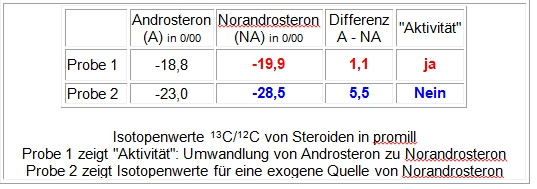
Examples in the table on the right: Sample 2 is positive for norandrosterone, as the isotopic value of norandrosterone differs from that of androsterone by 5.5 parts per thousand. In contrast, Sample 1 is negative, as the isotopic value of norandrosterone is comparable to that of androsterone (the deviation of 1.1 per mille falls within the range of physiological variation and the uncertainty of the measurement method).
References
[2] D. Thieme, P. Anielski, J. Grosse, P. Hemmersbach, H. Lund, and C. Rautenberg, “Kinetic of in-situ demethylation of endogenous steroids in urine samples,” in: W. Schänzer, H. Geyer, A. Gotzmann, and U. Mareck (eds.), Recent advances in doping analysis (12). Sport und Buch Strauß, Cologne, 2004, 177–188
[3] Hebestreit, M., Flenker, U., Fußhöller, G., Geyer, H., Güntner, U., Mareck, U., Piper, T., Thevis, M., Ayotte, C., Schänzer, W. Determination of the origin of urinary norandrosterone traces by gas chromatography combustion isotope ratio mass spectrometry. Analyst, 131, 2006, 1021–26