Anabolic Steroid Hormones - Analysis

(using metandienone as an example)
Because anabolic agents are not used directly for competition but rather during the training phase to improve strength and power, training controls have been in place (in Germany since 1990). In this context, analysts attempt to detect misuse of anabolic agents for as long as possible after the last dose.
A prerequisite for detecting these compounds is knowledge of their metabolism and pharmacokinetics. Many anabolic steroid hormones are metabolized in such a complex manner that the administered substance is not excreted unchanged in the urine. As an example, Fig. 1 illustrates the main metabolic pathways of the anabolic-androgenic steroid methandienone.
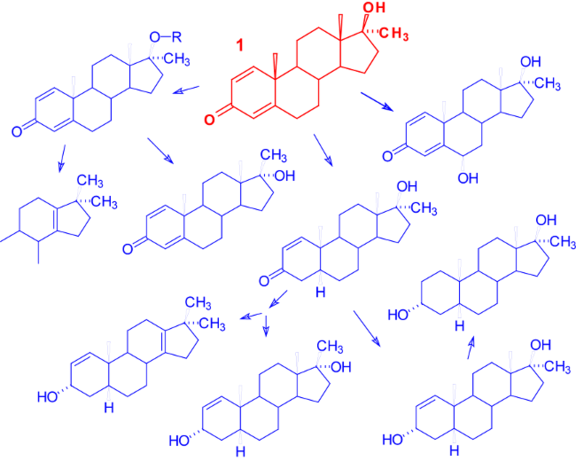

The analysis aims to identify metabolites with the longest elimination half-lives, so that they can be detected for as long as possible after the last administration. In general, it can be stated that steroid hormones administered as depot preparations—e.g., nortestosterone in the form of esters with long-chain fatty acids—via intramuscular (into the muscle) or subcutaneous (under the skin) injection can also be detected in urine for a long time. In some cases, detection times of over three months are possible. We therefore only find the use of these substances among so-called "inexperienced first-time dopers."
Elimination times for orally administered substances are generally significantly shorter
In contrast, the elimination times for orally administered substances are generally significantly shorter. Specific information regarding the detection times of individual compounds can only be provided imprecisely and typically varies due to individual factors, dosage levels, and duration of use. The metabolites that remain detectable the longest in the oral preparation methandienone—so-called long-term metabolites—include, for example, metabolites 9 and 10 in Fig. 1. To accurately identify the anabolic metabolites isolated from urine, most metabolites were synthesized as reference compounds.
To achieve detection limits for these compounds down to 1 ng/mL of urine or better, the steroids are derivatized with MSTFA, similar to the method described for stimulants (Fig. 2). This process is catalyzed by trimethyliodisilane (TMIS), so that secondary and tertiary hydroxy groups (Fig. 2A) are quantitatively converted into trimethylsilyl ethers, and keto groups, such as those in testosterone (Fig. 1B) and 6β-hydroxymethandienone (Fig. 1C), a metabolite of metandienone, are quantitatively converted into trimethylsilylenol ether.
Thus, following trimethylsilylation of 17β-methyl-5β-androst-1-en-3α,17α-diol (Fig. 10A), a long-term metabolite of metandienone with a molecular weight of 304, the corresponding mass spectrum (Fig. 3) shows a molecular ion of m/e 448, thereby providing evidence that two trimethylsilyl groups reacted with the steroid.
Detection using multiple substance-specific ions
For both the screening method and identification, detection is then performed using multiple substance-specific ions, whereby the intensities of the main fragments in the spectrum of the suspected substance must match the intensities of the fragments of the reference substance. If the compound is present in the higher concentration range, a full mass spectrum can also be recorded to further confirm the result.

References
Schänzer W: Metabolism of anabolic androgenic steroids. Clin Chem, 42 (1996) 1001-20. Review.
Schänzer W, Donike M: Metabolism of anabolic steroids in man: synthesis and use of reference substances for identification of anabolic steroid metabolites. Anal Chim Acta, 275 (1993) 23-48.
Donike M, Zimmermann J: Zur Darstellung von Trimethylsilyl-, Triethylsilyl und tert. Butyl-dimethylsilyl-enoläthern von Ketosteroiden für gaschromatographische und massenspektrometrische Untersuchungen. J Chromatogr, 202 (1980) 483.