Derivatization
Example: Steroid Analysis



In analytical chemistry, derivatization is a technique used to detect substances in trace amounts; it involves introducing protective groups into a molecule to make it more amenable to gas chromatography and mass spectrometry. Derivatization involves chemical reactions that convert polar groups such as -OH, -COOH, --NH2, -SH, and -CONHR into nonpolar and more volatile derivatives.
Derivatization reactions can be classified into the four main types based on the groups introduced, as follows:
1. Esterification
2. Alkylation
3. Acylation
4. Silylation
1. Esterification: Reaction of carboxylic acids with alcohol groups under acidic conditions; for example, stearic acid with methanolic HCl yields stearic acid methyl ester.
2. Alkylation: These reactions introduce alkyl groups, so that, for example, the reaction with methyl iodide (CH3I) yields methyl ether (-CO-CH3), methyl ester (-COO-CH3), or methylamine (-NR-CH3).
3. Acylation: Introduction of acyl groups (e.g., acetyl -COCH3, trifluoroacetyl -COCF3.
.
4. Silylation: Introduction of silyl groups (e.g., trimethylsilyl or triethylsilyl) (e.g., -CH2-O-Si(CH3)3)
Doping analysis uses trimethylsilylation
Trimethylsilylation is used extensively in doping analysis, employing a widely used reagent, N-methyl-N-trimethyltrifluoroacetamide (MSTFA), which was developed in 1967 by Manfred Donike.
Fig. 1, for example, illustrates the trimethylsilylation of norandrosterone, the major metabolite of nandrolone. With this type of derivatization, depending on the choice of reaction conditions—particularly the correct catalyst—norandrosterone can be converted into a mono-trimethylsilyl (TMS) or a bis-TMS derivative (TMS ether, TMS enol ether).
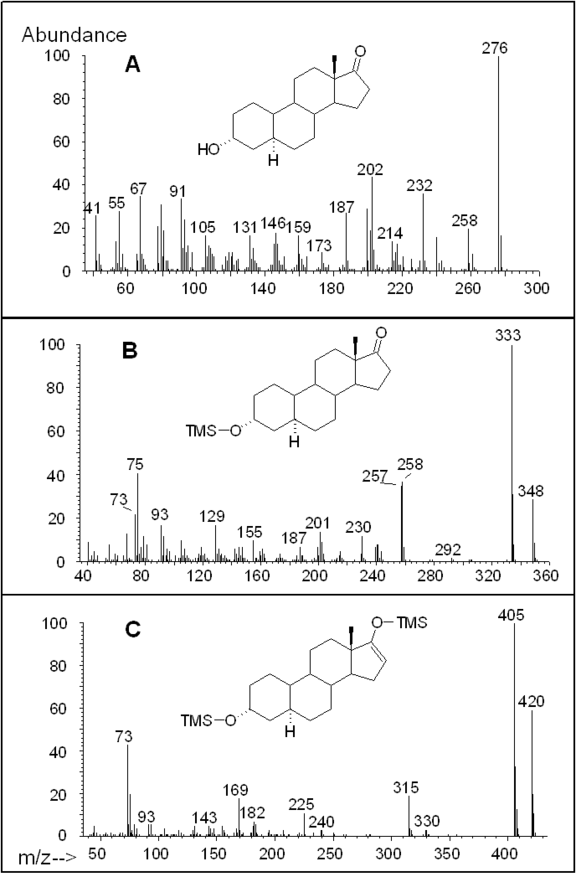
The gas chromatographic and mass spectrometric behavior of the various derivatives (Fig. 2) demonstrate the advantage of this type of derivatization: improved peak shape, fragmentation behavior in the mass spectrum (Fig. 3), and thus improved and more sensitive detection of the compound.
- Fig. 1 Trimethylsilylation of norandrosterone (TMS = trimethylsilyl)
- Fig. 2 GC/MS chromatograms of norandrosterone: A) Undervatized, B) Mono-TMS derivative, C) Bis-TMS derivative
- Fig. 3 A) Mass spectrum of norandrosterone (molecular ion m/z 276); B) Mass spectrum of norandrosterone mono-TMS (molecular ion m/z 348); C) Mass spectrum of norandrosterone bis-TMS (molecular ion m/z 420)