Dried Blood Spots (DBS) in Doping Control
Blood spot analysis in doping tests
Dried blood spot (DBS) analysis opens up new and innovative possibilities in the field of doping analysis.
The DBS technique is of interest in many areas of clinical research, such as drug development, drug monitoring, and disease surveillance (see also DBS in clinical chemistry). Unlike conventional intravenous blood draws, the DBS technique involves a minimally invasive blood sample, typically just 20 microliters from the fingertip.
Since 2011, the Institute of Biochemistry at the German Sport University Cologne and the Center for Preventive Doping Research have regularly published articles on the blood drop technique in the field of doping analysis (see Literature).
See Deutschlandfunk report (Jan. 15, 2015)
See statement from the World Anti-Doping Agency (Oct. 3, 2019)
Review Article
- Dried Blood Spot (DBS): Efficient Doping Analysis via Automated Dried Blood Spot Analysis.
Web: Laborpraxis June 29, 2020
- Abstract
To detect illegal performance-enhancing substances, the Center for Preventive Doping Research (ZePräDo) at the German Sport University Cologne requires only a few dried blood spots. Using an automated dried blood spot LC/HRMS system, the WADA-accredited laboratory detects low-molecular-weight peptide hormones and other doping agents.
_________________________________________
- Tretzel L, Thomas A, Geyer H, Pop V, Schanzer W, Thevis M. Dried blood spots (DBS) in doping controls: a complementary matrix for improved in- and out-of-competition sports drug testing strategies. Anal. Methods, 2015, 7, 7596–7605
- Abstract
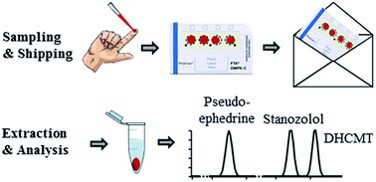
A drop of whole blood dried on filter paper (Dried Blood Spots, DBS) represents a promising technique for minimally invasive sample collection in a multitude of analytical disciplines, e.g., therapeutic drug monitoring, preclinical drug development, and diagnostic analysis of metabolic disorders in newborns. DBS sampling is characterized by cost-effectiveness, simplicity, robustness, and favorable storage and shipping conditions. The present study was conducted to highlight the opportunities arising from the implementation of DBS as a complementary matrix in doping control programs. Given their frequent abuse, three model compounds were selected to represent the classes of anabolic agents (stanozolol and dehydrochloromethyltestosterone) and stimulants (pseudoephedrine). A quantitative method was developed and validated for the detection of the target analytes in DBS using liquid chromatography coupled with high-resolution/high-accuracy tandem mass spectrometry. The imprecision of the assay was <8% for intraday measurements and <18% for day-to-day measurements. Highly purified DBS sample extracts exhibited no ion suppression effects due to interfering matrix components and provided limits of detection of 20 pg/mL for stanozolol and 0.8 ng/mL for DHCMT and pseudoephedrine, respectively, despite an overall recovery of 26%. Deuterium-labeled internal standards were used to yield reliable quantitative results (accuracy 84–125%). The stability of the analytes was demonstrated for at least 28 days at room temperature. The proof-of-principle for the presented method was substantiated by analyzing authentic specimens obtained from administration studies involving stanozolol, DHCMT, and pseudoephedrine. To the best of our knowledge, the results provided unprecedented detection windows for the tested anabolic agents achieved through DBS sampling to support out-of-competition testing efforts for these agents. Furthermore, the unambiguous demonstration of pharmacologically relevant blood concentrations at given urinary analyte levels is noteworthy for improving in-competition testing, e.g., with regard to stimulant analysis.
Literature on Dried Blood Spots
(Center for Preventive Doping Research at the DSHS Cologne)
Brockbals L, Thomas A, Schneider TD, Kraemer T, Steuer AE, Thevis M. Do dried blood spots have the potential to support result management processes in routine sports drug testing?—Part 3: LC-MS/MS-based peptide analysis for dried blood spot sampling time point estimation. Drug Test Anal. 2023 Feb 24. doi: 10.1002/dta.3463. Epub ahead of print. PMID: 36829300.
Download the article
M. Thevis, Katja Walpurgis & A. Thomas (2022): DropWise: current role and future perspectives of dried blood spots (DBS), blood microsampling, and their analysis in sports drug testing. Crit Rev Clin Lab Sci. 2022 Aug 7:1-22. doi: 10.1080/10408363.2022.2103085.
Abstract
Thevis M, Kuuranne T, Thomas A, Geyer H. Do dried blood spots have the potential to support result management processes in routine sports drug testing? - Part 2: Proactive sampling for follow-up investigations concerning atypical or adverse analytical findings. Drug Test Anal. 2021;1–5.
download the article
Thevis M, Kuuranne T, Dib J, Thomas A, Geyer H. Do dried blood spots (DBS) have the potential to support result management processes in routine sports drug testing? Drug Test Anal. 2020;12:704–710.
download the article
Lange T, Thomas A, Walpurgis K, Thevis M. Fully automated dried blood spot sample preparation enables the detection of lower molecular mass peptide and non-peptide doping agents by means of LC-HRMS. Anal Bioanal Chem. 2020 Apr 16. doi: 10.1007/s00216-020-02634-4. [Epub ahead of print]
download the article
Lange T, Walpurgis K, Thomas A, Geyer H, Thevis M: Development of two complementary LC-HRMS methods for analyzing sotatercept in dried blood spots for doping controls Bioanalysis. 2019 May;11(10):923-940.
Dib, J., Tretzel, L., Piper, T., Lagojda, A., Kuehne, D., Schänzer, W., & Thevis, M.: Screening for adiponectin receptor agonists and their metabolites in urine and dried blood spots. Clim Mass Spec, 2017, 13-20.
Thomas A, Thevis M: Analysis of insulin and insulin analogs from dried blood spots by means of liquid chromatography-high resolution mass spectrometry. Drug Test Anal. Nov 2018;10(11-12):1761-1768.
L. Tretzel, C. Görgens, H. Geyer, A. Thomas, J. Dib, S. Guddat, V. Pop, W. Schänzer, M. Thevis. Analyses of Meldonium (Mildronate) from Blood, Dried Blood Spots (DBS), and Urine Suggest Drug Incorporation into Erythrocytes. Int J Sports Med. 2016 Jun;37(6):500-2.
Tretzel L, Thomas A, Geyer H, Pop V, Schanzer W, Thevis M: Dried blood spots (DBS) in doping controls: a complementary matrix for improved in- and out-of-competition sports drug testing strategies. Anal. Methods, 2015, 7, 7596–7605.
Tretzel L, Thomas A, Geyer H, Delahaut P, Schänzer W, Thevis M. Determination of Synacthen® in dried blood spots for doping control analysis using liquid chromatography tandem mass spectrometry. Anal Bioanal Chem. June 2015;407(16):4709-20.
Tretzel L, Thomas A, Sköld K, Zeeberg D, Schänzer W, Thevis M: Improvement of the stability of Synacthen® in dried blood spots by means of heat stabilization. In: Schänzer W, Thevis M, Geyer H, Mareck U (eds.) Recent advances in doping analysis (23). Sportverlag Strauß, Cologne (2015) 126-129.
Höppner S, Delahaut P, Schänzer W, Thevis M. Mass spectrometric studies on the in vivo metabolism and excretion of SIRT1-activating drugs in rat urine, dried blood spots, and plasma samples for doping control purposes. J Pharm Biomed Anal, 2014, 88, 649–659.
Tretzel L, Thomas A, Geyer H, Gmeiner G, Forsdahl G, Pop V, Schänzer W, Thevis M. Use of dried blood spots in doping control analysis of anabolic steroid esters J Pharm Biomed Anal, 2014 Aug 5;96:21-30.
Thomas A, Geyer H, Schänzer W, Crone C, Kellmann M, Moehring T, Thevis M. Sensitive determination of prohibited drugs in dried blood spots (DBS) for doping controls using a benchtop quadrupole/Orbitrap mass spectrometer. Anal Bioanal Chem. May 2012;403(5):1279-89.
Möller I, Thomas A, Geyer H, Schänzer W, Thevis M. Development and validation of a mass spectrometric detection method for peginesatide in dried blood spots for sports drug testing. Anal Bioanal Chem, 2012 Jul;403(9):2715-24.
A. Thomas, H. Geyer, S. Guddat, W. Schänzer, M. Thevis. Dried blood spots (DBS) for doping control analysis. Drug Testing and Analysis 2011, 3, 11-12: 806-813.