Isotope analysis
Isotope Ratio Mass Spectrometry of Carbon
(Gas Chromatography/Combustion/Isotope Ratio Mass Spectrometry - GC/C/IRMS)
The testosterone detection method, which is relatively complex and also only an indirect method, has been supplemented since the late 1990s by a direct determination method using 13C/12C isotope ratio mass spectrometry [1-3]. 13C/12C isotope mass spectrometry enables the unambiguous detection of doping with endogenous steroid hormones such as testosterone, dihydrotestosterone, and dehydroepiandrosterone. The 13C/12C isotope ratio of synthetic steroid hormones—some of which are isolated from plant precursors and chemically modified—differs significantly from that of hormones synthesized in the body.
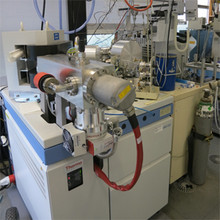
Endogenous hormones and their major metabolites are isolated and analyzed by gas chromatography
For this method, endogenous hormones and their major metabolites are isolated and analyzed by gas chromatography. After GC separation, the hormones are completely converted to CO2 by catalytic oxidation in an oxidation chamber (combustion) and subsequently identified in a mass spectrometer. Only the masses m/e 44 for 12CO2, m/e 45 for 13CO2, and m/e 46 for 12C18O16O are required (m/e 46 is calculated to correct for m/e 45, which is also formed from 12C17O16O). Using this method, the 13C/12C ratio, which naturally lies at approximately 1.11% (12C 98.89%, 13C 1.11%), can be determined to an accuracy of 0.0002%.
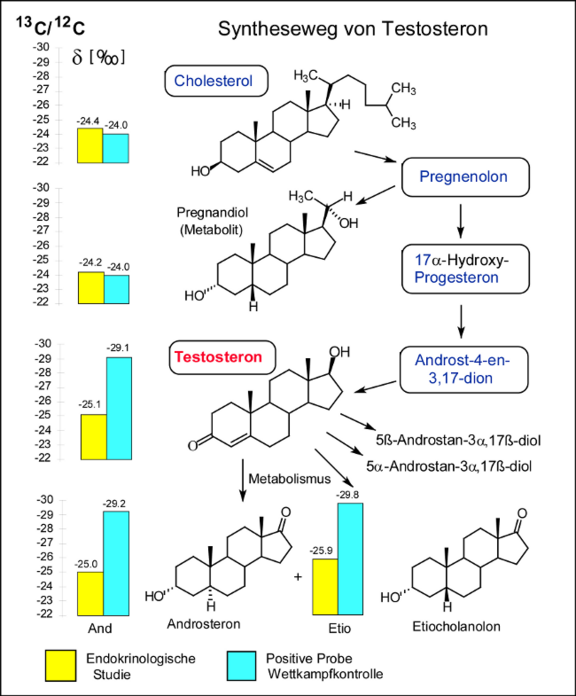
The measured isotope ratios are expressed in parts per thousand [d 13C(‰)] relative to the isotope ratio of a calibrated CO2 gas. The reproducibility of the measurements is, for example, +/- 0.2‰ at a value of -24.4‰. Figure 15 summarizes the results of the 13C/12C isotope analysis of endogenous steroid hormones based on a positive testosterone sample compared to a urine sample during an endocrinological study of the same athlete. Based on the synthesis pathway of testosterone, it becomes clear that precursors in testosterone metabolism, such as cholesterol or pregnenolone, show no change in either the positive or the normal sample. In contrast, in the positive sample, testosterone as well as its metabolites androsterone and etiocholanolone show clearly more negative values, which are comparable to the values of synthetic testosterone products (-28 to -31 ‰).
References
[1] Brand WA: High precision isotope ratio monitoring techniques in mass spectrometry. J Mass Spectrom, 31(3) (1996) 225–35.
[2] Becchi M, Aguilera R, Farizon Y, Flament MM, Casabianca H, James P: Gas chromatography/combustion/isotope-ratio mass spectrometry analysis of urinary steroids to detect misuse of testosterone in sport. Rapid Commun Mass Spectrom, 8(4) (1994) 304–8.
[3] Horning S, Geyer H, Machnik M, Schänzer W, Hilkert H, Oeßelmann J: Detection of exogenous testosterone by 13C/12C analysis. In: Schänzer W, Geyer H, Gotzmann A, Mareck-Engelke U (eds.), Recent advances in doping analysis (4). Sport und Buch Strauß, Cologne, (1997) 275–284.