Athlete Biological Passport - Blood Passport (Hematological Module)

History
For more than 10 years, sports federations have been using blood parameters to combat doping practices aimed at improving oxygen transport. In doing so, various federations have introduced threshold values for blood parameters to limit the misuse of erythropoietin (EPO), other EPO-analogous preparations, as well as blood doping (autologous blood transfusion or allogeneic blood transfusion).
Due to the physiological range of variation in blood parameters such as hematocrit, hemoglobin concentration, and especially the percentage of reticulocytes (young red blood cells), elevated values were not used as evidence of doping.
However, federations had established thresholds, and exceeding these resulted in a “protective suspension” of the athlete for 5–14 days (depending on the federation) (e.g., 50% hematocrit for men in cycling). The respective federation regulations stipulated compliance with these thresholds as a prerequisite for athletes to compete.
(November 25, 2009)
Doping Control - Blood Profiles as Indirect Evidence of Doping (Individual Blood Profile)
Since early 2009, however, the World Anti-Doping Agency (WADA) has included a provision in the World Anti-Doping Code allowing for the use of trends in blood values as evidence of doping.
Information from WADA - Athlete Biological Passport
To successfully implement such an “indirect detection method,” harmonization was sought, leading WADA to publish an “Operating Guideline” for the “Athlete Biological Passport” in January 2010, which includes specifications for sample collection, transport, laboratory analysis, and data evaluation.
This program calls for the collection of the following blood parameters:
| HCT | Hematocrit |
| HGB | Hb |
| % Ret | % Reticulocytes |
| RBC | red blood cell count |
| MCV | mean corpuscular volume, erythrocyte volume = HCT/RBC |
| MCH | mean corpuscular hemoglobin, hemoglobin content of red blood cells = HGB/RBC |
| MCHC | mean corpuscular hemoglobin concentration = HGB/RBC |
| WBC | white blood cell count, white blood cells or leukocytes |
| PLT | platelet count |
- Data collection may only be performed by laboratories that meet the relevant quality requirements;
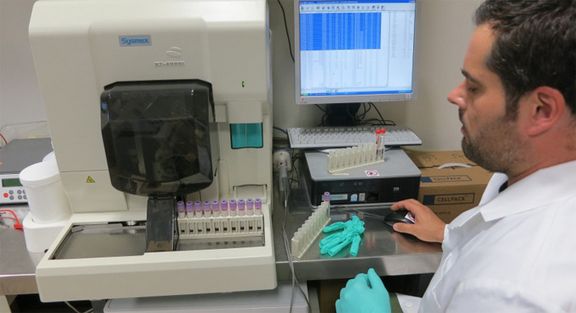
- Measurements are performed exclusively using the Sysmex XT 2000i device,
- the laboratory participates in regular monthly proficiency tests organized by WADA,
- Strict quality standards must be adhered to, which are significantly more stringent than those for ring tests conducted by clinical laboratories,
- A doping violation is assessed based on a statistical model by Sottas et al. (see References): Abnormal Blood Profile Score (ABPS). This is a statistical calculation (Bayesian statistics) of individual values that incorporates and weights all the blood parameters mentioned above and takes into account additional data such as altitude exposure.
- Based on these statistics, individual threshold values are calculated so that statistically significant deviations in subsequent blood tests can be assessed as a doping violation.
Further information
References:
Walpurgis, K., Thomas, A., & Thevis, M. Blood in Sports Drug Testing: Biological Matrix and Doping Agents. In: The Blood Project. September 27, 2022. Review article;
download article
Sottas PE, Robinson N, Rabin O, Saugy M. The Athlete Biological Passport. Clin Chem. July 2011;57(7):969-76. Epub May 19, 2011. Review
download
Sottas, Pierre-Edouard; Robinson, Neil; Giraud, Sylvain; Taroni, Franco; Kamber, Matthias; Mangin, Patrice; and Saugy, Martial (2006) "Statistical Classification of Abnormal Blood Profiles in Athletes," The International Journal of Biostatistics: Vol. 2, Iss. 1, Article 3.
Links