Athlete Biological Passport - Steroidal Module

Steroidprofile - Doping - Dopingnachweis - Dopingkontrolle
The steroidal athlete's biological passport (steroidal ABP) approach and isotope ratio mass spectrometry for the detection of the misuse of endogenous AAS
The following article is an excerpt of the publication: Geyer H, Schänzer W, Thevis M. Anabolic agents: Recent strategies for their detection and protection from inadvertent doping. Br J Sports Med. 2014 May; 48 (10):820-6 (download of the complete publication)
"For approximately 30 years the misuse of endogenous AAS is detected via alterations in the urinary steroid profile [1]. The main parameters of the steroid profile as analyzed in doping control laboratories are the concentrations and ratios of the glucuronidated testosterone metabolites androsterone, etiocholanolone, 5α-androstane-3α,17β-diol and 5β-androstane-3α,17β-diol and the glucuronides of testosterone and epitestosterone, which originates from the synthesis of testosterone. Among these parameters the best elucidated and investigated item is the ratio of testosterone and epitestosterone (T/E) which was introduced in doping controls by Manfred Donike et al. to provide a means to detect the misuse of testosterone [2]. The administration of testosterone and other endogenous steroids leads to “abnormal” steroid profiles e.g. abnormally increased T/E ratios. The first strategies to differentiate between normal and abnormal steroid profiles were based on population-based reference limits. With the growing knowledge of individuals with naturally abnormal steroid profiles e.g. naturally increased or decreased T/E ratios, the strategy changed from the use of population-based towards individual reference ranges [3]. The establishment of individual reference ranges was first adopted by UCI in the in the mid 1990s to identify individuals with naturally increased T/E ratios to prevent false positive cases. This was done by means of so-called endocrinological studies [4]. The combination of the application of population-based and individual reference ranges led to one of the biggest doping scandals in the mid 1990’s when during the Asian Games 1994 in Hiroshima, Japan, 9 gold medalists could be convicted of doping with the endogenous AAS dihydrotestosterone [5].
To globalize this strategy, i.e. be able to compare steroid profiles analyzed at different locations, WADA and the accredited doping control laboratories harmonized the employed analytical methods. Additionally the Anti-Doping Administration and Management System (ADAMS) was advanced to enable collection of the steroid profiles of all doping control samples and the direct comparison with individual and population based reference ranges. The calculation of the individual reference ranges is performed on the basis of an adaptive model developed by Sottas et al. [6, 7]
All these elements are now adopted in the steroidal module of the athlete`s biological passport (ABP) approach. Together with the increasing knowledge about factors influencing the steroid profile as e.g. pharmaceutical, genetic, pathological, analytical, medical, and other aspects [8], this strategy has proven fit-for-purpose to support detecting the misuse of endogenous AAS. The steroidal ABP is an open system and additional urinary steroids and ratios can be used for the decision making process [8-10]. An invaluable addition to this strategy is the use of the isotope ratio mass spectrometry (IRMS). This technique allows to differentiate between natural and synthetic endogenous steroids by means of the ratios of the stable carbon isotopes 13C and 12C [11, 12], i.e. a suspicion of the misuse of endogenous AAS, triggered by the steroidal module of the ABP, can be proven by subsequent IRMS analyses."
(11.Juni 2018 Hans Geyer)
Factors influencing the steroid profile
In the following are presented some examples of factors influencing the steroid profile, i.e. factors, which lead to changes of the steroid profile, which can be detected via the steroidal module of the ABP.
Abbreviations: A = Androsterone, Etio = Etiocholanolone; E = Epitestosterone, T = Testosterone, 5aAdiol = 5α-androstane-3α,17β-diol, 5bAdiol = 5β-androstane-3α,17β-diol
- Administration of testosterone
The most obvious influence of a testosterone administration is the increase of the T/E ratio due to an increase of the urinary T concentration. Further changes are the increase of the concentrations of A and Etio and 5αAdiol and 5βAdiol and the decrease of the ratio A/T.
Fig.1 Changes of the steroid profile - testosterone administration
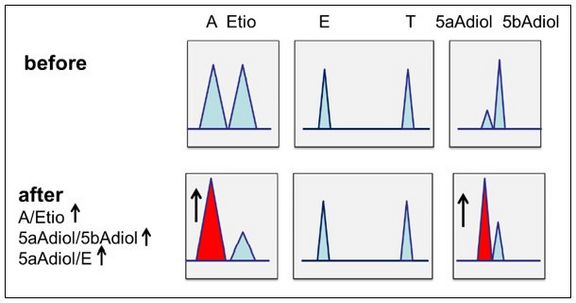
2. Administration of 5α-dihydrotestosterone
- The administration of 5α-dihydrotestosterone leads to an increase of the ratios A/Etio and 5αAdiol/5βAdiol due to an increase of the concentrations of the 5α-steroids A and 5αAdiol. The T/E ratio is not influenced (Fig.2).
Fig.2 Changes of the steroid profile - 5α-dihydrotestosterone administration
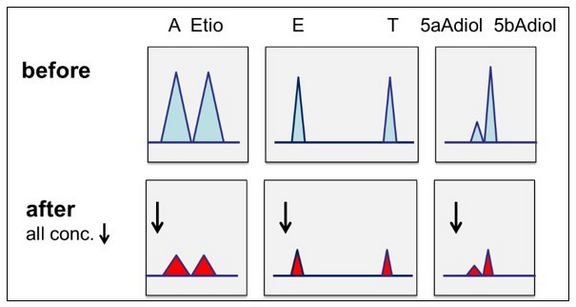
3. Application of exogenous anabolic androgenic steroids
- The administration of exogenous anabolic androgenic steroid leads to decreased concentrations of all 6 steroids due to a suppression of the production of endogenous testosterone (Fig,3).
Fig.3 Changes of the steroid profile - anabolic androgenic steroid administration
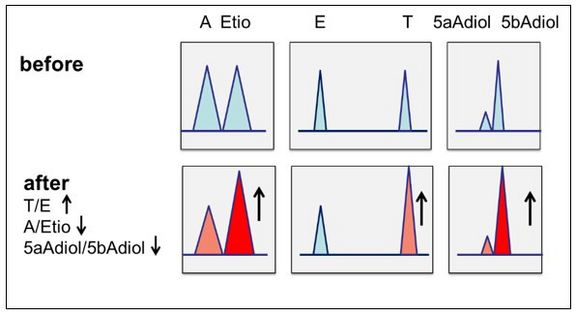
4. Administration of DHEA
- The administration of DHEA leads mainly to an increase of the 5β-steroids Etio and 5βAdiol and therefore to a decrease of the ratios A/Etio and 5αAdiol/5βAdiol. The T/E ratio is only slightly increased (Fig.4).
Fig.4 Changes of the steroid profile - DHEA administration
Further examples of factors influencing the steroid profile can be found in the publication Mareck et al. 2008 [8].
(15.Juni 2018 Hans Geyer)
Confounders of the steroid profile
Confounders of the steroid biomarkers are e.g. alcohol, 5α-alpha reductase inhibitors, contraceptive pills, bacterial contaminations etc. In the following are presented some examples of such confounding factors and their effect on the steroid profile.
Abbreviations: A = Androsterone, Etio = Etiocholanolone; E = Epitestosterone, T = Testosterone, 5aAdiol = 5α-androstane-3α,17β-diol, 5bAdiol = 5β-androstane-3α,17β-diol
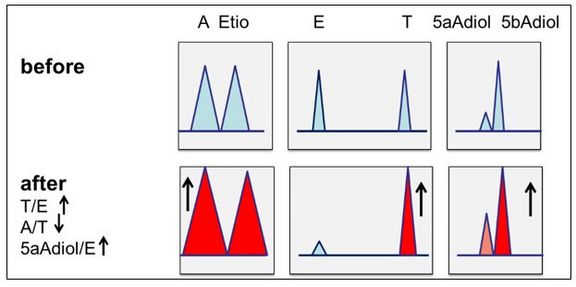
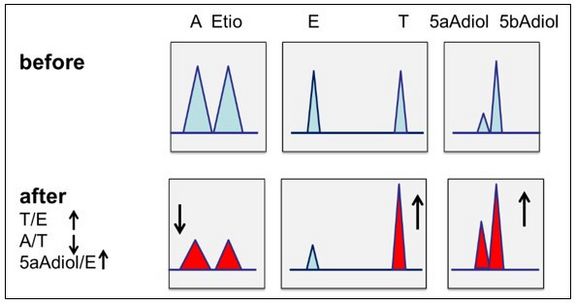
1. Consumption of alcohol
- The consumption of alcohol may lead to an increase of the T/E, a decrease of the A/T and Etio/T and an increase of the 5αAdiol/E ratios. The changes of these ratios are due to an increases of the concentrations of T and 5αAdiol and 5βAdiol and a decrease of the concentrations of A and Etio (Fig.5). In case of alcohol consumption metabolites of ethanol as e.g. ethylglucuronide can be detected.
Fig.5 Confounders of the steroid profile - alcohol consumption
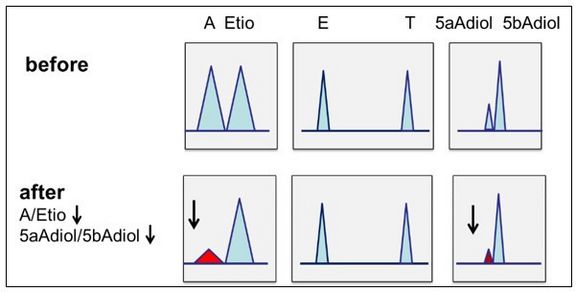
2. Administration of 5α-reductase inhibitors
- The administration of 5α- reductase inhibitors, e.g. finasteride , leads to a decrease of the ratios A/Etio and 5αAdiol/5βAdiol due to a decrease of the 5α-steroids A and 5αAdiol. The T/E ratio is not influenced (Fig.6). In case of the use of finasteride a metabolite of this substance can be detected in the doping control sample.
Fig.6 Confounders of the steroid profile - 5α-reductase inhibitors administration
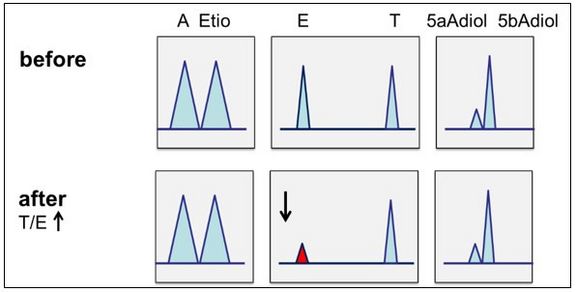
3. Administration of contraceptive pills
- The administration of contraceptive pills leads to an increase of the T/E ratio due to a decrease of the E concentration (Fig.7).
Fig.7 Confounders of the steroid profile - contraceptive pills administration
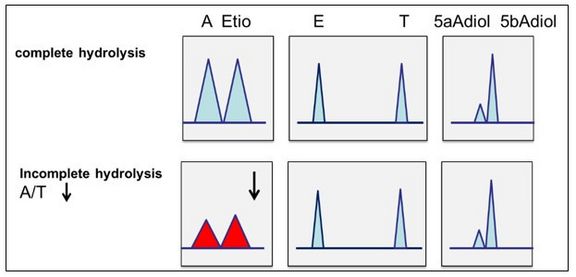
4. Factors resulting from the sample preparation e.g. incomplete hydrolysis
- An incomplete hydrolysis of the urinary steroid glucuronides leads to a decreased A/T and Etio /T because due to a decrease of A and Etio (Fig.8).
Fig.8 Confounders of the steroid profile - factors resulting from the sample preparation e.g. incomplete hydrolysis
Further examples for confounding factors of the steroid profile can be found in the publication Mareck et al. 2008 [8].
(15.Juni 2018 Hans Geyer)
References
- Donike M, Bärwald KR, Klostermann K, et al. The detection of exogenous testosterone. In: Heck H, Hollmann W, Liesen H, editors. Leistung und Gesundheit, Kongressbd, Dtsch. Sportärztekongress. Köln: Deutscher Ärtze-Verlag, 1983:293-98.
download - Donike M, Zimmermann J, Bärwald KR, et al. Routinebestimmung von Anabolika in Harn. Dtsch Z Sportmed 1984;35:14-24.
download - Donike M, Rauth S, Mareck-Engelke U, et al. (1994). Evaluation of longitudinal studies: the determination of subject-based reference ranges of the testosterone/epitestosterone ratio, in Recent Advances in Doping Analysis (Donike M, Geyer H, Gotzmann A, Mareck-Engelke U, Rauth S, Eds.), 33-39, Sport&Buch Strauss, Cologne.
download - Geyer H, Mareck U, Schänzer W, et al. (1997). The Cologne protocol to follow up high testosterone/ epitestosterone ratios, in Recent Advances in Doping Analysis (Schänzer W, Geyer H, Gotzmann A, Mareck U, Eds.), Vol. 4, 107-25, Sport und Buch Strauss, Cologne.
download - Donike M, Ueki M, Kuroda Y, et al. Detection of dihydrotestosterone (DHT) doping: alterations in the steroid profile and reference ranges for DHT and its 5 alpha-metabolites. J Sports Med Phys Fitness 1995;35:235-50.
- Sottas PE, Saugy M, Saudan C. Endogenous steroid profiling in the athlete biological passport. Endocrinol Metab Clinics North Am 2010;39:59-73, viii-ix.
- Sottas PE, Baume N, Saudan C, et al. Bayesian detection of abnormal values in longitudinal biomarkers with an application to T/E ratio. Biostatistics 2007;8:285-9
- Mareck U, Geyer H, Opfermann G, et al. Factors influencing the steroid profile in doping control analysis. J Mass Spectrom 2008;43:877-91.
free download of the article
- Van Renterghem P, Van Eenoo P, Van Thuyne W, et al. Validation of an extended method for the detection of the misuse of endogenous steroids in sports, including new hydroxylated metabolites. J Chromatogr B 2008;876:225-35.
- Van Renterghem P, Van Eenoo P, Geyer H, et al. Reference ranges for urinary concentrations and ratios of endogenous steroids, which can be used as markers for steroid misuse, in a Caucasian population of athletes. Steroids 2010;75:154-63.
- Piper T, Emery C, Saugy M. Recent developments in the use of isotope ratio mass spectrometry in sports drug testing. Anal Bioanal Chem 2011;401:433-47.
- Becchi M, Aguilera R, Farizon Y, et al. Gas chromatography/combustion/isotope-ratio mass spectrometry analysis of urinary steroids to detect misuse of testosterone in sport. Rapid Commun Mass Spectrom 1994;8:304-8.
Recent Publications
Piper T, Geyer H, Haenelt N, Huelsemann F, Schaenzer W, Thevis M. Current Insights into the Steroidal Module of the Athlete Biological Passport. Int J Sports Med. 2021 Sep;42(10):863-878. doi: 10.1055/a-1481-8683.
download Article