Laufen, Sprinten und Springen mit Sportprothese
Projektbeschreibung
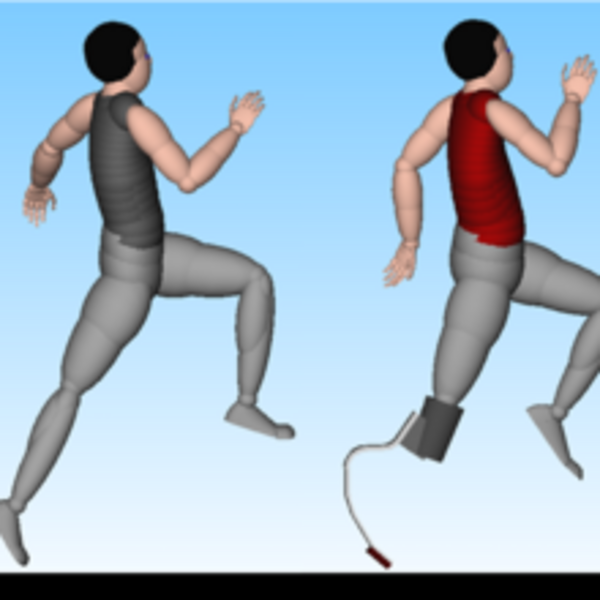
Wir erforschen das Laufen, Sprinten und Springen mit Sportprothese. Aus einer biomechanischen Perspektive betrachten und analysieren wir die Interaktion zwischen der Prothese (technologische Komponente) und dem muskulo-skelettalen System (biologische Komponente).
Forschungszeitraum
Seit 2013
Projektteam

Wolfgang Potthast

Ausgewählte Publikationen
-
Leg amputation side determines performance in curve sprinting: a case study on a Paralympic medalist
The lower limb kinetics of curve sprinting in amputees are not well described in the literature, particularly with respect to the effect of the side of amputation. This is an issue due to the importance of the knowledge for prosthetic design and classification of athletes. Thus, the aim of this study was to investigate the influence of side of amputation on curve sprinting performance in athletes with a unilateral leg amputation. A three-dimensional motion analysis system (Vicon), four force plates (Kistler) and a modified mathematical human model (ALASKA) were used to compare clockwise and counter clockwise curve sprinting lower limb kinematics and kinetics of a Paralympic medalist with a left-sided knee exarticular amputation. Results reveal that vertical ground reaction force application and total vertical impulse were lower when the affected limb was at the inside of the curve. The unaffected limb showed joint mechanics different to those established for non-amputee athletes and might contribute better to propulsion when being the inside limb. Curve sprinting biomechanics and the ability to attain high radial velocities are directly dependent on the side of amputation relative to the curve direction in a unilateral amputee athlete of highest performance level.
-
Elite long jumpers with below the knee prostheses approach the board slower, but take-off more effectively than non-amputee athletes
The use of technological aids to improve sport performance (‘techno doping’) and inclusion of Paralympic athletes in Olympic events are matters of ongoing debate. Recently, a long jumper with a below the knee amputation (BKA) achieved jump distances similar to world-class athletes without amputations, using a carbon fibre running-specific prosthesis (RSP). We show that athletes with BKA utilize a different, more effective take-off technique in the long jump, which provided the best athlete with BKA a performance advantage of at least 0.13 m compared to non-amputee athletes. A maximum speed constraint imposed by the use of RSPs would indicate a performance disadvantage for the long jump. We found slower maximum sprinting speeds in athletes with BKA, but did not find a difference in the overall vertical force from both legs of athletes with BKA compared to non-amputees. Slower speeds might originate from intrinsically lower sprinting abilities of athletes with BKA or from more complex adaptions in sprinting mechanics due to the biomechanical and morphological differences induced by RSPs. Our results suggest that due to different movement strategies, athletes with and without BKA should likely compete in separate categories for the long jump.