Partnership & Modules
The M.A. Olympic Studies has been created on initiative of Prof. Stephan Wassong and Prof. Norbert Müller. The first intake started in September 2010 and the participants graduated with a degree in "Master of Arts in Olympic Studies" in summer 2013.
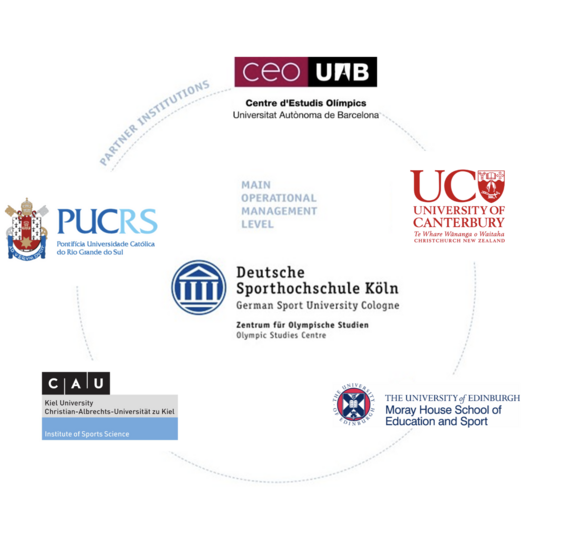
The programme is delivered by a core network of international universities, including the German Sport University Cologne (Germany), Autonomous University of Barcelona (Spain), University of Canterbury (New Zealand), Kiel University (Germany), Pontifical Catholic University of Rio Grande do Sul (Brazil) and Scottish Centre of Olympic Research and Education (SCORE) at the University of Edinburgh (Scotland).
Find out more about the modules
Pierre de Coubertin's educational intentions to revive the Olympic Games will be analysed. It will be examined how and why Coubertin aimed at utilising Olympic Sport as a valuable tool to spread moral and social values among the masses. Based on this historical background information emphasis will be given on the further development of the core Olympic values. In addition to this, programmes and projects of Olympic Education which have been and still are conducted at the school level and beyond will be critically evaluated. The module will also discuss contemporary value issues affecting the Olympic movement and their implications for future policy, e.g. the UN´s Sustainable Development Goals and the Olympism 365 initiative, as well as current challenges to the Olympic Movement.
Module Leader: Prof. Dr. Nelson Todt (Pontifical Catholic University of Rio Grande do Sul, Brazil)
The module will analyse the role of athletes as key actors of the Olympic Movement and the transformation of their institutional position at and beyond the Olympic Movement. Based on this it will be analysed how the changing profile of elite sport has led to new expectations placed on the athletes as Olympic role models. As the modern world of elite sport has become increasingly complex it is necessary to define and analyse the role of the athlete in this system. This will be done by analysing the mutual interdependence and power relationships between athletes and relevant external reference groups, especially coaches and educationalists. This includes discussions on the holistic wellbeing of the athlete as well as the educational and social responsibility of stakeholders to work towards a successful transition of the athlete into post athletic careers. Discussions on the changing profile of elite sport will also include the rights and responsibilities of athletes, referring to the Olympic Charta (e.g. Rule 50) as well as to the athlete´s social and political voice in connection with youth development and social responsibility (e.g. in connection with the UN´s Sustainable Development Goals and the UNESCO International Charter of Physical Education, Physical Activity and Sport).
Module Leaders: Prof. Dr. Ian Culpan, Susannah Smith (University of Canterbury, New Zealand)
The module covers a broad range of methodological and analytical topics. These include the philosophy of social science and paradigms (ontology and epistemology) as well as the philosophy of history (teleological accounts, history as narrative). Students will also engage with techniques in summarising, evaluating and presenting literature reviews (narrative reviews, systematic reviews, meta-analysis and meta-synthesis) and with historiography, focusing on evaluating authorship, sourcing, interpretation, style, bias and audience. Further topics include qualitative techniques and analysis such as ethnography, content and document analysis, discourse analysis, interviews / focus groups, life histories and case research, as well as the range and nature of quantitative techniques and analysis (descriptive statistics, correlations, overview of tests, regression, t-tests, ANOVA). The module concludes with an introduction to techniques of electronic research.
Module Leader: Prof. Dr. Jens Flatau (Kiel University, Germany)
The module aims to provide participants with a critical understanding of governance in the Olympic movement at three levels – systemic, organisational and political. At the systemic level the focus will be on the interests of internal (Olympic family network) and external (e.g. UN, UNESCO WADA) stakeholders and on the strategies and tactics adopted by stakeholders to realise their interests. At the organisational level the focus will be on key features of good organisational or corporate governance and how these are reflected in the policies and practices of key Olympic bodies, in particular the IOC, IPC, NOCs, IFs and NFs. Such analysis will consider the specificity of sport and the need to adapt corporate governance principles to take account of this specificity. It is analyzed how reform agendas of the IOC are driven by both the need for internal modernisation and external challenges as well as societal changes. The range of policies to be considered within this framework may for example include anti-doping, sustainability and climate change, selection of Olympic host cities, selection of sports for inclusion in the Olympic Games and the recognition of federations and sports-related activities (e.g. E-Sports), the role of the Court of Arbitration, the use of Olympic Solidarity as a vehicle for achieving partnership and desired policy outcomes, and current challenges.
Guest Lecturer: Prof. Dr. Thierry Zintz
The key developments of the relationship between the Olympic World and Worlds of Media and Commercialisation will be analysed. Their impact on the sustainable development of the Olympic Movement and Olympic Sports will be critically discussed. Special considerations will be given to the 1980s in which strategic decisions were made to turn to new commercial strategies. Clear turning points were the new financial concept developed for the 1984 Los Angeles Olympic Games and the invention of the TOP-Programme in 1983. The relationship between media sponsors, and Olympic organisations and their values will be a critical focus of this module. The IOC's use of its media resources as policy vehicles (including the collection and dissemination of media images through the Information Management Department) will be subject to evaluation. The development of new media and their implications for the Olympic movement and its media policies will also represent a core concern of the module.
Module Leader: Prof. Dr. Emilio Fernández Peña
The module will focus on substantive policy areas / Olympic phenomena with an international relations dimension, and on aspects of IR and globalisation related theory and their contribution to understanding such phenomena.
Substantive topics may include: the challenge of boycotts; terrorism and security issues; soft power and the hosting of the Olympic Games; the role of the Olympic movement in relations between divided nations; sport and the Cold War; sport and the peace movement; the development and political context of the modern Olympic Truce; elite sport development models and 'policy learning and transfer' between states; the United Nation´s Sustainable Development Goals (SDGs) and their application within the Olympic context; the multicultural dimension of Olympism and the Olympic Games as a platform for educational internationalism.
Theoretical perspectives employed through which to address these substantive areas will be drawn from the fields of international relations, political sociology and policy analysis.
Module Leaders: Dr. Jung-Woo Lee and Dr. Louis Nolte (The University of Edinburgh, Scotland)
The thesis is undertaken through independent study. It offers students the opportunity to undertake a research project on a topic of their choice but with clear links to the contents taught in the programme. Students will have formal teaching on a range of research skills and strategies which have to be applied in the thesis in particular through the module Research Methodologies in Olympic Studies. Students also receive a guiding tutorial consisting of a group tutorial and an individual tutoring session to help them plan their thesis. During the writing process of the thesis students will be guided by regular individual tutorials from their dissertation supervisor who teaches on the programme. The supervisor will oversee the research proposal for the thesis and will feed back to the students on that draft.
The thesis has to be written in English, however, in consultation with a module leader, it can be written in his/her native language.
Module Handbook
You can find the official PDF version of the Module Handbook here:
-
save_altModule_Handbook_2026.pdfDownload "Module_Handbook_2026.pdf"Pdf, 344 KB
The Advisory Board of the M.A. Olympic Studies oversees the financial, organisational, administrative and academic activities of the Main Operational Management Level at the German Sport University Cologne and of the Partner Institutions.
The chair of the Advisory Board will be elected from among the members of the Board for a term of three years. A representative from each university involved in the programme will be member of the Board. The Executive Director of the programme, who will be on the board as well, is not eligible to be elected as chair of the board. Further members will be invited from the IOC Olympic Studies Centre and/or from other stakeholders such as companies sponsoring the programme.
The university at the Main Operational Management Level is responsible for setting up and running the organisational, administrative and overall academic elements of the programme. In addition to this it will validate the degree, administer the student registration, award the degree and report regularly to the Advisory Board.
The modules will be delivered by the university validating the degree and by the Partner Institutions. The partner universities have full responsibility for organising their modules. This includes the delivery of contents, managing the teaching workload, organisation and administration of course work and assessments. The German Sport University Cologne has the responsibility to evaluate each module.