Amphetamine


Definition
Amphetamine (Fig. 1) is a banned doping substance classified as a stimulant. Amphetamine is considered a narcotic. The sale and possession of amphetamine are restricted. It may only be used for medical purposes. Until 2013, no medication containing amphetamine was available on the market in Germany.
In March 2013, the active ingredient lisdexamfetamine (brand name Elvanse), a prodrug of amphetamine, was approved for children aged six and older with attention-deficit/hyperactivity disorder (ADHD). In February 2019, the approval was expanded: Since then, lisdexamfetamine (brand name Elvanse Adult) has also been approved for use in adults.
History - The Development Leading to the Discovery of Amphetamine
Amphetamine was developed with the intention of alleviating asthmatic symptoms. In asthma, a narrowing of the airways leads to attack-like shortness of breath. One of the most effective treatments for asthma was epinephrine.
Adrenaline is a hormone that is produced in increased amounts in the adrenal medulla under stressful conditions and released into the bloodstream.
Adrenaline accelerates the heart rate, increases muscle strength, and dilates the bronchioles, allowing for deeper and easier breathing.
Unfortunately, however, epinephrine cannot be administered orally, as it is broken down relatively quickly in the gastrointestinal tract. Therefore, a derivative was sought that was sufficiently stable and well absorbed from the gastrointestinal tract.
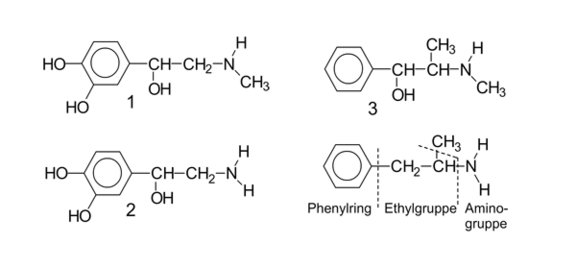
This was achieved in the 1920s with the isolation of ephedrine from the plant "ma huang," which is found in China. The effect of ephedrine was very similar to that of epinephrine. The similarity between the two active substances is illustrated in the following structural formulas (Fig. 2) in comparison to epinephrine and norepinephrine.
Since the Chinese plant “ma huang” was very rare, the problem essentially remained. In the mid-1930s, Gordon Alles in Los Angeles succeeded in synthesizing a compound he named amphetamine. Under the trade name Benzedrine, amphetamine was marketed in the form of inhalers. The advantage of this was that amphetamine could be inhaled directly into the lungs.
Literature: Solomon H. Snyder, Chemistry of the Mind, Drug Effects in the Brain. Spektrum Akademischer Verlag, Heidelberg Berlin Oxford, 1988, pp. 134–135.
WDR Zeitzeichen - Amphetamine
WDR Zeitzeichen, January 18, 2022
First synthesis of amphetamine (January 18, 1887)
"It suppresses fatigue, curbs hunger and thirst. It boosts energy, increases concentration and performance. And: It’s addictive—amphetamine. On January 18, 1887, Lazar Edeleanu synthesized the substance for the first time at what is now Humboldt University in Berlin—a substance that would later become the first synthetic drug to gain notoriety. As part of an experiment, the Romanian chemistry doctoral student concocted the new compound." Author: Steffi Tenhaven
Significance as a Doping Agent
Amphetamine is one of the best-known doping substances, the abuse of which in sports led to spectacular deaths in the 1960s (see also Deaths associated with amphetamine). As a result, both the International Olympic Committee and the International Cycling Union introduced the first anti-doping rules in 1967.
Since amphetamine was primarily used as a performance-enhancing drug in competition and is still abused today, most sports federations limit their bans to competition-related use only. The International Cycling Union was the only sports federation to have extended this ban to the period outside of competition until the end of 2003, so that stimulants were also tested during so-called "training controls" in cycling.
The reason for this was the assumption that stimulants were also used in cycling during training, with the intention of better coping with extremely intense and extensive training loads. Following alignment with the WADA (World Anti-Doping Agency) Anti-Doping Code since 2004, stimulants are no longer on the prohibited list for the period outside of competition.
Effects
It was quickly discovered that amphetamine prevented drowsiness and energized a tired person. In the United States, amphetamine was particularly popular among students to suppress the need for sleep while preparing for exams.
During World War II, the German Wehrmacht supplied its pilots with methamphetamine (Pervitin), an amphetamine-like substance, to keep them awake for nights on end during attacks. Meanwhile, the British distributed amphetamine tablets to their soldiers.
The effects of amphetamine-type stimulants essentially correspond to those of the body’s own stress hormones, adrenaline and noradrenaline (catecholamines), and result from their structural similarity. However, a distinction must be made here between direct and indirect effects.
Substances that, like catecholamines, have hydroxyl groups on the phenyl ring exhibit direct effects. These derivatives then stimulate the α- and β-receptors of the target cells in a manner similar to catecholamines. Substances that, like amphetamine, do not have hydroxyl groups on the phenyl ring, on the other hand, exhibit an indirect effect. The indirect effect is mediated by the fact that the duration of the catecholamines’ effectiveness is increased.
Catecholamines enable the body to perform at a higher level. Examples of their effects include the dilation of the bronchioles (easier breathing and thus improved O₂ uptake) and an increase in cardiac output and heart rate (improved O₂ transport). In the liver and muscles, glycogen is broken down more rapidly into glucose, and in fat cells, fats are broken down into fatty acids. Both glucose and fatty acids provide the muscle cells with the energy needed to sustain physical activity.
The efficacy of amphetamine-type substances has been scientifically proven. They have positive effects on physical performance, particularly when fatigued.
Further information
References:
Forth, Henschler, Rummel, Starke: Textbook of General and Special Pharmacology, 7th edition. Wissenschaftsverlag Mannheim, Leipzig, Vienna, Zurich, 1996.
Snyder SH: Chemistry of the Mind - Drug Effects in the Brain. Spektrum der Wisssenschaft, Heidelberg, 1988.
Links:
Side effects of amphetamine: see Side Effects/Stimulants
Analytical detection: see Analysis/Stimulants