HRMS mass spectrometry
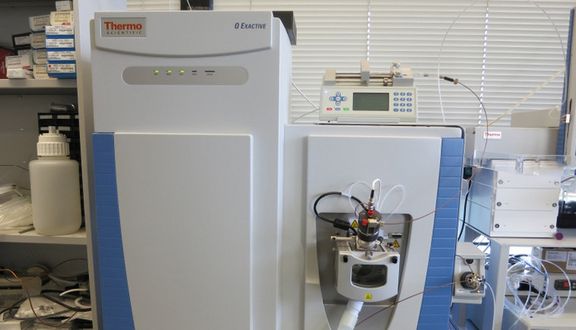

Gas chromatography coupled with high-resolution mass spectrometry (HRMS)
High-resolution mass spectrometry (HRMS)
To further improve the detection of anabolic steroids, high-resolution mass spectrometry was introduced in the 1990s for routine use as a screening method.
Fig. 1 shows the screening result for the metandienone metabolite 9 (see Fig. 1, Anabolic Steroid Detection), wherein sensitive screening is performed at a resolution of R = 3000 for two intense ions (mass spectrum, see Fig. 11). The advantage of this method lies in the fact that it exhibits higher sensitivity than low-resolution GC/MS, and that, at higher resolution, it significantly reduces the biological background from the co-isolated matrix with improved selectivity. This significantly improves the signal-to-noise ratio and thus the detection of a compound [1].
Prerequisite for HRMS: Atomic masses are not integer values
The prerequisite for the application of high-resolution mass spectrometry is the fact that the exact atomic masses are not integer values. By convention, only carbon has a mass of 12, while hydrogen has an exact mass of 1.007825, nitrogen a mass of 14.003074, and oxygen a mass of 15.994914. These masses should not be confused with the average atomic weights, which include the contribution of natural isotopes.
Fig. 1A GC/HRMS chromatogram (resolution R=3000) Screening probe for the methandienone metabolite 17β-methyl-5β-androst-1-en-3α,17α-diol (1) as a bis-TMS derivative with the ions m/e 448.3192 (M+) and m/e 358.2692 (M+ -90, M+ - Si(CH3)3OH) at 2 ng/mL urine. Instrument: MS: Finnigan MAT 95, GC: Hewlett-Packard 5890, Column: Hewlett-Packard, Ultra1, 17 m, I.D. 0.2 mm, film thickness 0.11 µm, carrier gas: helium 1 ml/min split 1:20, temperature program: 185°C - 5°C/min - 240°C. 1B) Analysis with a standard-resolution mass spectrometer
The following example shows how two different mass fragments, both having the same mass of 58, can be separated using high resolution:
| Fragment | Mass | Exact mass |
| C3H6O | 58 | 58.041864 |
| C3H8N | 58 | 58.065674 |
Calculation of the resolution R
R = m / Δm = 58.05 / (58.065674 - 58.041864) = 2436
Separation of these two fragments is possible with a resolution of approximately 2500. This illustrates that with a resolution setting of 2500 and a measurement of m/e 58.0419 for fragment 1, no signal is displayed for a compound with m/e 58.0657 for fragment 2, which differs by only 0.024 in mass.
Using this technique, 65 additional positive cases were detected in 1995 at the Cologne laboratory during routine testing for international sports federations (primarily the International Weightlifting Federation) that would otherwise have gone undetected.
The identification of suspicious samples is then carried out using advanced isolation methods, allowing a distinct mass spectrum to be recorded. Depending on the compound, detection limits of up to 100 pg/ml of urine can currently be achieved.
References
[1] Schänzer W, Delahaut P, Geyer H, Machnik M, Horning S: Long-term detection and identification of metandienone and stanozolol abuse in athletes by gas chromatography-high-resolution mass spectrometry. J Chromatogr B Biomed Appl, 687(1) (1996) 93–108.

Liquid chromatography coupled with high-resolution mass spectrometry (HRMS)
With the high-resolution mass spectrometers currently in use at the institute, resolutions (R) of up to R=240,000 can be achieved using Orbitrap technology, and R=40,000 when using time-of-flight mass spectrometers (TOF). Both technologies can, in principle, be coupled with liquid as well as gas chromatography and offer the possibility of fragmentation experiments (tandem mass spectrometry).
The high resolution (e.g., R = 240,000) theoretically allows for the differentiation of molecules with a mass of 240,000 Da from those with a mass of 240,001 Da,
24,000.0 Da from 24,000.1 Da,
2400.00 Da from 2400.01 Da, or
240.000 Da from 240.001 Da.
In practice, this can be particularly helpful in the analysis of intact proteins to characterize them in detail. Fig. 2 shows the spectrum of a previously unknown fusion protein that was identified in a seized black market product.
Fig. 2: HRMS spectrum (R = 240,000 at m/z 200, measured on a Thermo Q Exactive HF using electrospray ionization) of an intact fusion protein with the accurately determined monoisotopic mass of 17,931.84 Da. The characteristic isotope pattern of the 21-fold protonated precursor ion at m/z = 854.91 is recognizable [2]
However, HRMS is also ideally suited for the precise determination of molecular masses and the resulting molecular formula for smaller molecules (such as anabolic steroids, stimulants, etc.). For example, for a measured mass-to-charge ratio of m/z = 329.2587 with a permissible measurement error interval of 2 ppm (parts per million), taking into account the elements carbon, hydrogen, nitrogen, and oxygen, there is only one possible molecular formula: C21H33ON2 (stanozolol). At 5 ppm, there are 2 (C21H33ON2, C19H31N5); at 10 ppm, there are 3 (C21H33ON2, C19H31N5, C18H35O4N), and at 20 ppm there are 6 (C21H33ON2, C19H31N5, C18H35O4N, C16H33O3N4, C14H31O2N7, C13H31ON9) possible molecular formulas. HRMS systems used today are capable of achieving a measurement error range of 1–5 ppm after appropriate calibration. High-resolution mass spectrometric data therefore contain a very high density of information, which in principle also allows for retrospective data evaluation and thus enables measurements to be re-examined for previously unknown substances even years after the analysis [3, 4]. However, the final identification of prohibited substances will still be based on retention time and characteristic peak patterns in comparison to the respective reference substance.
(November 20, 2017 Andreas Thomas)
References
[2] Walpurgis, K., Krug, O., Thomas, A., Laussmann, T., Schänzer, W., Thevis, M.: Detection of an unknown fusion protein in confiscated black market products. Drug Test Anal (2014) 6: 1117-24.
[3] Görgens, C., Guddat, S., Thomas, A., Wachsmuth, P., Orlovius, A. K., Sigmund, G., Thevis, M., Schänzer, W.: Simplifying and expanding analytical capabilities for various classes of doping agents by means of direct urine injection high-performance liquid chromatography high-resolution/high-accuracy mass spectrometry. J Pharm Biomed Anal (2016) 131: 482-96.
[4] Thomas, A., Guddat, S., Kohler, M., Krug, O., Schänzer, W., Petrou, M., Thevis, M.: Comprehensive plasma screening for known and unknown substances in doping controls. Rapid Commun Mass Spectrom (2010) 24: 1124-32.