Amino acids, peptides, and proteins
Amino acids are the basic monomeric building blocks of all proteins. Proteins are complex macromolecules that perform important functions in an organism’s metabolism.
Functions of proteins:
- Component of muscle tissue, movement
- Enzymes; function of enzymes as catalysts of biochemical reactions
- Hormones (regulation)
- Receptors in the cell membrane or intracellular receptors
- Ion channels
- Functions in the blood, defense, coagulation, etc.
The term "peptide" is often used as a synonym for protein. Although the term "peptide" generally refers only to smaller proteins with molecular weights up to 10,000, this convention is not always followed.
For example, the term "peptide hormone" is used in anti-doping regulations, which includes, among others, growth hormone and erythropoietin (EPO)—molecules with molecular weights well over 20,000.
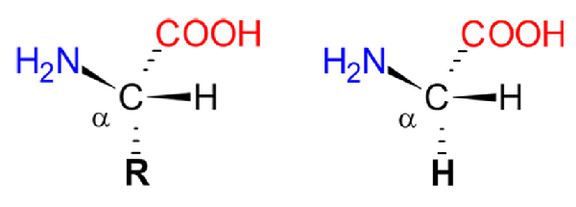
There are a total of 20 amino acids, all of which share a common structure (Fig. 1) and differ only in the nature of their side chain R. The simplest amino acid is glycine, with R = H (Fig. 2).
Fig. 1 Basic structure of all proteinogenic amino acids (left); Fig. 2 Glycine (right)
With the exception of glycine, all other amino acids found in proteins have four different groups (substituents) attached to the alpha-carbon atom. Carbon atoms with four different substituents are optically active, can rotate polarized light, and are referred to as chiral centers.
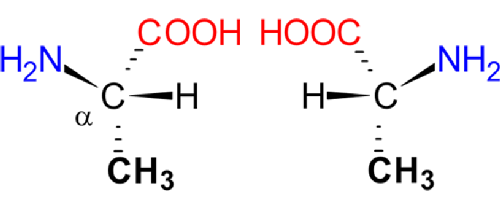
Therefore, there are two forms of each amino acid that are mirror images of each other and are designated as L- and D-forms (Fig. 3). The L- and D-forms are not identical due to their spatial arrangement. All proteinogenic (naturally occurring) amino acids possess the L-form.
Fig. 3 L-alanine (left) and D-alanine (right)
Amino Acids - Abbreviations, Symbols, Molecular Weights, and Chemical Formulas
| Name | Abbrev. | Symbol | Molecular weight g/mol | Chemical formula |
| Alanine | Ala | A | 89.0935 | C3H7NO2 |
| Arginine | Arg | R | 174.2017 | C6H14N4O2 |
| Asparagine | Asn | N | 132.1184 | C4H8N2O3 |
| Aspartic acid | Asp | D | 133.1032 | C4H7NO4 |
| Cysteine | Cys | C | 121.1590 | C3H7NO2S |
| Glutamine | Gln | Q | 146.1451 | C5H10N2O3 |
| Glutamic acid | Glu | E | 147.1299 | C5H9NO4 |
| Glycine | Gly | G | 75.0669 | C2H5NO2 |
| Histidine | His | H | 155.1552 | C6H9N3O2 |
| Isoleucine | Ile | I | 131.1736 | C6H13NO2 |
| Leucine | Leu | L | 131.1736 | C6H13NO2 |
| Lysine | Lys | K | 146.1882 | C6H14N2O2 |
| Methionine | Met | M | 149.2124 | C5H11NO2S |