CERA (Mircera®)

Definition
In June/July 2004, various journals first reported on a new EPO analogue: CERA
CERA (Continuous Erythropoiesis Receptor Activator) is a chemically modified variant of epoetin α, which is marketed by Hoffmann-La Roche under the name Mircera®. Mircera® has been approved in the European Union since July 2007.
The difference from other EPO preparations lies in a methoxypolyethylene glycol group linked to the peptide chain of the EPO molecule. The molecular weight of this chain is approximately 30 kDa. The increase in the size of the erythropoietin caused by the methoxypolyethylene group results in reduced renal excretion. This increases the half-life to approximately 133 hours, whereas unmodified erythropoietin ? has a half-life of 4–12 hours.
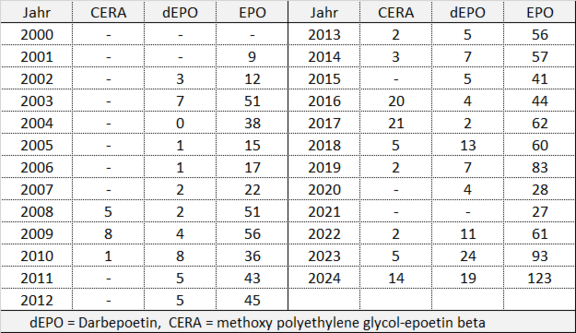
Detection
In 2008, several cyclists were found guilty of CERA doping during the Tour de France. Detection was performed using the IEF-PAGE method according to F. Lasne. CERA was detected in the urine of one of the cyclists; for the other three, the finding was only confirmed several months after the Tour through improved CERA detection in the blood.
The previously described reduced excretion of CERA in urine and the associated difficulty in detection can be circumvented if CERA is detected directly from the blood. It is assumed that the cyclists in question were convinced that this EPO preparation, which was new at the time, was undetectable.
In the spring of 2009, systematic follow-up tests were conducted on long-term stored blood samples from the 2008 Summer Olympics in Beijing. These revealed 5 additional positive findings of CERA abuse.
Further information
Information on the market launch of CERA: Roche press release