Creatine
Anti-doping rule: Creatine is not banned!

Definition
Synthetic creatine (Fig. 1) has been used in many sports over the past decade, sometimes in high doses, to enhance performance during short-term exertion. Since creatine is not currently on the list of banned substances, the use of creatine is not considered doping!


Significance as a Doping Substance
Creatine is not currently classified as a doping agent by the World Anti-Doping Agency. It remains to be seen whether this type of nutritional supplement will be accepted in the long term, despite ethical and health concerns. A threshold level in urine could potentially be established to prevent the use of high doses of creatine.
Effects
Fig. 1 Structural formula of creatine
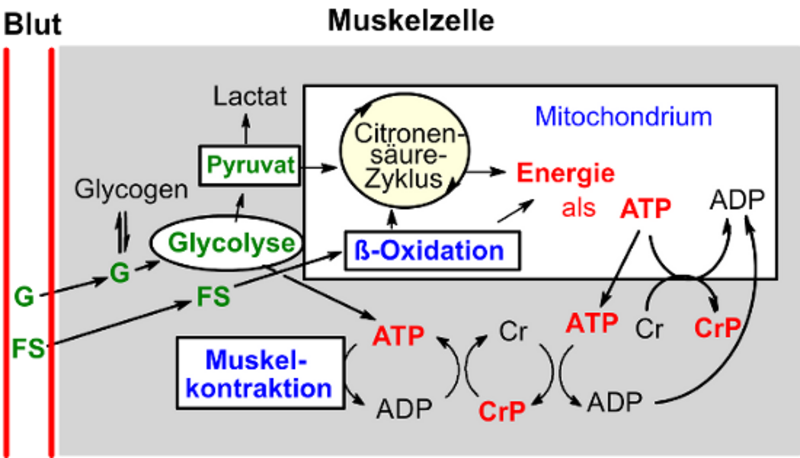
The biological function of creatine is shown schematically in Fig. 2.
Fig. 2 Function of creatine in the mammalian organism; abbreviations: ADP = adenosine diphosphate, ATP = adenosine triphosphate, Cr = creatine, CrP = creatine phosphate, FS = fatty acid, G = glucose
In the context of energy production, creatine serves as a storage compound for high-energy molecules; in the form of creatine phosphate, it stores the energy that the body generates through the formation of ATP (adenosine triphosphate) (see Fig. 2). The reaction occurring here is catalyzed by the enzyme creatine kinase (Fig. 3).
Fig. 3 Formation of energy-rich creatine phosphate (Note: at pH 7, creatine is present in ionized form)
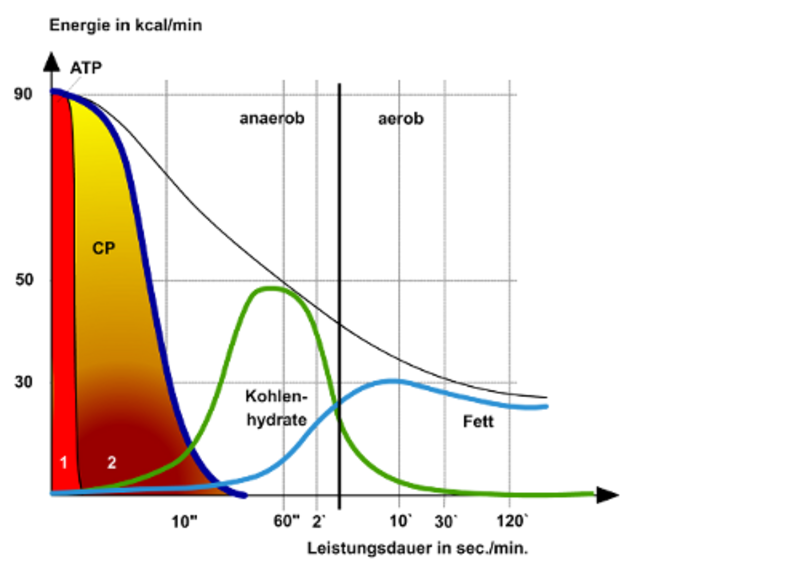
Creatine phosphate enables the cell to perform anaerobic work over a longer period during short-term high-intensity exertion by maintaining a high ATP concentration (Fig. 4). For example, creatine phosphate (CP) is the primary energy source for a 100-meter sprint.
Fig. 4 Energy Sources and Duration of Performance
Administering high doses of creatine (20–30 g per day for the first 7 days) is intended to increase the creatine pool in muscle cells while simultaneously boosting the available amount of creatine phosphate. This leads to improved performance during short-term exertion. This has been scientifically confirmed in numerous trials.
However, creatine is not a foreign substance, as it can be synthesized by the human body. Furthermore, creatine can be obtained through diet (meat, fish).
When athletes use creatine, they initially take doses of 20–30 g per day, which is roughly 10 to 15 times the amount synthesized by the body daily and the average amount obtained through diet. This use would thus involve the administration of a substance identical to that produced by the body in abnormally high quantities and could therefore be considered a practice in the gray area between supplementation and doping.
Side Effects
It is currently not possible to determine whether this unnaturally high intake of creatine can cause health damage. However, it is known that high muscular stress combined with creatine use can lead to muscle hardening.
It should be noted that there is no reliable data on the safety of long-term use of high doses of creatine. In particular, there is insufficient knowledge regarding the effects and side effects of creatine on other organs such as the liver, kidneys, brain, and heart. The use of creatine is therefore considered controversial.
Food Supplements, 12/92000:
EU SCIENTISTS CALL FOR CUTS IN USE OF CREATINE
On September 12, the EU’s Scientific Committee on Food called for reductions in the use of the performance-enhancing food supplement creatine until more research has been conducted into its long-term side effects.
The panel stated that there is insufficient evidence to confirm the safety of creatine at the initially high doses recommended by manufacturers to "load" muscles—up to 20 times the body’s normal daily intake. The committee recommended that these doses be avoided until more is known about the effects on the kidneys, liver, heart muscle, brain, and testes.
Creatine occurs naturally in meat and fish and is widely used by athletes to improve their explosive power. Many recreational athletes also take the supplement, which is freely available in pharmacies, health-food stores, and supermarkets.
"Large-scale, well-controlled studies are lacking. Available results observed in highly trained athletes cannot necessarily be extrapolated to the general public," the EU panel said, and it also expressed concern about creatine’s effect on athletes who become dehydrated or who combine it with other supplements.
(Opinion of the Scientific Committee on Food on safety aspects of creatine supplements; SCF/CS/NUT/SPORT/9 Final, September 12, 2000)