Darbepoeitin (NESP)
Darbepoetin alfa is a peptide hormone that, like erythropoietin (EPO), stimulates erythropoiesis in bone marrow stem cells. This results in an increase in the number of red blood cells (erythrocytes) in the blood. Like EPO, darbepoetin is produced from Chinese hamster ovary cells using recombinant DNA technology. Like EPO, darbepoetin is a glycoprotein consisting of 165 amino acids, but it differs from EPO in that it has two additional sugar chains. This was achieved by replacing a total of 5 amino acids in the amino acid chain.
Darbepoetin is a modified EPO analogue, in which five of the EPO molecule’s 165 amino acids have been replaced:
| Position | EPO | Darbepoetin |
| 30 | Alanine | Asparagine |
| 32 | Histidine | Threonine |
| 87 | Proline | Valine |
| 88 | Tryptophan | Asparagine |
| 90 | Proline | Threonine |
Sugar chains are attached to the two new amino acids, asparagine, just as they are in the EPO molecule, so that darbepoetin has 6 sugar chains instead of 4, unlike EPO.
Recommended link: Information from Ambgen on darbepoetin alfa (NESP, Novel Erythropoiesis Stimulating Protein, Aranesp®)
Significance as a doping agent
The misuse of darbepoetin was first suspected in November 2001, after Ambgen received approval for the product’s medical use in the United States under the name Arnesap®.
At the 2002 Winter Olympics in Salt Lake City, three athletes were found guilty of Darbepoetin abuse, including Johann Mühlegg, who competed for Spain. Although darbepoetin was not specifically listed on the doping list at that time, the substance clearly falls under these regulations, as it belongs to the group of peptide hormones, such as EPO. This is specified in the regulations under the heading “Peptide Hormones and Analogs.”
Effect
Like EPO, darbepoetin stimulates erythropoiesis (the formation of red blood cells) via the same mechanism.
In the presence of oxygen deficiency (hypoxia), the kidneys produce increased amounts of EPO and release it into the bloodstream. In response to oxygen deficiency, EPO promotes the development of individual blood cells, particularly the rate of red blood cell formation, from stem cells in the bone marrow. Endogenous EPO production is directly linked to the clinical picture of chronic renal anemia, with impaired EPO production considered the primary cause of the anemia.
Treatment with darbepoetin leads to the formation of new red blood cells and an increase in hemoglobin levels, thereby improving oxygen transport. According to the manufacturer, these changes are generally observed only 2 to 6 weeks after the start of treatment.
Compared to EPO preparations such as epoetin alfa, darbepoetin has a half-life that is three times longer, both following subcutaneous (injection into the skin tissue) and intravenous (i.v.) administration. After subcutaneous injection, the half-life is 49 hours (27–89 h), while after intravenous injection it is approximately 21 hours.
Side Effects
The most commonly observed serious side effects are thrombosis, heart failure, and cardiac arrhythmias. Other common side effects include infections, high blood pressure, headaches, and diarrhea.
Further information on side effects is summarized in the Adverse Reactions section on the Arnesap® website.
Dosage
Darbepoetin is administered either intravenously or subcutaneously once weekly. The initial dose is approximately 0.45 mg/kg body weight and is gradually increased.
Treatment is monitored by checking the hemoglobin (Hb) concentration. The increase in Hb concentration should not exceed 1 g/100 mL of blood over a 2-week period. The dosage must be adjusted so that the final Hb concentration does not exceed 12 g/100 mL of blood.
Evidence
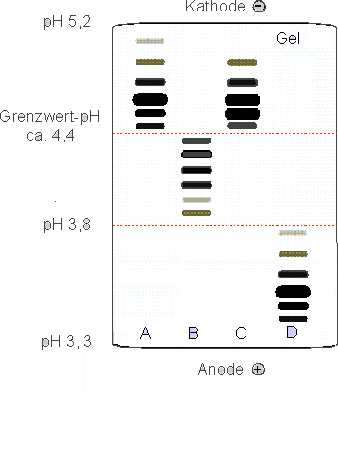
Due to the introduction of two additional sugar chains, the increased number of terminal sialic acid groups enhances the acidic character of the compound. Thus, darbepoetin has a lower pI value compared to recombinant and human EPO and can be clearly identified during analytical separation (isoelectric focusing)—see EPO detection—(see Fig. 1).
Unlike EPO, darbepoetin migrates toward the anode in the electric field and is separated from genetically engineered recombinant (rh) and human (h) EPO.
Fig. 1: EPO bands after isoelectric focusing: A = rh EPO; B = human EPO (negative urine sample); C = positive urine sample; D = darbepoetin