Ephedrine and related compounds

Definition
Ephedrine (Fig. 1) is classified as a prohibited doping substance under the prohibited substance group S6 (stimulants). The substance may not be used in competition. It is not prohibited during the out-of-competition period. However, if used during the out-of-competition period, the substance must be discontinued at least 2 days prior to a competition.
Structural similarity
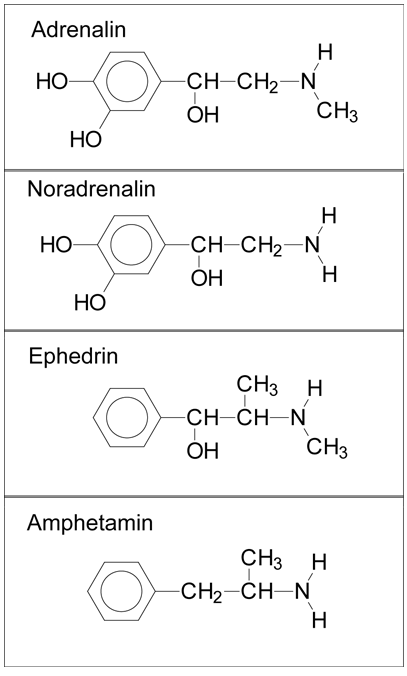
The structural similarities between ephedrine and amphetamine, as well as the endogenous catecholamines norepinephrine and epinephrine, are shown in red in the structural formulas below (Fig. 3).
All four compounds share a common basic structure known as phenylethylamine (Fig. 2). The substitution of the phenyl ring with two adjacent hydroxyl groups, as seen in norepinephrine and epinephrine, is defined as a catechol structure.
Origin
Ephedrine is the main alkaloid of the Chinese plant "ma huang" of the genus Ephedra. Ephedrine can exist in four different isomeric forms; see Stereoisomers
Effect
Ephedrine belongs to the class of indirectly acting sympathomimetics and has effects similar to those of norepinephrine.
In medical use, ephedrine is primarily utilized for its decongestant effect on the nasal mucosa in conditions such as the common cold. Its effect on the bronchial muscles, however, is said to be less pronounced.
References: Forth, Henschler, Rummel, Starke: Textbook of General and Special Pharmacology, 7th edition. Wissenschaftsverlag Mannheim, Leipzig, Vienna, Zurich, 1996.
See also: Effects of Catecholamines
Usage:
For bronchitis, dry cough, flu-related cough, measles cough, colds, flu-like infections, acute and chronic inflammation of the bronchial mucosa, and bronchial asthma.
Ephedrine is found in over-the-counter medications, e.g., in Germany in Wick MediNait®, a nighttime cold syrup.
Side effects
See also Side Effects of Stimulants
Significance as a doping agent
Positive doping test results involving ephedrine and ephedrine analogs such as pseudoephedrine, methylephedrine, and cathine (norpseudoephedrine) were still the most common among stimulants around the year 2000.
Statistics from IOC-accredited laboratories showed, for example, that in 2000, out of a total of 117,315 test samples worldwide, 289 A-samples tested positive for various ephedrines. However, abuse has since declined significantly.
Statistics from WADA-accredited laboratories, for example, showed only 34 and 46 positive A-samples containing various ephedrines, respectively, out of a total of 267,645 and 243,193 tests worldwide in 2011 and 2012.
The threshold for ephedrine is 10 µg/ml of urine.