Epiandrosterone sulfate (testosterone detection)

Recent publication on improved detection
Piper T, Putz M, Schänzer W, Pop V, McLeod MD, Uduwela DR, Stevenson BJ, Thevis M. Epiandrosterone sulfate prolongs the detectability of testosterone, 4-androstenedione, and dihydrotestosterone misuse by means of carbon isotope ratio mass spectrometry. Drug Test Anal. 2017 Nov;9(11-12):1695-1703. doi: 10.1002/dta.2291. Epub 2017 Oct 27.
See abstract and download the article
The misuse of testosterone and testosterone prohormones remains a major problem in sports and leads to many positive test results every year. Detecting the illegal use of testosterone is difficult because testosterone is one of the hormones produced endogenously by everyone. The mere presence of testosterone or its metabolites in urine does not, therefore, constitute a doping violation. Rather, attempts are made to distinguish suspicious samples from non-suspicious ones based on the absolute concentrations or concentration ratios of the steroids. This is now achieved with great success, but does not yet constitute clear proof of testosterone use. This requires a so-called confirmatory analysis, which is conducted based on the carbon isotope ratios of testosterone and its metabolites.
Carbon naturally occurs in the stable isotopes 13C and 12C, and the ratio is approximately 1.1% to 98.9%. Synthetically produced testosterone differs from endogenous testosterone in precisely this ratio, with the synthetic form containing slightly less 13C. These small differences can be detected using an isotope ratio mass spectrometer, and this is the basis for the ability to conclusively convict athletes of testosterone abuse. This is currently possible for a period of approximately 24 to 36 hours following a single administration of testosterone or a testosterone prohormone.
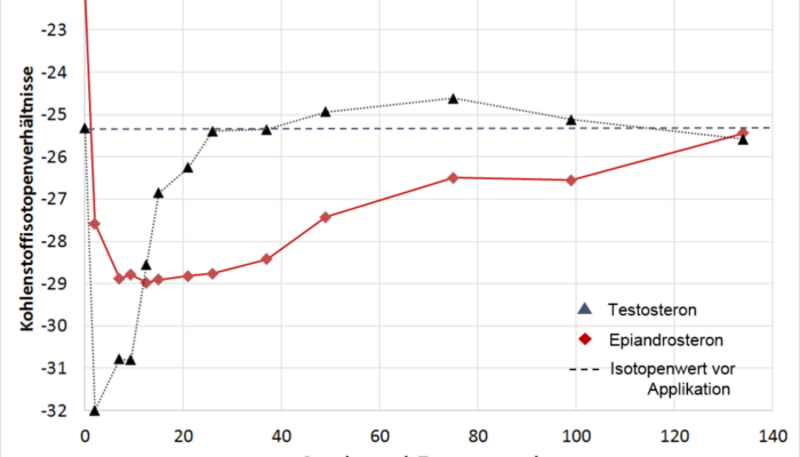
Currently, only glucuronide conjugates—that is, steroids that have been modified with a sugar residue to make them water-soluble and excretable via urine—are considered for detection. Another metabolic pathway, sulfation—the binding of a steroid to a sulfuric acid residue—has so far been largely overlooked in steroid doping analysis. Accordingly, epiandrosterone, a known metabolite of testosterone that is excreted exclusively in a sulfated form, has not yet been thoroughly investigated. This study demonstrated that the use of epiandrosterone extends the detection window for testosterone administration to up to 120 hours. This fivefold increase in detection time is presumably due to a peculiarity in the metabolism of epiandrosterone, the cause of which can only be speculated upon at this time.
(December 1, 2017 Thomas Piper)