Prohormones

Definition
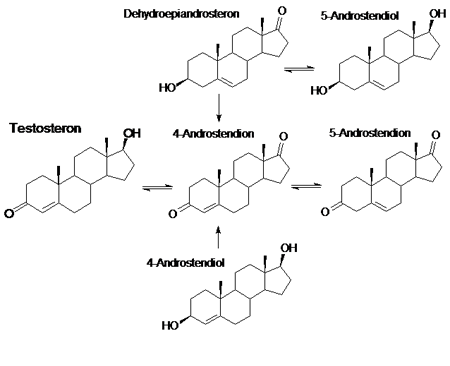
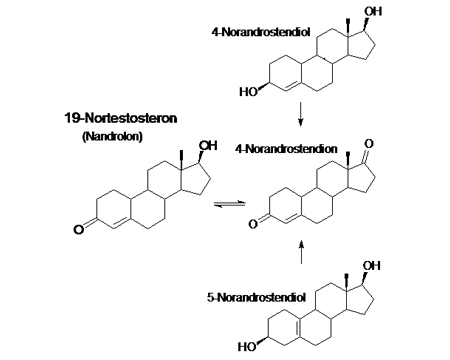
Prohormones are steroid hormones (Fig. 1) that act as intermediate products in the biosynthesis of the male sex hormone testosterone (Fig. 2). Similarly, after the administration of nandrolone prohormones—which are supplied to the body, for example, in the form of tablets—the human body can synthesize nandrolone from them (Fig. 3).
When discussing prohormones, a distinction must be made between endogenous steroids, which are produced in the body in physiologically relevant quantities and are considered prohormones of testosterone (Fig. 2), and exogenous prohormones of nandrolone (Fig. 3).
The following steroids are currently marketed as body-identical prohormones in the form of dietary supplements abroad, particularly in the United States:
- 4-Androstenedione
- 4-Androstenediol
- 5-Androstenedione
- Dehydroepiandrosterone (DHEA)
- 5-Androstendiol
Dehydroepiandrosterone (also known as prasterone) occupies a special position here, as it is also marketed as a medical preparation.
Significance as a Doping Agent
In Germany, prohormones are generally considered to be drugs due to their hormonal structure, specifically unapproved drugs. An exception to this is medically marketed DHEA (prasterone), which is sold as a drug in the United States.
It is not available on the market in Germany as a single-ingredient preparation, but it can be prescribed and imported for therapeutic purposes. As a combination preparation, it is marketed in Germany in the drug Gynodian® Depot Injection Solution by the company Schering. For non-medical DHEA products as well as for all other prohormones, the sale or distribution in Germany constitutes a violation of the German Medicines Act.
As prohormones of nandrolone (19-nortestosterone), 4-norandrostendione, 4-norandrostendiol, and 5-norandrostendiol are currently marketed abroad as dietary supplements. The extent to which these prohormones are converted by liver enzymes into nandrolone, as shown in Fig. 3, is possible in small quantities.
All prohormones are prohibited under the World Anti-Doping Agency (WADA) doping regulations.
Effects and Side Effects
There is very little data on the side effects and effects of prohormones, with the exception of DHEA. Prohormones appear to be of little interest to medicine, as they cannot be used to achieve a constant blood level of physiologically active testosterone or nandrolone.
Furthermore, the conversion rate to testosterone or nandrolone is very low. To achieve physiologically relevant concentrations in the blood, prohormones are therefore offered in large quantities (tablets or capsules containing up to 200 mg of steroid hormones) in oral form (instructions: multiple daily doses).
This is certainly not harmless to the liver, as these substances must be metabolized in the liver and then excreted into the urine via the kidneys! Even for the medical use of DHEA, 200 mg per day is recommended, with warnings about possible side effects.
Meanwhile, dietary supplement manufacturers offer combinations of various prohormones as well as combinations of prohormones with plant extracts such as chrysin and Tribulus terrestris. Caution is also advised regarding these combination products, as no data on side effects exists.
Sublingual preparations (absorption through the oral mucosa after the substance is placed under the tongue) are also marketed, e.g., 4-norandrostendione (25 mg tablets). With this method of administration, the substance is said to be more effective because it bypasses the liver (first-pass effect) (see also information on nandrolone). For this reason, lower doses are advertised compared to oral preparations. For these applications as well, it is recommended to take the substance several times a day.
Further information
- Side effects of nandrolone: see information on nandrolone and side effects of anabolic steroids
- For information on contamination of dietary supplements with prohormones, see the information on nandrolone