Mass spectrometry
using electron impact ionization (EI)

The following describes mass spectrometry using electron impact ionization, as it is used in conjunction with gas chromatography. Mass spectrometry is an analytical technique for determining molecular masses.
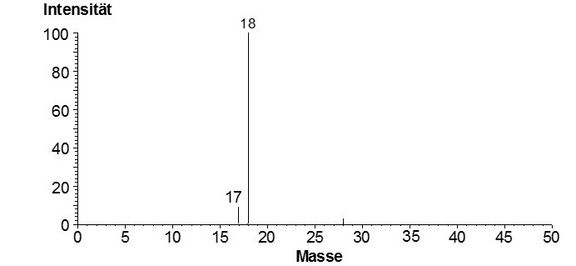
Example: Water is a molecule with a mass of 18; it consists of one oxygen atom with a mass of 16 and two hydrogen atoms, each with a mass of 1. In this case, the analyzer would register a mass of 18. See also the mass spectrum of water below.
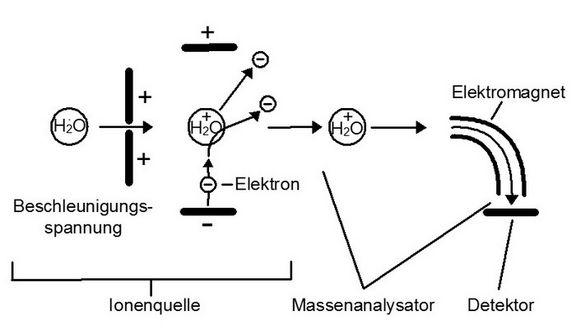
A mass spectrometer consists of an ion source, in which the gaseous molecules are ionized; a mass analyzer, which separates the ions based on their mass-to-charge ratio (m/z); and a detector, which measures the intensity of the generated ions (Fig. 2).

The analysis produces a mass spectrum that shows which ions have been formed and in what relative proportions to one another.
EI mass spectrum of water (Fig. 3)
The water ion formed, with a mass of 18, is very stable and is the most intense ion. The intensity of the most abundantly formed ion is set to 100%. In about 10% of the ions formed, a hydrogen atom is stripped away, resulting in an ion fragment with a mass of 17.
The intensity scale indicates the relative intensity of an ion compared to the ion with the highest intensity. The mass scale (mass/charge) indicates the respective mass of the detected ion.
Various techniques are available for the ionization of molecules.
For example, in electron impact ionization (EI) combined with gas chromatography, the separated molecule is bombarded with electrons. Under electron bombardment, a molecule is positively ionized because an electron is removed from its outer shell.
Example: A water molecule is ionized into a positive ion (M+) with a mass of 18.
However, strictly speaking, this should be referred to as a radical cation, and the correct notation would be [H2O]•+.
"By removing an electron from a molecule, one obtains the molecular ion M+. This contains an unpaired electron and thus has a radical character, which is often indicated by the notation M•+; here, the dot represents the unpaired electron. Radical cationic molecular ions are typical for electron ionization (EI), although the signal from the M•+ ions may also be absent." (Herbert Budzikiewicz, Mathias Schäfer. Mass Spectrometry. 6th edition, p. 53, Wiley-VCH Verlag, Weinheim, 2012)
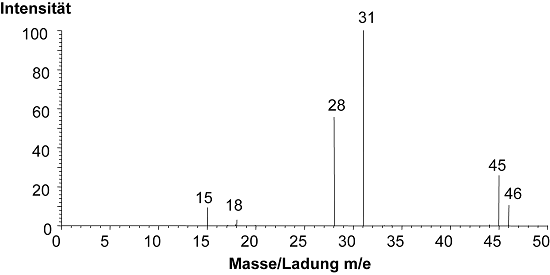
EI mass spectrum of ethanol (Fig. 4)
Example: An ethanol molecule is ionized to form a molecular ion M+ with a mass of 46.
The correct structure and notation for the radical cationic molecular ion would be [CH3-CH2-OH]•+.
When bombarded with electrons, a molecule absorbs energy; in the process, it is not only ionized but can also fragment according to its structure, breaking down into further, more stable fragment ions. The pattern of this fragmentation (mass spectrum) is characteristic of each molecule and can, in a sense, be regarded as a compound’s “fingerprint.”
The mass spectrum of ethanol (Fig. 4) shows characteristic ion fragments with m/z 28 (detachment of water), m/z 31 (detachment of a methyl group CH3), and m/e 45 (detachment of a hydrogen atom).
In doping analysis, mass spectrometry was typically operated with an upstream gas chromatograph (GC) until the late 1990s. Today, liquid chromatographs (LC) are increasingly being used as separation systems alongside GC.