Chromatography - Analytical Chemistry
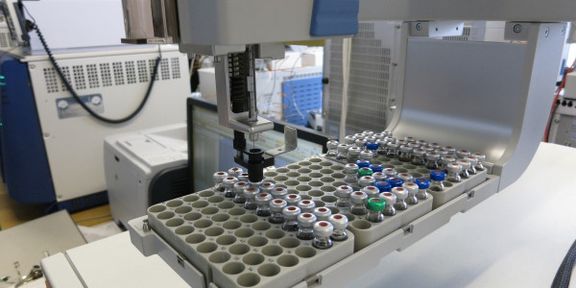
Chromatographic Methods
The term chromatography refers to methods for separating mixtures of substances. In this process, separation occurs between two phases, one of which is stationary (stationary phase) and the other flows past it (mobile phase).
Depending on the nature of the mobile phase, a distinction is made between gas chromatography (GC) and liquid chromatography (LC). Depending on the carrier material used, liquid chromatography is further classified into column, paper, and thin-layer chromatography. One of the most widely used forms of column chromatography is high-performance liquid chromatography (HPLC).
Following the chromatographic separation, the actual analytical measurement takes place: detection, which can be substance-specific or quantitative depending on the type of detector.
The type of detection should be specified when naming the chromatographic method, e.g., GC/MS (gas chromatography/mass spectrometry).
See Chromatography Chemistry website by Thomas Seilnacht
A story of chromatography as an introduction for chemistry instruction:
Lit. FP Zimmermann und E Wiederholt: Naturwissenschaften im Unterricht Chemie, in F.Wöhrle, Chromatographie in Theorie und Unterrichtspraxis, Sammelband Nr. 92137, 1996, Seite 15. Pädagogische Zeitschriften bei Friedrich in Velber in Zusammenarbeit mit Klett
Thin-layer and paper chromatography
Paper chromatography primarily uses cellulose as the stationary phase and allows for the separation of hydrophilic substances. In contrast to paper chromatography, thin-layer chromatography is widely used. The advantages of thin-layer chromatography over paper chromatography include better sample application, a wider selection of stationary phases, solvents, and detection reagents, and better quantitative analysis.
The following types of chromatography can be performed using thin-layer chromatography:
a) Adsorption chromatography (silica gel, aluminum oxide, diatomaceous earth)
b) Partition chromatography (cellulose, silica gel, diatomaceous earth)
c) Ion-exchange chromatography
d) Gel chromatography
In recent years, hydrophobic surface-modified plates have been developed that, unlike silica gel, have a nonpolar surface and thus improve the separation of nonpolar substances. In such a separation system, contrary to the list above, the stationary phase is hydrophobic.
Detection in paper and thin-layer chromatography can be physical, in which the UV absorption or fluorescence of the substance is measured. In the majority of applications, chemical detection is often used, in which the substances are stained with a substance-specific spray reagent.
Gas chromatography
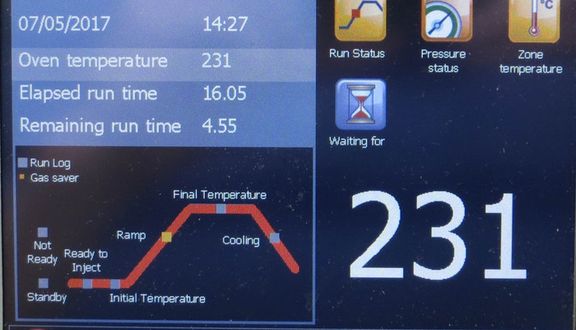
Control unit of a modern gas chromatograph combined with an MS system
Gas chromatography is a separation method in which a mixture of dissolved substances (sample) is carried by a gas stream over a stationary phase, where it is separated into the individual components of the sample. The gas is typically helium, and the stationary phase consists of a 10–50 m long quartz column with an inner diameter of approximately 0.2 mm, coated on the inside with a specially developed thin film of a separation material. The individual components of the sample leave the separation column after a certain time (retention time) and can then be analyzed using a sensitive detector.
The following detectors are available for this purpose:
1. Flame ionization detectors (FID)
2. Nitrogen- and phosphorus-selective flame ionization detectors (N/P-FID)
3. Electron capture detectors (ECD)
4. Thermal conductivity detectors (WLD)
5. Mass spectrometers (MS)
For a gas chromatography
simulator, see the YouTube video; for the Kappenberg Chemie gas chromatography simulator,
For gas chromatography, see the example on analytics/stimulants, Fig. 3
High-Performance Liquid Chromatography (HPLC)
High-performance liquid chromatography can be regarded as a further development of thin-layer chromatography, in which the stationary phase is not present as a layer on a plate but as a packing material in a column. The separation columns used are typically 3 to 25 cm long with an inner diameter of 1 to 10 mm. The particle size of the column packing is only 5–10 µm. To achieve sufficient solvent flow, the solvent is pumped through the column at high pressure (up to 400 bar).
Similar to thin-layer chromatography, the following types of chromatography are used:
1. Adsorption chromatography (phases: silica gel, aluminum oxide)
2. Partition chromatography; bound phases, e.g.:
a) Reverse-phase (RP phases): octadecylsilane, octylsilane
b) Normal-phase: alkyl nitrile, alkylamine
3. Ion-exchange chromatography (polystyrene, silica-cellulose ion exchangers)
4. Gel chromatography (exclusion chromatography)
The most commonly used columns for the determination of hormones and doping agents are RP columns (reverse-phase columns) with spherical particles ranging in size from 5 to 10 µm. Detection of the substances following liquid chromatographic separation can be performed using the following techniques:
1. Ultraviolet detection
2. Fluorescence detection
3. Electrochemical detection
4. Mass spectrometric detection
Of these four methods, mass spectrometry is used as the definitive method for identifying substances in doping analysis, whereby a sensitive measurement range in the pico- and nanogram range can routinely be achieved.
Further information:
http://www.seilnacht.com/versuche/chromat.html
PDF download: Thin-layer chromatography of caffeine