Doping Analysis - Overview 2000
*and excreted in an unconjugated form
Doping Analysis - Overview - As of 2000
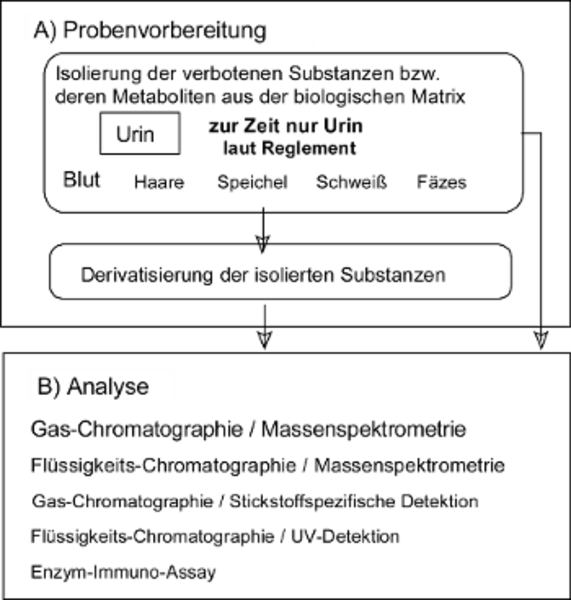
Fig. 1 illustrates the analytical procedure. The process begins with sample preparation, during which the relevant active substances or their metabolites are isolated from the urine. Subsequently, the substances may be derivatized to improve their gas chromatographic properties. However, this is not always necessary, as is the case, for example, with stimulants.
Next comes the actual analysis, which typically consists of a chromatographic separation system followed by a detection system. For the group of peptide hormones, substance-specific enzyme-linked immunosorbent assays (ELISAs) are used.
In practical application, when dealing with a large number of samples to be tested, a distinction is made between a screening method and an identification method. The screening method is one that, ideally, should detect all substances with as little effort as possible while simultaneously being sensitive, fast (with high sample throughput), and cost-effective. However, this is generally not possible, especially when detecting anabolic agents.
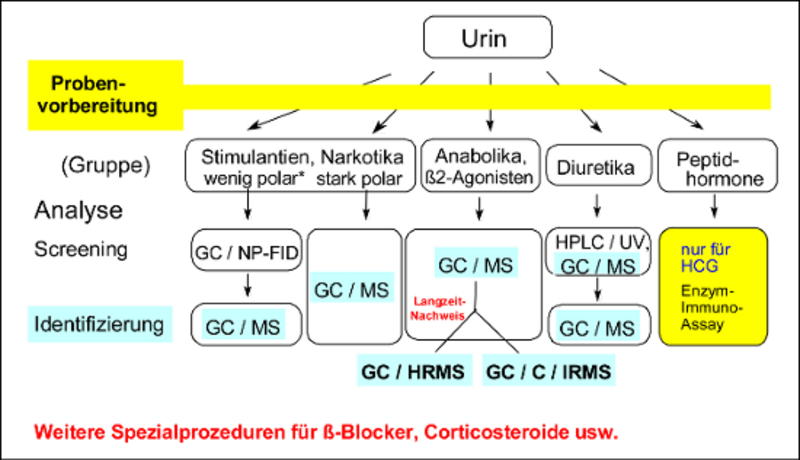
To ensure the necessary sensitivity for all compounds, specific methods must be used for each substance group (Fig. 2). In the screening method for anabolic agents, analysis is even performed using an extremely sensitive and cost-intensive technique: high-resolution mass spectrometry.
Identification method follows the screening method
If suspicious substances are detected using the screening method, a second isolation and unambiguous identification of the active substance are performed as part of an identification method. In this process, a substance-specific isolation procedure can be used to further reduce the biological matrix, along with a distinct physical measurement principle. The unambiguous identification of doping substances is currently performed primarily using a combination of gas chromatography and mass spectrometry (GC/MS).
Similarly, liquid chromatographic separation followed by mass spectrometric analysis (LC/MS) can also be performed. An exception to this is the peptide hormone human chorionic gonadotropin (HCG), which is identified using two different enzyme-linked immunosorbent assays (ELISAs) that rely on different antibodies.
Fig. 2 Overview of the procedures used in doping control (as of January 2000)
*and excreted in an unconjugated form
Further information
The following publication also provides a good overview:
Schänzer W, Thevis M Doping-Analytik Praxis der Naturwissenschaften-Chemie in der Schule, 2 (2006) 3-8 download als pdf