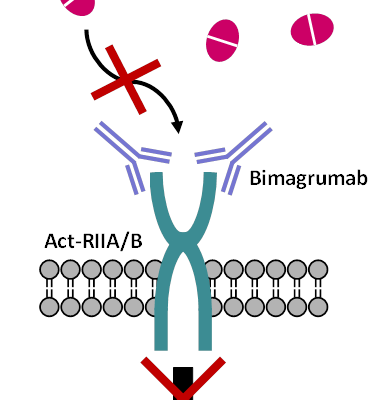
Bimagrumab (myostatin inhibitor)

Publication
Walpurgis K, Thomas A, Dellanna F, Schänzer W, Thevis M. Detection of the Human Anti-ActRII Antibody Bimagrumab in Serum by Means of Affinity Purification, Tryptic Digestion, and LC-HRMS. Proteomics Clin. Appl. 2017 Dec 11. doi: 10.1002/prca.201700120. [Epub ahead of print]
Abstract
Bimagrumab
Introduction: see Myostatin and Myostatin Inhibitors: New Therapeutics in Doping Analysis
Bimagrumab (Novartis) is a human monoclonal antibody that targets the Activin Type 2 receptors A and B [4, 5]. The highly specific binding of the therapeutic antibody to the receptors inhibits interaction with endogenous ligands such as myostatin (MSTN), thereby altering downstream signaling pathways and stimulating the growth and differentiation of muscle cells (see Figure 1).
Bimagrumab is currently in clinical development at Novartis and is intended for use in treating a wide variety of muscular disorders. In collaboration with the manufacturer, a detection method for doping analysis has now been developed prior to market launch, enabling the antibody to be detected with high specificity in serum samples [6]. First, all antibodies are concentrated from the sample using ammonium sulfate precipitation. To specifically isolate bimagrumab from the antibody extract, small magnetic particles are then used, onto which a fusion protein consisting of the extracellular domain of the activin type 2 receptor B and the Fc fragment of human IgG1 (ActRIIB-Fc) has been immobilized (Figure 2). can be detected [6]. First, all antibodies are concentrated from the sample using ammonium sulfate precipitation. To specifically isolate bimagrumab from the antibody extract, small magnetic particles are then used onto which a fusion protein consisting of the extracellular domain of the activin type 2 receptor B and the Fc fragment of human IgG1 (ActRIIB-Fc) has been immobilized (Figure 2).