DMBA (1,3-dimethylbutylamine)
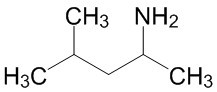
DMBA (Fig. 1) was first detected in dietary supplements in 2014.
An initial publication was released by Cohen et al. in October 2014:
Cohen PA, Travis JC, Venhuis BJ. A synthetic stimulant never tested in humans, 1,3-dimethylbutylamine (DMBA), is identified in multiple dietary supplements. Drug Test Anal. 2015 Jan;7(1):83-7. Epub 2014 Oct 8.
See abstract
Warnings to athletes against taking dietary supplements labeled as containing DMBA were issued later that same year by various anti-doping agencies (e.g., in Australia, the U.S., and Germany).
DMBA is illegally added to dietary supplements and marketed for its performance-enhancing or weight-loss effects.
DMBA can be regarded as a successor to methylhexanamine (see article on methylhexanamine), which first appeared on the dietary supplement market in 2008 and was marketed with the same claims regarding performance optimization.
Fig. 1 DMBA
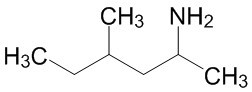
Fig. 2 Methylhexanamine
Both substances are specifically banned in sports by WADA.
DMBA differs from methylhexanamine by a methylene group (-CH2-). Thus, in DMBA (Fig. 1), the basic structure of the substance consists of an unbranched carbon chain with five carbon atoms (pentane), whereas in methylhexanamine (Fig. 2), this chain has six carbon atoms (hexane).
Various chemical names for both substances are used in the literature: For example
, WADA lists the two substances on the Prohibited List under Group S6 Stimulants as follows:
DMBA as 4-methylpentan-2-amine (1,3-dimethylbutylamine)
Methylhexanamine as 4-methylhexan-2-amine (1,3-dimethylpentylamine)
(For 1,3-dimethylpentylamine, the analogous name 1,3-dimethylamylamine or DMAA is also often used)
Relevance to Doping
There are no scientific studies on the extent to which DMBA actually enhances performance. However, due to its structural similarity to methylhexanamine, DMBA has been clearly classified by WADA as doping-relevant and added to the Prohibited List.
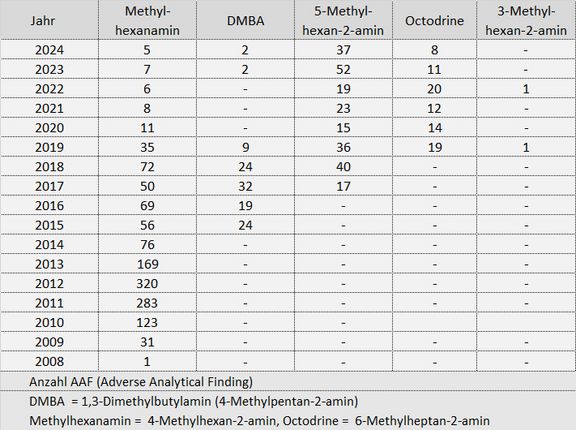
The first positive test results for DMBA have been reported by doping control laboratories since 2015. See WADA statistics under >Alkylamine-type stimulants<