Insulin - Structure, Doping, and Detection
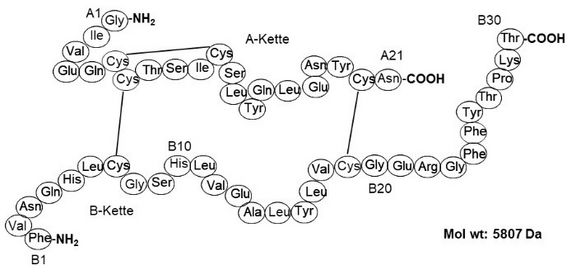
Insulin is a naturally occurring polypeptide consisting of two peptide chains linked by disulfide bonds. The A chain consists of 21 amino acids and the B chain of 30 amino acids (heterodimer). The schematic structure of the molecule is shown in Fig. 1.
(For abbreviations in Fig. 1, see Amino Acids)
The average molecular weight is 5807 Da, and the isoelectric point is approximately 5.3. Insulin is produced in the β-cells of the islets of Langerhans in the pancreas from a precursor peptide (proinsulin, consisting of insulin and C-peptide) and secreted into the bloodstream together with C-peptide. [1]
There, it is primarily responsible for regulating blood sugar levels. The isolation and characterization of insulin in the early to mid-20th century is often regarded as the birth of peptide and protein chemistry, and much of our current understanding is based on this research (including the Nobel Prizes in Chemistry and Medicine awarded in 1923, 1958, and 1964). Today, insulin plays a major role in the treatment of diabetes mellitus, and in addition to recombinant human insulin, several synthetic rapid- or long-acting insulin analogs are available. [1]
Doping
The misuse of insulin as a doping substance, however, is a phenomenon that was not recognized until the late 20th century. [2] It was added to the list of prohibited substances in 1999 and has been classified under the S4 category (Metabolic Modulators) since 2013. While it is used therapeutically to treat diabetics, it is primarily the anti-catabolic and lipolytic effects, as well as the replenishment of glycogen stores, that are discussed as performance-enhancing effects of insulin and its synthetic analogs. [2] A combined administration of insulin, growth hormones, and anabolic steroids is described as particularly effective. [2] Unlike many other doping substances, however, insulin and its analogs carry the risk of acute hypoglycemia (low blood sugar) with life-threatening consequences, especially when misused by healthy (non-diabetic) athletes.
Detection
Analytically, distinguishing between individual synthetic and animal insulins poses a particular challenge, as they differ structurally only through the substitution or rearrangement of the sequence of individual amino acids (see Table 1). The clear identification and differentiation from endogenously produced human insulin is the decisive factor here.
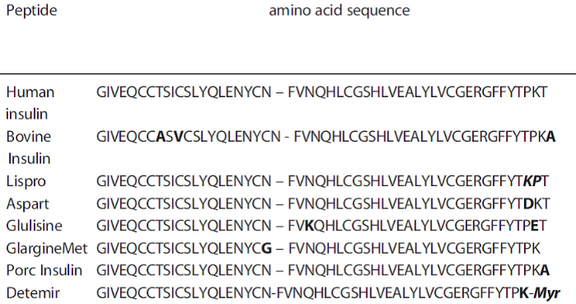
(For abbreviations in Table 1, see Amino Acids)
Detailed mass spectrometric studies were conducted in advance to enable unambiguous identification. Fig. 2 shows the post-administration spectra from various administration studies with a) the rapid-acting insulin analog lispro (Humalog) added at the detection limit of approximately 5 pg/mL, b) insulin lispro (Humalog) after administration, c) insulin aspart (Novolog) after administration, and d) insulin degludec (Tresiba) after administration.
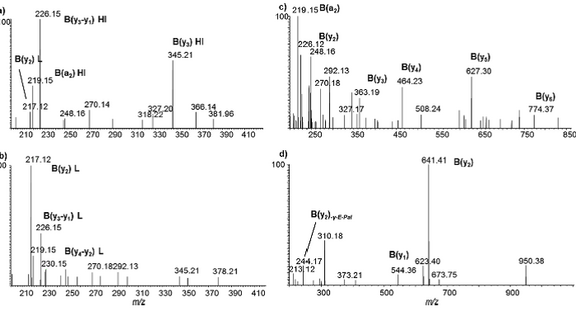
The peaks shown in the spectra (referred to as y- and b-ions) are diagnostic for the respective synthetic insulin and unequivocally confirm the presence of the prohibited synthetic insulin even in the presence of human insulin, in accordance with the criteria specified by WADA. In principle, the detection of the various insulins is possible from different matrices (urine, serum, plasma, etc.) and is based on antibody-based purification of the samples, liquid chromatographic separation of the analytes, and subsequent detection via high-resolution mass spectrometry. This method currently allows for the simultaneous and highly sensitive detection of all approved insulins (lispro, aspart, glulisine, glargine, detemir, degludec, porcine, and bovine insulin). Furthermore, there are promising approaches to detect the use of recombinant human insulin, which is chemically identical to endogenous insulin. [5] Among other factors, the ratio to equimolar secreted C-peptide is taken into account. The detection method for insulins also allows for the simultaneous determination of other prohibited peptides > 2 kDa (e.g., growth hormone-releasing hormones). [4] Further comprehensive information on this topic can also be found at [6].
(February 25, 2018 Andreas Thomas)
References
1) Löffler G, Petrides PE, Heinrich PC. Biochemie und Pathobiochemie, 8.Aufl. 2007, Springer, ISBN-10 3-540-32680-4
3) Thomas A, Schänzer W, Thevis M. Determination of human insulin and its analogues in human blood using liquid chromatography coupled to ion mobility mass spectrometry (LC-IM-MS). Drug Test Anal. 2014 Nov-Dec; 6(11-12):1125-32
siehe Abstract
4) Thomas A, Walpurgis K, Tretzel L, Brinkkötter P, Fichant E, Delahaut P, Schänzer W, Thevis M. Expanded test method for peptides >2 kDa employing immunoaffinity purification and LC-HRMS/MS. Drug Test Anal. 2015 Nov-Dec; 7(11-12):990-8
siehe Abstract
5) Thomas A, Brinkkötter P, Schänzer W, Thevis M. Metabolism of human insulin after subcutaneous administration: A possible means to uncover insulin misuse. Anal Chim Acta. 2015 Oct 15; 897:53-61
siehe Abstract
6) Identifizierung und Bestimmung von Humaninsulin, synthetischen Insulinanalogen, deren Abbauprodukten und C-Peptid in Humanurin und Humanplasma zu Dopingkontrollzwecken mittels Flüssigkeitschromatographie / Massenspektrometrie, 2008; Dissertation Universität Bonn / Deutsche Sporthochschule Köln, http://hss.ulb.uni-bonn.de/2008/1433/1433.pdf