Myostatingen

Definition
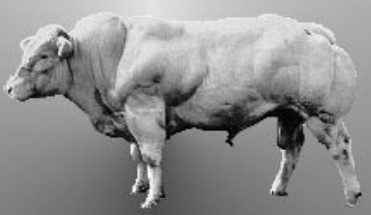
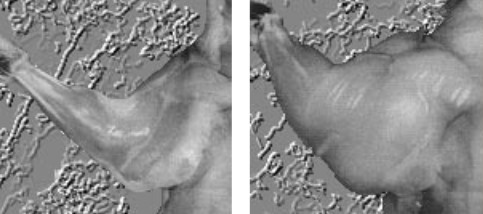
Myostatin is a growth factor that plays a significant role in regulating muscle growth. In this context, it acts as a negative regulator. If myostatin production is inhibited or ceases entirely, increased muscle growth occurs (Figs. 1 and 2). Myostatin production is regulated by the so-called myostatin gene. Any alteration of this gene therefore has consequences for muscle growth.
Fig. 1 Loss of the myostatin gene in a "Belgian Blue" cow leads to massive muscle growth (from Schulz et al. 1998)
Fig. 2 "Knock-out" supermouse. (Massively hypertrophied leg muscles following myostatin gene failure, shown on the right). (from Schulz et al. 1998)
Substances that inhibit the activity of the myostatin gene (gene expression) thus indirectly cause abnormal muscle growth, which can certainly be abused for doping purposes.
Relevance to Doping
This type of manipulation—i.e., the use of substances to inhibit myostatin—has been banned by the World Anti-Doping Agency (WADA) since January 2008 under Group S4 of hormone antagonists and modulators. Since 2013, Group S4 has been designated as “Hormone and Metabolic Modulators.”
Excerpt from the English text of the WADA Prohibited List 2026:
The following hormone and metabolic modulators are prohibited:
...
3. Agents modifying …, but not limited to: Myostatin inhibitors such as: Agents reducing or ablating myostatin expression; Myostatin-binding proteins (e.g., follistatin, myostatin propeptide); Myostatin-neutralizing antibodies (e.g., domagrozumab, landogrozumab, stamulumab)
...
References
Schulz et al. 1998: Gendoping im Sport: Fakt oder Fiktion (Artikel als PDF)