Research Focus Areas
Center for Preventive Doping Research (ZePräDo)
Building on the existing expertise of the German Sport University Cologne in the field of doping research (the Institute of Biochemistry is considered one of the world’s leading laboratories in the field of doping analysis), the Center for Preventive Doping Research (ZePräDo) was founded on September 1, 2002. At ZePräDo, the knowledge and experience of the individual departments at the German Sport University Cologne are to be focused on the field of doping in an interdisciplinary and topic-oriented manner.


Research Focus: The Athlete Exposome
Like many other people, athletes are exposed to a wide range of factors, which are determined by and vary according to, among other things, their respective lifestyles, geographical and social environments, and physicochemical parameters, etc. Unlike most people, however, athletes undergo regular chemical-analytical testing as part of doping controls, and abnormal results (influenced by the exposome composed of the aforementioned parameters) can have different professional consequences in this context. Therefore, a central focus of research at the Institute of Biochemistry at DSHS Cologne is dedicated to the athlete exposome, with the aim of providing comprehensive information for the assessment and interpretation of analytical findings.
Exposome research includes, among other things, the investigation of causal relationships in analytical findings, triggered, for example, by substance residues in food, contaminated or counterfeit dietary supplements, metabolic and transformation pathways of approved medications and chemicals, interindividual transfer of medications and metabolites (e.g., through intimate contact), etc. There is a steadily growing need for research in this area, particularly to protect athletes, e.g., to address questions such as what quantities athletes were likely exposed to, at what time, and by what means, etc.
Research Focus: Method Development
Doping analysis must respond as quickly as possible to developments in the doping scene by developing new, legally admissible detection methods.
In this research focus, substances newly added to the World Anti-Doping Agency (WADA) Prohibited List—such as new anabolic agents, antibody- or siRNA-based agents, nature-identical hormones, etc.—are incorporated into existing screening methods or dedicated testing procedures are established. In addition, more efficient screening methods for numerous doping substances are being (further) developed.
Research Focus: Mass Spectrometry of Anabolic Agents
The identification of steroid hormones and their metabolites is performed using mass spectrometry. Typically, MS technology is used in combination with prior gas chromatographic or liquid chromatographic separation. The mass spectra of substances generated by electron impact ionization exhibit substance-specific fragmentation patterns (comparable to “fingerprints”). Basic research aimed at elucidating the fragmentation patterns of steroid hormones, their metabolites, and the steroid glucuronides formed by Phase II metabolism following passage through the body—following appropriate derivatization—constitutes the focus of this project. This research is complemented by studies on selective androgen receptor modulators (SARMs) and their metabolites.
Research Focus: Isotope Ratio Mass Spectrometry
Since 1996, the application of isotope analysis (isotope ratio mass spectrometry, IRMS) has made it possible to detect the use of banned synthetic steroid hormones such as DHEA, androstenedione, androstenediol, and testosterone, which are also synthesized by the human body. This technique allows for a clear distinction between synthetic (doping) and endogenously produced steroid hormones. Isotope techniques are also being used to develop methods related to the nandrolone issue, enabling a distinction between endogenously produced norandrosterone (a metabolite of nandrolone and its prohormones) and small amounts of endogenous production. Furthermore, IRMS has proven to be a particularly helpful tool in the identification of metabolites, for example, when these are metabolized as deuterated analogs.
Research Focus: Steroid Profile Analysis
This research focus primarily aims to establish reference values for urinary steroid parameters in athletes. Reference values for steroid profile parameters enable screening and the detection of doping with endogenous anabolic androgenic steroid hormones and their precursors. Knowledge of such reference values serves, among other things, to detect attempts at manipulation.
Research Focus: Dietary Supplements
This project develops methods for detecting anabolic-androgenic steroids and other doping-relevant substances in dietary supplements. These methods are intended to screen the dietary supplement market for contaminated products and to provide analytical data in connection with positive test results.
Research Focus: Peptide Hormone Analysis
Here, the focus is on erythropoietin (EPO) research, as well as the simulation of peptide hormone metabolic pathways and the detection of relevant degradation products in blood and urine. Both nature-identical peptides and proteins (e.g., human growth hormone (hGH), insulin, insulin-like growth factor-I (IGF-I), ghrelin, etc.) as well as exogenous peptide active substances (e.g., insulin analogs, hGH-releasing peptides (GHRPs and GHRHs), mitochondria biogenesis-stimulating peptides such as MOTS-c, etc.) are investigated, among other things, with regard to their degradation following subcutaneous or intravenous administration and in natural circulation, whereby stable isotope-labeled substrates are also used in metabolism simulations. Metabolites are then identified and characterized using IRIS (isotope-labeled reporter ion screening) via high-resolution mass spectrometry.
Research Focus: Organ-on-a-Chip Metabolism Simulation
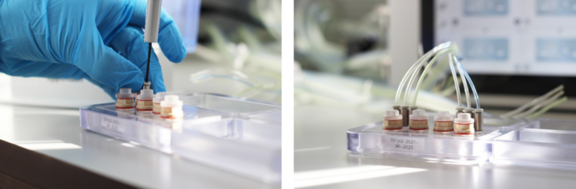
Anti-doping work relies, among other things, on extensive knowledge, particularly regarding the metabolism of doping-relevant and structurally related compounds. Since unapproved substances, in particular, are very rarely found in humans and are extremely difficult to study in animal models, state-of-the-art alternatives are being established in place of administration/elimination studies. A key milestone in this regard is the development of systems that utilize single- and multi-organ models based on chip technology. To this end, so-called spheroids are constructed that simulate organs such as the liver, skin, or kidney and are connected to a (blood-mimicking) perfusion circuit, thereby enabling the investigation of metabolic pathways, degradation products, and thus target analytes for doping analysis.
Organ-on-a-chip: HUMIMIC 96-Chip2 during loading (left) and in operation (right)
Research Focus: Gene Doping
The development of testing methods for gene doping has proven to be a lengthy and complex undertaking, although the detection of erythropoietin gene transfer has already been achieved. However, the enormous advances in gene therapy and biotechnology require consideration of numerous additional target genes and manipulation possibilities, which is why methods for detecting further transgenes—preferably within a comprehensive analytical framework—need to be developed. To this end, multiplex-capable systems with the necessary test sensitivity and optimized sample preparation are required, and additional testing strategies are indispensable—strategies that enable the detection of, for example, gene and gene expression manipulations based on CRISPR/Cas, RNA interference, etc.
Research Focus: Alternative Matrices
The expansion and enhancement of testing capabilities in the anti-doping field is of particular interest to both the athlete population and anti-doping organizations. Key drivers include reducing the invasiveness and intrusiveness of testing, faster and more cost-effective alternatives, complementary information—e.g., regarding potential ingestion or exposure to prohibited substances—higher testing frequencies, etc. In particular, research into the possibilities and limitations of dried blood spot (DBS) analysis has been conducted in numerous projects for more than 10 years and, since September 2021, has received direct endorsement from the World Anti-Doping Agency (WADA) for routine use in doping analysis. Qualitative and quantitative findings regarding prohibited substances, (long-term) stability of analytes, automation options, hematocrit determination from DBS, etc., are being investigated and established.
In addition, the added value and opportunities of breath analysis with regard to prohibited substances have been investigated since 2015. Through simple sampling by breathing into a test cartridge (with an electret membrane), aerosol particles—which can detect stimulants, beta-blockers, and narcotics in particular, as well as anabolic substances—can be collected and analyzed for monitoring purposes. Specifically for selected groups in elite sports, this testing method could represent a very good alternative to conventional testing.
July 2022