Leistenverletzungen im Nachwuchsfußball
Projektbeschreibung
Promotionsprojekt von: Dr. Thomas Dupré
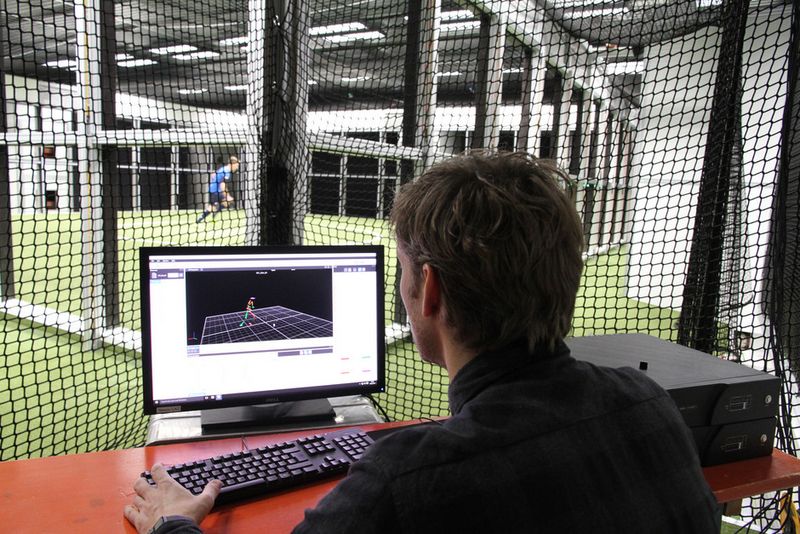
Leistenverletzungen stellen in vielen Sportarten, aber besonders im Fußball ein großes Problem dar. Trotzdem sind die Ursachen nur unzureichend erforscht. Ähnlich verhält es sich mit der plötzlichen Zunahme der Verletzungszahlen bei Nachwuchsathleten während der Pubertät. Beide Wissenslücken sollten von der vorliegenden Arbeit geschlossen werden. Dafür wurden vier Studien mit insgesamt 105 Teilnehmern durchgeführt. 3D-Bewegungsanalyse, in Kombination mit Muskel-Skelett-Modellierung, bildeten den Kern der Methodik und wurden zum Teil durch EMG oder Dynamometrie ergänzt. Die Studien I und III zeigten, dass Passspiel und Richtungswechsel das Risiko erhöhen, eine Leistenverletzung zu erleiden. Verantwortlich dafür sind in beiden Bewegungen ausgedehnte Phasen exzentrischer Kontraktion, zum Teil in Kombination mit schneller Muskellängung. In der zweiten und vierten Studie zeigte sich, dass das Wachstum in der Pubertät das Leistenverletzungsrisiko allgemein, aber auch spezifisch, für die beiden zuvor untersuchten Bewegungen erhöht. Zwischen den verschiedenen Altersgruppen in Studie II, stieg die für den Pass benötigte Kraft rapide an. Ausgelöst wird dies durch eine schnelle Zunahme der Segmentträgheit während des jugendlichen Wachstumsschubes. Diesem schnellen Anstieg kann sich das Muskelskelettsystem nicht schnell genug anpassen und ist für die Dauer
der Anpassung einem erhöhten Verletzungsrisiko ausgesetzt. Unklar bleibt, ob die Phase des schnellsten Wachstums (PHV) durch eine Beeinflussung von Bewegungstechniken ebenfalls das Verletzungsrisiko erhöht. Zwar zeigte die Studie IV hierauf Hinweise, der genaue Einfluss der PHV blieb jedoch offen. Für die Sportpraxis bedeuten die vorliegenden Ergebnisse, dass Verletzungsprävention in Form von gezieltem Krafttraining der Adduktoren eine größere Rolle spielen sollte. Bei jugendlichen Spielern sollte dies aber gezielt
in Vorbereitung auf steigende Beanspruchung während des Wachstumsschubs eingesetzt werden. Von Belastungssteigerungen innerhalb des Wachstumsschubes sollte dringend abgesehen werden, um das Verletzungsrisiko nicht zusätzlich zu steigern.
Forschungszeitraum
Januar 2016 - Dezember 2020
Projektteam

Wolfgang Potthast

Ausgewählte Publikationen
-
Groin Injuries in Soccer: Investigating the Effect of Age on Adductor Muscle Forces
Purpose The sudden rise in the injury incidence during adolescence is also evident in soccer-related injuries to the groin. Submaximal passing applies high stress on the adductor muscles and pubic symphysis and is therefore likely to be connected to the occurrence of groin injuries. Therefore, the purpose of the study was to compare hip joint kinematics and adductor muscle forces of different adolescent age groups during submaximal soccer passing. Methods Sixty participants, in four groups, younger than 12, 15, 16. and 23 yr (U12, U15, U16, U23), were analyzed. A Footbonaut, equipped with a 3D motion capture system consisting of 16 cameras, was used to capture kinematic data of short passes. Inverse dynamic analysis was performed to calculate muscle forces of 10 passes of each subject. Results The U15 group showed reduced angular velocities. A rise in hip adductor muscle forces was evident from the youngest group up to the oldest groups. The largest increase (49%) was found between U12 and U15. Lower-limb mass was identified as the best predictor for the increasing adductor force. Conclusions The reduced angular velocities of the U15 and the increase in muscle forces between all age groups were attributed to the increasing segment masses and length. This increases the moments of inertia of the leg segments thereby demanding higher forces to accelerate the segments. Most likely, the stress put upon the adductors apophyses increases during adolescence, as tendons are known to adapt slower than muscles, increasing the risk for overuse injuries. Coaches could use lower-limb mass as an indicator for fast increases in the force demand to identify players who would benefit from a reduced training volume.
-
Groin injury risk of pubertal soccer players increases during peak height velocity due to changes in movement techniques
Adolescent athletes experience an increase in injury incidence when they undergo peak height velocity (PHV). To find the reason behind this increase, the present study investigated if PHV influences hip joint kinematics, kinetics and adductor muscle forces in two groups of adolescent soccer players performing 90°-cutting manoeuvres and inside passing. One group was estimated to be more than half a year before PHV (PRE, N = 12). The second group was estimated to be less than half a year before or after PHV (MID, N = 10). Maximum static gripping and adductor forces were measured. Motion capturing and inverse dynamics were used to calculate kinematics and kinetics. The MID group was significantly taller and heavier compared to PRE while the force measurements showed no differences. Statistics showed a higher hip abduction moment for MID during the cutting manoeuvre. Results from the anthropometrics and force measurements suggest that the moments of inertia of the participants’ extremities increase faster than the muscles can adapt. A higher abduction moment of MID likely increases the load on the adductor muscles through a change of technique. Combining both findings, it is likely that the risk of suffering a groin injury is increased in the MID group.