Postdocs & Career Development
Scientific expertise, professional know-how, and innovative strength
Postdocs make an important contribution to the substantive and strategic development of our university. They have a unique impact on research, teaching, and knowledge transfer, and play a key role in shaping our university’s profile. For this reason, supporting postdocs is a central priority for the German Sport University Cologne.

We view the postdoc phase as a formative stage in one’s career and aim to provide targeted support to outstanding researchers to help them further develop their academic profiles, take on responsibility, and explore new perspectives. At the same time, the international diversity of our postdocs is a great asset to our university. Researchers from all over the world contribute diverse experiences, perspectives, and skills, thereby strengthening the exchange of ideas, the capacity for innovation, and the international orientation of our university.
Career Development, Counseling & Networking
Our counseling services help postdocs at the German Sport University Cologne to strategically plan the next stage of their careers—whether within or outside academia. We provide guidance on career paths, typical challenges in the academic system, and individual development opportunities.

In addition, we provide information on funding opportunities in research and knowledge transfer and connect you with relevant experts and resources both within and outside the university, such as Family Services, Equal Opportunity, Human Resources Development, and Research Funding. At the same time, close networking within our university is a central component of our postdoc culture: We promote disciplinary and interdisciplinary exchange to create synergies, broaden perspectives, and facilitate new collaborations. Take advantage of our advisory network to strategically plan and successfully shape your professional future.
Training & Further Education
The German Sport University Cologne offers its employees a comprehensive professional development programme consisting of numerous courses offered by various departments. Of particular interest to postdocs are the courses in the “Fit for Research and Knowledge Transfer” series.


Certificate Programme “Qualification for Career Fields in Business and Society”
The goal of this programme is to better prepare researchers in the late stages of their doctoral studies or in the postdoctoral phase for careers outside academia. This includes positions in business and society, as well as roles at universities of applied sciences and non-university research institutions.
The certificate programme is designed to be university-wide, meaning participants have the opportunity to take courses at any of the universities participating in the programme, subject to availability. The programme is aimed at
- PhD students in the late stages of their dissertation as well as
- postdocs.
They can showcase their personal skills portfolio and supplement it with key competencies that are particularly important for the non-university — as well as the academic — job market.
The certificate programme is divided into five modules: leadership skills, management skills, communication skills, methodological skills, and counseling, career planning, and job applications.
The programme begins with a mandatory initial orientation meeting and concludes with a reflective discussion with a staff member from our Department of Research and Academic Qualification.
Skills & Requirements
To have a successful career in both academic and non-academic fields, (early-career) researchers are expected to possess a wide range of skills.
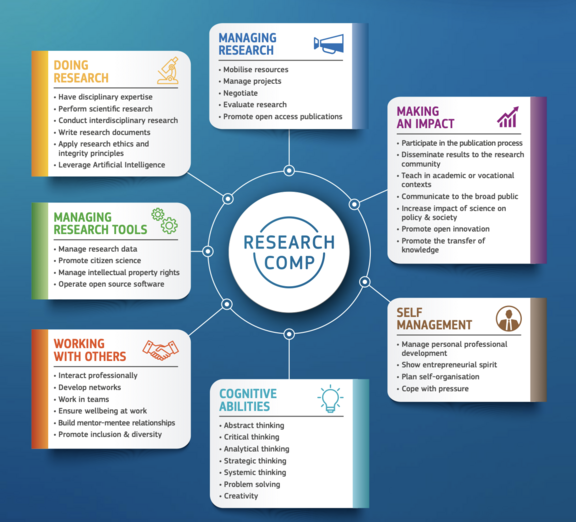
In the course of their daily work in research and teaching, researchers acquire numerous skills that are relevant not only within the academic world but also in the non-academic job market. To make these skills more visible, the European Commission has developed an overview titled “ResearchComp: The European Competence Framework for Researchers,” which presents the broad range of these skills in a structured manner.
The skill set required of researchers is diverse. While subject-specific qualifications and career development primarily take place through one’s own teaching and research activities and with the support of supervisors at the institutions, additional career-relevant skills (e.g., leadership skills, project management) are often acquired rather unconsciously through indirect means (“learning by doing”). (Early-career) researchers are often unaware of the interdisciplinary relevance of these competencies. However, these competencies are particularly important for careers in non-academic fields as well.
Our colleagues in the Department of Research and Academic Development will be happy to advise you and connect you with suitable opportunities.

