Academic Studies & Teaching
Our teaching portfolio covers all levels of study as well as numerous degree programs in sports science and teacher education.
Our goal is to integrate research and teaching in a way that enables students to develop sociologically grounded reflective knowledge and practical skills for sustainable sports development.
In addition, we aim to raise students’ awareness of—and motivate them toward—the potential for applying and commercializing the knowledge gained through their studies.




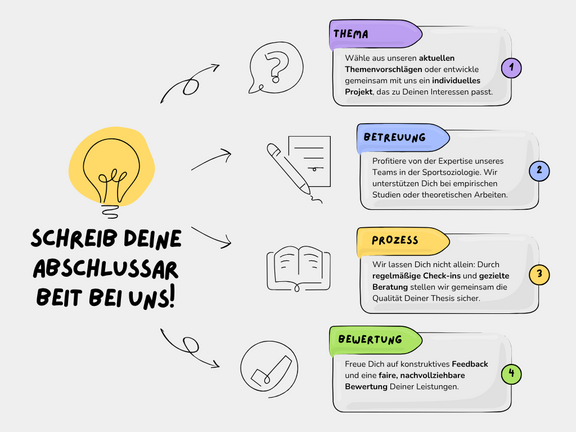
Thesis Supervision
Our teaching activities also include supervising bachelor’s and master’s theses.
Our goal is to ensure professional supervision and high-quality theses. In the supervision process, we follow a supervision guide and provide students with comprehensive information about their thesis, including an online portal.
If you are interested in researching a topic in the sociology of sport, please take a look at our research profile on FIS. We have compiled the research areas of our individual faculty members as well as possible specific topics here.
If you are interested, please contact the department office or the faculty members directly, depending on the topic.
At the faculty level, Prof. Astrid Schubring supervises doctoral candidates in the field of sociology of sport.
If you are interested in pursuing a Ph.D. in this field, please contact the department’s office with a brief proposal.
Our Courses

Bachelor's Degree
- Foundation Program: Content in the sociology of sport is taught in lectures and seminars covering the fundamentals of behavioral and social sciences (Module BAS2).
- Key Qualifications: Research methods are taught in lectures and seminars on methodological competence (Module SQ3).
- B.A. in Sports Management and Sports Communication: Methods of social research are applied in the academic project seminar (SMK 13).
- B.A. in Sports and Physical Activity Instruction in Recreational and Mass Sports: Methods of social research are applied in the academic project seminar (SBV2).
- B.A. in Sports and Health in Prevention and Therapy: In the seminar on public health and the social foundations of health-related sports (SGP1), basic social science concepts are taught and students practice observational approaches—such as those related to social inequality.
- Additional Specializations: In the modules “Gender and Diversity in Sports” (PE 1.17) and “Health-Promoting Physical Activity for Older Adults” (PE 2.2), students practice applying social science perspectives.
Teacher Education
- Reflecting on and Evaluating School Sports: Lecture and Seminars on Scientific Thinking and Research in School Sports (Module B1)
- Understanding, Experiencing, and Influencing Social Phenomena in Context: Lecture on Socialization and Social Learning (Module B5)

Master's Degree
In our master’s programs in sports science, we incorporate sociological and social science perspectives into our teaching:
- M.A. in International Sport Development and Politics
- M.A. Rehabilitation, Prevention, and Health Management
- M.Sc. in Sports Management, M.Sc. in Human Technology in Sports and Medicine
- M.Sc. in Sports and Exercise Gerontology
Doctoral Program
We offer the following courses as part of the doctoral program:
- Elective Module: Independent Research – Seminar on Applied Qualitative Research Methods
- Subject-Specific Research Colloquium of the Institute for Sociology and Gender Studies (Ph.D. students interested in participating should contact the office)