Beißkraft von Libellen
Aus der Natur in die Industrie
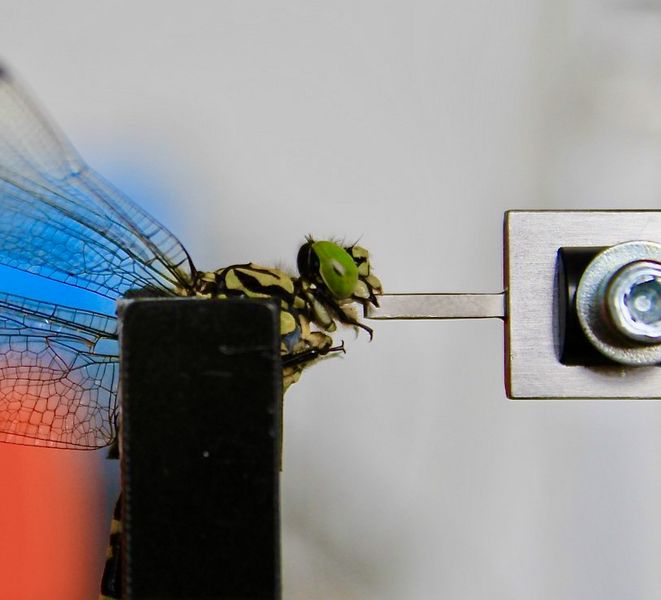
Im Rahmen eines Kooperationsprojekts mit der Universität Bonn, Bereich Zoologie, haben wir die Beißkräfte von Libellen erfasst und mechanische Modelle ihrer Beißwerkzeuge entwickelt. Die experimentell gewonnenen Daten dienten dabei als Input für die Modellierung, um Rückschlüsse auf die Lastverteilung innerhalb der Beißwerkzeuge zu ziehen. Die Ergebnisse liefern nicht nur neue Erkenntnisse zur funktionellen Biomechanik der Libelle, sondern auch wertvolle Impulse für die Entwicklung industrieller Greifwerkzeuge. Insbesondere zeigen sie, wie sich mit ultraleichten Strukturen hohe Greifkräfte realisieren lassen.
Forschungszeitraum
Januar 2015 - Dezember 2016
Projektteam

Wolfgang Potthast

Ausgewählte Publikationen
-
Musculoskeletal modelling of the dragonfly mandible system as an aid to understanding the role of single muscles in an evolutionary context
Insects show a great variety of mouthpart and muscle configurations; however, knowledge of their mouthpart kinematics and muscle activation patterns is fragmentary. Understanding the role of muscle groups during movement and comparing them between insect groups could yield insights into evolutionary patterns and functional constraints. Here, we developed a mathematical inverse dynamic model including distinct muscles for an insect head–mandible–muscle complex based on micro-computed tomography (µCT) data and bite force measurements. With the advent of µCT, it is now possible to obtain precise spatial information about muscle attachment areas and head capsule construction in insects. Our model shows a distinct activation pattern for certain fibre groups potentially related to a geometry-dependent optimization. Muscle activation patterns suggest that intramandibular muscles play a minor role in bite force generation, which is a potential reason for their loss in several lineages of higher insects. Our model is in agreement with previous studies investigating fast and slow muscle fibres and is able to resolve the spatio-temporal activation patterns of these different muscle types in insects. The model used here has a high potential for large-scale comparative analyses on the role of different muscle setups and head capsule designs in the megadiverse insects in order to aid our understanding of insect head capsule and mouthpart evolution under mechanical constraints.
-
Musculoskeletal modelling under an evolutionary perspective: deciphering the role of single muscle regions in closely related insects
Insects show a remarkable diversity of muscle configurations, yet the factors leading to this functional diversity are poorly understood. Here, we use musculoskeletal modelling to understand the spatio-temporal activity of an insect muscle in several dragonfly species and to reveal potential mechanical factors leading to a particular muscle configuration. Bite characteristics potentially show systematic signal, but absolute bite force is not correlated with size. Muscle configuration and inverse dynamics show that the wider relative area of muscle attachment and the higher activity of subapical muscle groups are responsible for this high bite force. This wider attachment area is, however, not an evolutionary trend within dragonflies. Our inverse dynamic data, furthermore, show that maximum bite forces most probably do not reflect maximal muscle force production capability in all studied species. The thin head capsule and the attachment areas of muscles most probably limit the maximum force output of the mandibular muscles.