Weitsprung mit Unterschenkelprothese
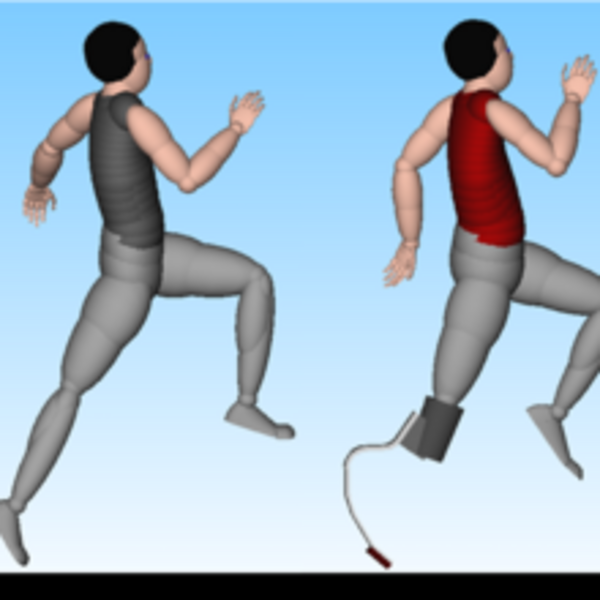
Weitsprung mit Unterschenkelprothese
Leistungs- und Belastungscharakteristika im leichtathletischen Weitsprung mit Unterschenkelprothese
Promotionsprojekt von: Dr. Johannes Funken
Weitspringer mit Unterschenkelamputation, die ihre Prothese für den Absprungschritt nutzen, sind in der Lage außerordentliche Weiten zu erzielen. Die zu Grunde liegende Biomechanik ist allerdings nicht umfassend bekannt. Wissen hierüber ist jedoch wichtig, um Trainingsprotokolle anzupassen, Verletzungsmechanismen zu erkennen und Sportprothesen weiterzuentwickeln. Weiterhin können die gewonnenen Erkenntnisse als wichtige Informationsquelle für zukünftige Anpassungen in olympischen und paralympischen Regularien genutzt werden.
Im Rahmen eines multinationalen Forschungsprojektes, aus dem die vorliegende Dissertation hervorgeht, wurden drei Weitspringer mit Unterschenkelamputation und sieben nicht amputierte Athleten unter Laborbedingungen bewegungsanalytisch untersucht. Während des Absprungs beim Weitsprung und während des maximalen Sprints wurde die Kinematik und Kinetik der Athleten erfasst und zusammen mit der probanden-spezifischen Anthropometrie als Eingangsdaten für ein invers dynamisches Mehrkörpermodel zur detaillierten dreidimensionalen Analyse genutzt.
Athleten mit Unterschenkelprothese zeigten andere Merkmale bzgl. Körperschwerpunkt- und Gelenkmechanik während des Sprints und dem Absprung als nicht amputierte Athleten. Athleten mit Unterschenkelprothese liefen langsamer an, aber sprangen effizienter ab als nicht amputierte Athleten. Während des Absprungschrittes platzieren die amputierten Athleten ihre Prothese anders in Relation zum Körperschwerpunkt als nicht amputierte Athleten ihren Fuß und die Bewegungscharakteristik des Körperschwerpunks wies deutliche Unterschiede zwischen den beiden Gruppen auf. Im Allgemeinen war die muskulo-skelettale Belastung an der Hüfte und am Knie geringer während des Absprungs bei Athleten mit Unterschenkelprothese als bei nicht amputierten Athleten. Dies resultierte vornehmlich aus geringeren Abständen zwischen den Gelenkszentren und dem Vektor der Bodenreaktionskraft bei Athleten mit Unterschenkelprothese im Vergleich zu nicht amputierten Athleten. Das Absprungverhalten von Athleten mit Unterschenkelprothese glich dem Sprung von einem Sprungbrett, während die nicht amputierten Athleten den bekannten Hebelmechanismus (Pivot) nutzten, um vertikale Abfluggeschwindigkeit zu generieren.
Resultierend aus begrenzten muskulo-skelettalen Kapazitäten oder mechanischen Beschränkungen weisen Weitspringer mit bzw. ohne Unterschenkelprothese, speziell im Absprungschritt, Bewegungscharakteristika auf, die einerseits auf unterschiedlichen Lokomotionsmechanismen basieren und andererseits von der jeweils anderen Gruppe nicht adaptiert werden können.
Forschungszeitraum
Januar 2016 - September 2019
Projektteam


Wolfgang Potthast
Ausgewählte Publikationen
-
Three-Dimensional Takeoff Step Kinetics of Long Jumpers with and without a Transtibial Amputation
Purpose The loads applied on the musculoskeletal system during the long jump takeoff step are not well established for nonamputee athletes or athletes with a lower extremity amputation. Information on joint loading and potential injury mechanisms is important for improving training or rehabilitation protocols, prosthetic design, and the general understanding of the long jump. Methods Three-dimensional takeoff step kinematics and kinetics were used for inverse dynamic model calculations on three male athletes with and seven male athletes without a below the knee amputation (BKA). Athletes with BKA used their affected leg as their takeoff leg. Results Despite equivalent long jump performance, ground reaction force application characteristics were widely different, and calculated joint loads were significantly lower in athletes with BKA compared with nonamputee athletes during the takeoff step. The takeoff step of the long jump for athletes with BKA seems to be dominated by sagittal plane movements, whereas it involves sagittal plane movement and compensatory joint work in the frontal plane for nonamputee athletes. Conclusions Coaches and athletes should adapt training protocols to the unique musculoskeletal loading patterns of long jumpers with or without a BKA. Specifically, nonamputee athletes should strengthen the muscles responsible for hip and knee extension, as well as for frontal plane stabilization, early in the season to avoid injuries. The presented data enable clinicians to identify potential causes of pain or injury more differentially in both groups of athletes and might stimulate future research in the field of robotics and prosthetic components. Furthermore, the altered joint mechanics of athletes with BKA versus nonamputees serves as an explanation for their previously described more effective takeoff step.
-
Long jumpers with and without a transtibial amputation have different three-dimensional centre of mass and joint take-off step kinematics
Long jumpers with below the knee amputation (BKA) have achieved remarkable performances, yet the underlying biomechanics resulting in these jump distances are unknown. We measured three-dimensional motion and used multi-segment modelling to quantify and compare the centre of mass (COM) and joint kinematics of three long jumpers with BKA and seven non-amputee long jumpers during the take-off step of the long jump. Despite having the same jump distances, athletes with BKA, who used their affected leg for the take-off step, had lower sagittal plane hip and knee joint range of motion and positioned their affected leg more laterally relative to the COM compared to non-amputee athletes. Athletes with BKA had a longer compression phase and greater downward movement of their COM, suggesting that their affected leg (lever) was less rigid compared to the biological leg of non-amputees. Thus, athletes with BKA used a different kinematic mechanism to redirect horizontal to vertical velocity compared to non-amputee athletes. The specific movement patterns of athletes with BKA during the take-off step were constrained by the mechanical properties of the prosthesis. These results provide a basis for coaches and athletes to develop training protocols that improve performance and inform the design of future prostheses.