Filtern nach
4221 Ergebnisse
-
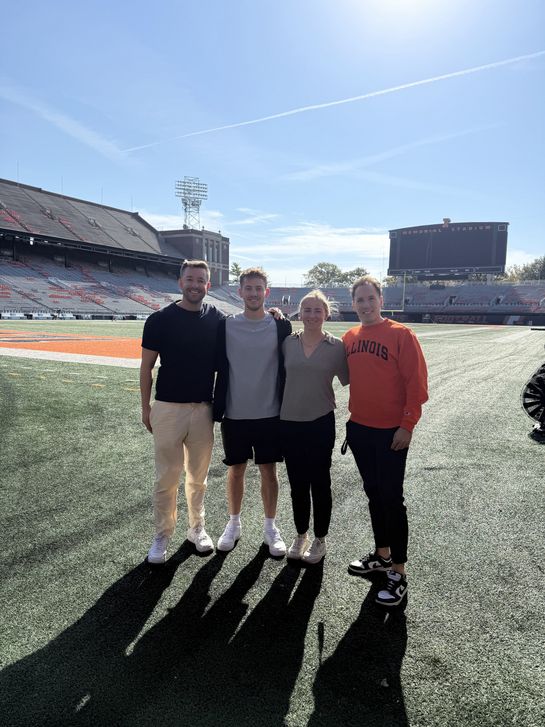 05.11.2024Marloes Ekkelboom, doctoral student at the Institute of Sport History, took part in the renowned annual conference of the North American Society for the Sociology of Sport from October 30 to November 2. Under the motto *"Communities, Axiologies, Politics, and Praxis ”, the event brought together over 300 experts and researchers, mainly from North America, to discuss current topics such as inclusion, power structures in sport and their connections with gender, race, disability and sexual orientation. The area of activism in sport also took center stage. In her presentation entitled *“Female Activism at the Olympic Games: A Comparative Analysis of Tokyo 2020 & Paris 2024”, Marloes Ekkelboom examined the framework conditions and motivational factors that shape female athletes in the context of social justice activism at the Olympic Games. Her analysis provided an insight into the developments and challenges faced by female athletes during these global sporting events. In addition, she visited the University of Illinois to exchange ideas with her mentor Dr. Yannick Kluch, who works there in the field of 'Diversity, Equity and Inclusion' in sport.
 -
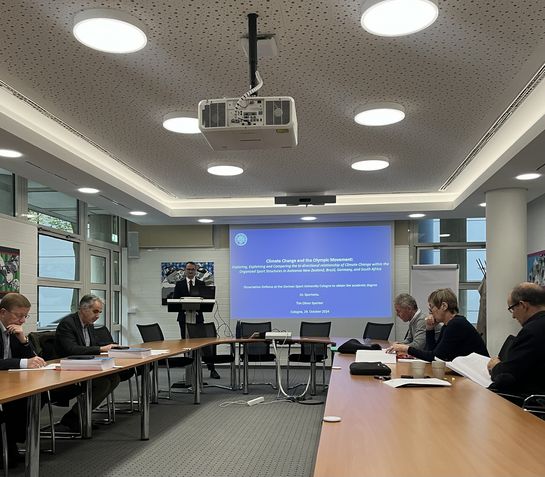 04.11.2024We are happy to share that Tim Sperber has successfully completed his PhD at the German Sport University. His dissertation, titled „Climate Change and the Olympic Movement: Exploring, Explaining and Comparing the Bi-Directional Relationship of Climate Change within the Organized Sport Structures in Aotearoa New Zealand, Brazil, Germany, and South Africa“ analyzes impacts on sports infrastructure, sustainability practices, and local community engagement. The Olympic Studies Centre at the German Sport University congratulates Tim on his accomplishment.
 -
Weitere Informationen: www.dshs-koeln.de/master Bewerbung • Bewerbung nur zum Wintersemester möglich • Online-Bewerbung • elektronischer Zulassungsantrag wird um weitere Unterlagen (PDF-Upload) ergänzt • Bewerbungsfrist*: • Nicht-EU: 31. Mai • D & EU: 15. Juli * Änderungen vorbehalten. Weitere Informationen unter: www.dshs-koeln.de/master-ltc » Bewerbung Contacts Deutsche Sporthochschule Köln German Sport University Cologne Am Sportpark Müngersdorf 6 50933 Cologne - Germany Studienberatung studienberatung@dshs-koeln.de www.dshs-koeln.de/studienberatung Studiengangsleitung Univ.-Prof. Dr. P. Wahl Studiengangskoordination Dr. Y. Wahl Die Deutsche Sporthochschule Köln vereint qualifizierte Lehre, internationale Forschung und Spitzensport auf höchstem Niveau. Sie ist Deutschlands einzige Universität, die sich ausschließlich dem Themenfeld Sport und Bewegung widmet. An 19 wissenschaftlichen Instituten und neun interdisziplinären Zentren wird geforscht und gelehrt – von erziehungs-, geistes- und sozialwissenschaftlichen Fächern bis hin zu medizinisch-naturwissenschaftlichen Disziplinen. 02 /2 02 5 | Ä nd er un ge n vo rb eh al te n | G ra fik en : f re ep ik .c om | De si gn : T an ja G ör re s | T it el bi ld m it K in de rn : p ex el s. co m Kosten Den aktuellen Semesterbeitrag findet ihr hier: www.dshs-koeln.de/semesterbeitrag Master-Studiengänge an der Deutschen Sporthochschule Köln Die Deutsche Sporthochschule Köln bietet acht konsekutive Master-Studiengänge an, die der wissen- schaftlichen Vertiefung oder Ergänzung dienen. Die Studiengänge schließen jeweils mit dem international anerkannten Grad Master of Arts (M.A.) oder Master of Science (M.Sc.) ab. Sie weisen eine Regelstudienzeit von vier Semestern auf und haben einen Umfang von 120 Credit Points. Alle Master-Studiengänge sind als Vollzeit-Präsenzstu- dium akkreditiert und zulassungsbeschränkt. Zurzeit stehen 30 Studienplätze pro Master-Studiengang zur Verfügung. Die Zulassung erfolgt jährlich, jeweils zum Wintersemester. www.dshs-koeln.de/master M.A. Sport, Medien- und Kommunikationsforschung M.A. International Sport Development and Politics M.Sc. Human Technology in Sports and Medicine M.Sc. Sporttourismus und Destinationsmanagement M.Sc. Sport Management M.Sc. Leistung, Training und Coaching im Spitzensport M.Sc. Psychology in Sport and Exercise M.Sc. Sport- und Bewegungstherapie, Prävention und bewegungsbezogene Gesundheitsforschung Master-Studiengang M.Sc. Leistung, Training und Coaching im Spitzensport http://www.dshs-koeln.de/master-ltc http://www.dshs-koeln.de/master mailto:studienberatung@dshs-koeln.de http://www.dshs-koeln.de/studienberatung http://www.dshs-koeln.de/master http://www.dshs-koeln.de/semesterbeitrag Leistungs- und Spitzensport nehmen gesell- schaftlich sowohl national als auch interna- tional einen immer höheren Stellenwert ein. Dies begründet eine wissenschaftliche Aus- einandersetzung mit Themen der körperli- chen Belastung sowie der Diagnostik und Steuerung von Anpassungsprozessen. www.dshs-koeln.de/master-ltc Master-Studiengang M.SC. LEISTUNG, TRAINING UND COACHING IM SPITZENSPORT Zielgruppe Der Master-Studiengang M.Sc. Leistung, Training und Coaching im Spitzensport richtet sich an Personen, die eine ausge- prägte Affinität zum Leistungssport und zur Wissenschaft aufweisen. Besonderes Interesse an (natur-)wissenschaftlichen Fragestellungen und sowohl Spaß an wissenschaftlicher Arbeit im Labor als auch an praktischer Trainingsarbeit sollte vorhanden sein. www.dshs-koeln.de/master-ltc » Ziele und Zielgruppe Qualifikationsziele Die Absolvent*innen erlangen umfassende sportwissenschaftliche wie interdisziplinä- re Kompetenzen in den Bereichen Leistung, Training und Coaching mit Fokus auf den Spitzensport. Sie verstehen biologische Systeme und ihre Anpas- sungsprozesse und setzen diese in den Kontext des sportlichen Trainings. Sie erheben und analysieren mit Hilfe geeigneter diagnostischer Verfahren trai- ningsrelevante Daten und treffen interdisziplinär aus- gerichtete Entscheidungen und Prognosen für den Trainingsprozess. Sie übertragen ihre Kenntnisse und Schlüsselkompetenzen auf „reale“ praxisnahe oder akademische Problemstellungen. Studienaufbau & -inhalte Das zentrale Ziel des Master-Studiengangs M.Sc. Leistung, Training und Coaching im Spitzensport ist die Vertiefung und Erwei- terung von Kompetenzen in Konzeption, Realisation und Evaluation von wissenschaftlichen und praxisori- entierten Angeboten und Konzepten zum Aufbau und Erhalt der psycho-physischen Leistungsfähigkeit und Gesundheit des Menschen. Berufsperspektive Nach erfolgreichem Abschluss des Master- Studiengang M.Sc. Leistung, Training und Coaching im Spitzensport steht den Studie- renden als Expert*innen im Kompetenzbereich mensch- licher Leistungsfähigkeit eine Vielzahl von Berufsfel- dern offen: Verantwortungsvolle Positionen in Vereinen und Verbänden im (inter-)nationalen Leistungs- und Spitzensport; in der Forschung und Lehre an Univer- sitäten und Forschungseinrichtungen; in der Wissen- schaftskoordination in Bundes- und Landesverbänden; als selbstständige Trainer*innen/ Athletik-Trainer*in- nen oder Leistungsdiagnostiker*innen. www.dshs-koeln.de/master-ltc » Berufsfelder Der Studiengang M.Sc. Leistung Training und Coa- ching im Spitzensport kombiniert vertieftes Wissen in Disziplinen der Sportwissenschaften, Biologie, Medizin, Ernährungswissenschaften und Lebenswis- senschaften. Ein interdisziplinärer Zugang aus trai- ningswissenschaftlicher, leistungsphysiologischer, biomechanischer, psychologischer, pädagogischer, ernährungswissenschaftlicher Sicht wird in Studi- um und Lehre umgesetzt und verfolgt. Dabei spielt neben der theoretischen Vermittlung auch die praktische Anwendung von Methoden zur Diagnostik und Steuerung eine zentrale Rolle. Es werden Fähigkeiten und Fachwissen in transla- tionalen forschungs- und praxisnahen Projekten angewendet sowie die projekt- und forschungsorien- tierte Zusammenarbeit fokussiert. Der Studiengang verfolgt dabei einen modernen, evidenzbasierten und forschungs-, als auch praxisorientierten Lehransatz. Studierende erlangen Fähigkeiten und das Know-how zur individuellen beruflichen Profilbildung. Der Studi- engang verfolgt eine stringente und stete Verbindung von wissenschaftlichen und anwendungsbezogenen Kompetenzen. www.dshs-koeln.de/master-ltc » Studienaufbau und -inhalte Grundsätzlich gilt für diesen Master-Studiengang: • Erfolgreiche Absolvierung eines mindestens sechssemestrigen einschlägig wissenschaft- lichen Studiums (180 Credit Points; wovon 90 Credit Points naturwissenschaftlich oder sportwissenschaftlich ausgerichtet sind) an einer deutschen Hochschule oder gleich- wertiger berufsqualifizierender Abschluss an einer ausländischen Hochschule • Nachweis der fachlichen Eignung durch einen überdurchschnittlichen Studien- abschluss (mindestens Note 2,5 nach dem deutschen Notensystem oder Grade B nach ECTS) • Nachweis der erforderlichen Sprach- kenntnisse in Deutsch für Bewerber*innen aus nicht deutschsprachigen Ländern • Die Sporteignungsprüfung stellt keine Zugangsvoraussetzung dar. www.dshs-koeln.de/master-ltc » Zugangsvoraussetzungen Zugangsvoraussetzungen http://www.dshs-koeln.de/master-ltc http://www.dshs-koeln.de/master-ltc http://www.dshs-koeln.de/master-ltc http://www.dshs-koeln.de/master-ltc http://www.dshs-koeln.de/master-ltc -
Further information: www.dshs-koeln.de/ master Application • only for the winter semester • online application • electronic application for admission is complemented with additional documents (PDF upload) • application deadlines*: • for non-EU citizens: 31st May • for GER & EU citizens: 15th July * Subject to change. For further information please see: www.dshs-koeln.de/master-pse » Application Contacts Deutsche Sporthochschule Köln German Sport University Cologne Am Sportpark Müngersdorf 6 50933 Cologne - Germany Student Advisory Service studienberatung@dshs-koeln.de www.dshs-koeln.de/studienberatung Application masterbewerbung@dshs-koeln.de Programme Director Univ.-Prof. Dr. Dr. M. Raab Programme Coordinator Miguel Reuss master-pse@dshs-koeln.de German Sport University Cologne The German Sport University Cologne combines qualified teaching and international research of the highest level. It is the only university in Germany that is dedicated exclusively to the world of sport and exercise science. All aspects of this exciting field are studied in detail at 19 institutes, four affiliate institutes and nine academic centers. 03 /2 02 5 | Ä nd er un ge n vo rb eh al te n | G ra fik en : f re ep ik .c om | De si gn : T an ja G ör re s The Master‘s Programmes at the German Sport University Cologne The German Sport University Cologne offers eight con- secutive Master‘s programmes, which complement and deepen scientific knowledge. On completion, the stu- dents are awarded either the internationally recogni- zed title of Master of Arts (M.A.) or Master of Science (M.Sc.). Each programme has a regular duration of four semesters in which 120 credit points must be obtained. The programmes are accredited as full-time, on-site degrees and have a limited number of participants. At present 30 places are available per degree course. The intake is once per year in the winter semester. www.dshs-koeln.de/master Costs You can find the current semester fee at www.dshs-koeln.de/semesterbeitrag M.A. Sport, Medien- und Kommunikationsforschung M.A. International Sport Development and Politics M.Sc. Human Technology in Sports and Medicine M.Sc. Sporttourismus und Destinationsmanagement M.Sc. Sport Management M.Sc. Leistung, Training und Coaching im Spitzensport M.Sc. Psychology in Sport and Exercise M.Sc. Sport- und Bewegungstherapie, Prävention und bewegungsbezogene Gesundheitsforschung Master‘s Degree Programme M.Sc. Psychology in Sport and Exercise http://www.dshs-koeln.de/master-pse http://www.dshs-koeln.de/ mailto:studienberatung@dshs-koeln.de http://www.dshs-koeln.de/studienberatung mailto:masterbewerbung@dshs-koeln.de mailto:master-pse@dshs-koeln.de http://www.dshs-koeln.de/master http://www.dshs-koeln.de/semesterbeitrag The M.Sc. Psychology in Sport and Exercise comprises aspects of psychology, sport and health from an multidisciplinary per- spective perspective. The course will provide the academic knowledge and foundational research skills necessary to pursue careers in research or further develop necessary skills for the applied field. www.dshs-koeln.de/master-pse Master‘s Degree Programme M.SC. PSYCHOLOGY IN SPORT AND EXERCISE Target Group • Are you interested in combining sport and psychology? • Are you interested in scientific thinking and working? • Are you interested in practical application of research? The M.Sc. Psychology in Sport and Exercise targets graduates with a degree in sport science or psycholo- gy. Students should be interested in scientific thinking and working (e.g. conducting experiments) and theory- and research-based practical application. Students are educated towards an integrated degree of sport and exercise psychology. You can use the MasterCheck to see whether the degree matches your expectations: www.dshs-koeln.de/master-pse » Objectives and target group Qualification Targets Remember: Graduates will recall and describe key psychological and sport-related theories, models, and research findings, particularly those that integrate both disciplines. Understand: Graduates will explain and inter- pret psychological and physiological processes in sport and exercise, critically analysing how they interact to influence behaviour, performance, and well-being. Apply: Graduates will implement research methodolo- gies, statistical analyses, and diagnostic tools to assess psychological factors in sport and exercise settings, translating theory into practice. Analyse: Graduates will compare and differentiate bet- ween theoretical perspectives and empirical evidence, identifying patterns, relationships, and inconsistencies in psychological research. Evaluate: Graduates will critically assess psychological interventions, research designs, and data interpreta- Career Perspectives Graduates of the master programme will be eligible for further study or employment (e.g. as a PhD student or lecturer) in research institu- tions orientated towards the fields of motion-, neuro-, health or cognitive science. Graduates looking to pur- sue a career in the applied setting may consider further education to pursue a career as a sport psychological expert, providing performance and personal develop- ment support to professional and recreational athletes or clients outside of the sport setting. Aside from self-employment, potential employers in- clude many associations, clubs and support centres for competitive sports, reflecting the growing demand for sport psychology consultants. Furthermore, potential tions, using scientific reasoning to justify conclusions and optimise practical applications. Create: Graduates will design and conduct independent research, developing innovative approaches to studying psychological aspects of sport and exercise while con- tributing to the advancement of the field. Admission Requirements The following requirements apply to the M.Sc. Psychology in Sport and Exercise: • completion of an undergraduate degree in Psychology, Sports Science or another re- lated field of study (180 credit points) at a German university or a similar qualification from a foreign university • proof of eligibility by means of an above average final grade (at least 2.5 in the German grading system or Grade B according to ECTS) • certified English language proficiency (see homepage for TOEFL and IELTS scores or CAE-level) • passing the physical aptitude test is not an admission requirement. www.dshs-koeln.de/master-pse » Ad- mission requirements Study Programme To gain a comprehensive understanding of the psychology in sports and exercise, students must complete 11 essential mo- dules, with most courses necessitating mandatory at- tendance. The programme begins with the first module (PSE 1), a vital review course designed to ensure that every student has a solid foundation in these import- ant fields. As students advance through the subsequent modules, they will refine their general research skills (PSE2, PSE3) and explore the theoretical and practical aspects of a range of engaging topics (PSE4 – PSE9). The final two modules (PSE10, PSE11) allow students the opportunity to undertake individual research pro- jects centered around their personal interests, foste- ring innovation and depth in their academic pursuits. www.dshs-koeln.de/studydocuments_en employers search specifically for sport psychologists with a research background, as ensuring effective dia- gnostics and interventions (including quality manage- ment and evaluation) is an essential field. As such, the Psychology in Sport and Exercise master will lay the foundation for independent planning, implementation and evaluation of sport psychology-oriented diagno- stics and interventions. The M.Sc. Psychology in Sport and Exercise degree allows for consecutive postgradua- te studies earning a doctor‘s degree: www.dshs-koeln.de/english/studying-structure/ full-time-studies/phd-programme http://www.dshs-koeln.de/master-pse http://www.dshs-koeln.de/master-pse http://www.dshs-koeln.de/master-pse http://www.dshs-koeln.de/studydocuments_en http://www.dshs-koeln.de/english/studying-structure/ -
Further information: www.dshs-koeln.de/ master Application • only for the winter semester • online application • electronic application for admission is complemented with additional documents (PDF upload) • application deadlines*: • for non-EU citizens: 31st May • for GER & EU citizens: 15th July * Subject to change. For further information please see: www.dshs-koeln.de/master-tsm » Application Contacts Deutsche Sporthochschule Köln German Sport University Cologne Am Sportpark Müngersdorf 6 50933 Cologne - Germany Student Advisory Service studienberatung@dshs-koeln.de www.dshs-koeln.de/studienberatung Application masterbewerbung@dshs-koeln.de Programme Director Univ.-Prof. Dr. Wolfgang Potthast Programme Coordinator Dr. Johannes Funken German Sport University Cologne The German Sport University Cologne combines qualified teaching and international research of the highest level. It is the only university in Germany that is dedicated exclusively to the world of sport and exercise science. All aspects of this exciting field are studied in detail at 19 institutes, four affiliate institutes and nine academic centers. 04 /2 02 6 | Ä nd er un ge n vo rb eh al te n | G ra fik en : f re ep ik .c om | De si gn : T an ja G ör re s | T it el bi ld m it K in de rn : p ex el s. co m The Master‘s Programmes at the German Sport University Cologne The German Sport University Cologne offers eight con- secutive Master‘s programmes, which complement and deepen scientific knowledge. On completion, the stu- dents are awarded either the internationally recogni- zed title of Master of Arts (M.A.) or Master of Science (M.Sc.). Each programme has a regular duration of four semesters in which 120 credit points must be obtained. The programmes are accredited as full-time, on-site degrees and have a limited number of participants. At present 30 places are available per degree course. The intake is once per year in the winter semester. www.dshs-koeln.de/master M.A. Sport, Medien- und Kommunikationsforschung M.A. International Sport Development and Politics M.Sc. Human Technology in Sports and Medicine M.Sc. Sporttourismus und Destinationsmanagement M.Sc. Sport Management M.Sc. Leistung, Training und Coaching im Spitzensport M.Sc. Psychology in Sport and Exercise M.Sc. Sport- und Bewegungstherapie, Prävention und bewegungsbezogene Gesundheitsforschung Costs You can find the current semester fee at www.dshs-koeln.de/semesterbeitrag Master‘s Degree Programme M.Sc. Human Technology in Sports and Medicine http://www.dshs-koeln.de/master-tsm http://www.dshs-koeln.de/ mailto:studienberatung@dshs-koeln.de http://www.dshs-koeln.de/studienberatung mailto:masterbewerbung@dshs-koeln.de http://www.dshs-koeln.de/master http://www.dshs-koeln.de/semesterbeitrag Use of modern technologies has become a matter of course in Sports and Medicine no- wadays. The programme Human Technology in Sports and Medicine combines in-depth knowledge in disciplines like: sports and medical technologies, life sciences, sport sciences and engineering. www.dshs-koeln.de/master-tsm Master‘s Degree Programme M.SC. HUMAN TECHNOLOGY IN SPORTS AND MEDICINE Target Group The study programme M.Sc. Human Tech- nology in Sports and Medicine addresses students with a passion for science and a wide interest in the interaction bet- ween humans and technology. The Master’s course in Human Technology in Sports and Medicine fills the niche between engineering sciences and sports and medical science. The aim of this course is to build a bridge bet- ween sports equipment, machines and clothing as well as technological orthopaedic aids. The degree programme is aimed at people who have a strong affinity with the subjects of science and enginee- ring and also possess a basic understanding of human movement and the human body. Furthermore, they should also be curious and creative, enjoy developing ideas and creating and reviewing new concepts. www. dshs-koeln.de/master-tsm » Objectives and target group Qualification Targets The central aim of this programme is to pro- vide you with the essential skills required to develop, assess and improve sport equipment as well as medical technologies. You will gain skills in problem-solving and innovative thinking along with extensive knowledge in developing sports and medicine products and special skills in developing methods and tools for the improve- ment of training and performance assessment. Global Opportunities Throughout the programme you’ll have opportunities to work on projects with international and leading sports and medicine companies and organisations. Admission Requirements The following requirements apply to the M.Sc. Human Technology in Sports and Medicine: • completion of an undergraduate degree in a related field of study (180 credit points) at a German university or a similar qualifi- cation from a foreign university • proof of eligibility by means of an above average final grade (at least 2.5 in the German grading system or Grade B according to ECTS) • certified English language proficiency (see homepage for TOEFL and IELTS scores or CAE-level) • passing the physical aptitude test is not an admission requirement. www.dshs-koeln.de/master-tsm » Admission requirements Study Programme This Master consists of 120 credit points. All courses are held in English. The mo- dule-based degree takes four semesters. Each module is a closed unit with defined aims and con- tents. This programme includes intensive laboratory work from classroom-integrated projects to practical work. Details of the degree structure and content in the study plan and module handbook can be found under: www.dshs-koeln.de/studydocuments_en Career Perspectives Considering the size of rapidly growing global sports and medicine market, gradua- tes will be able to work as leading sports and medical technology specialists in multi- and trans-disciplinary teams in the global industry, research organisations and universities. The M.Sc. Human Technology in Sports and Medicine degree allows for consecutive postgraduate studies earning a doctor‘s degree. http://www.dshs-koeln.de/master-tsm http://www.dshs-koeln.de/master-tsm http://www.dshs-koeln.de/master-tsm http://www.dshs-koeln.de/studydocuments_en -
Weitere Informationen: www.dshs-koeln.de/master Bewerbung • Bewerbung nur zum Wintersemester möglich • Online-Bewerbung • elektronischer Zulassungsantrag wird um weitere Unterlagen (PDF-Upload) ergänzt • Bewerbungsfrist*: • Nicht-EU: 31. Mai • D & EU: 15. Juli * Änderungen vorbehalten. Weitere Informationen unter: www.dshs-koeln.de/master-tdm » Bewerbung Contacts Deutsche Sporthochschule Köln German Sport University Cologne Am Sportpark Müngersdorf 6 50933 Cologne - Germany Studienberatung studienberatung@dshs-koeln.de www.dshs-koeln.de/studienberatung Studiengangsleitung Univ.-Prof. Dr. R. Roth Studiengangskoordination Dr. Stefan Mühl Die Deutsche Sporthochschule Köln vereint qualifizierte Lehre, internationale Forschung und Spitzensport auf höchstem Niveau. Sie ist Deutschlands einzige Universität, die sich ausschließlich dem Themenfeld Sport und Bewegung widmet. An 19 wissenschaftlichen Instituten und neun interdisziplinären Zentren wird geforscht und gelehrt – von erziehungs-, geistes- und sozialwissenschaftlichen Fächern bis hin zu medizinisch-naturwissenschaftlichen Disziplinen. 02 /2 02 5 | Ä nd er un ge n vo rb eh al te n | G ra fik en : f re ep ik .c om | De si gn : T an ja G ör re s Master-Studiengänge an der Deutschen Sporthochschule Köln Die Deutsche Sporthochschule Köln bietet acht konsekutive Master-Studiengänge an, die der wissen- schaftlichen Vertiefung oder Ergänzung dienen. Die Studiengänge schließen jeweils mit dem international anerkannten Grad Master of Arts (M.A.) oder Master of Science (M.Sc.) ab. Sie weisen eine Regelstudienzeit von vier Semestern auf und haben einen Umfang von 120 Credit Points. Alle Master-Studiengänge sind als Vollzeit-Präsenzstu- dium akkreditiert und zulassungsbeschränkt. Zurzeit stehen 30 Studienplätze pro Master-Studiengang zur Verfügung. Die Zulassung erfolgt jährlich, jeweils zum Wintersemester. www.dshs-koeln.de/master M.A. Sport, Medien- und Kommunikationsforschung M.A. International Sport Development and Politics M.Sc. Human Technology in Sports and Medicine M.Sc. Sporttourismus und Destinationsmanagement M.Sc. Sport Management M.Sc. Leistung, Training und Coaching im Spitzensport M.Sc. Psychology in Sport and Exercise M.Sc. Sport- und Bewegungstherapie, Prävention und bewegungsbezogene Gesundheitsforschung Kosten Den aktuellen Semesterbeitrag findet ihr hier: www.dshs-koeln.de/semesterbeitrag Master-Studiengang M.Sc. Sporttourismus und Destinationsmanagement http://www.dshs-koeln.de/master-tdm http://www.dshs-koeln.de/master mailto:studienberatung@dshs-koeln.de http://www.dshs-koeln.de/studienberatung http://www.dshs-koeln.de/master http://www.dshs-koeln.de/semesterbeitrag Tourismus zählt weltweit zu den wichtigs- ten Wirtschaftsfaktoren. Hierbei spielen Sporttourismus und Destinationsma- nagement eine entscheidende Schlüssel- position als Standortfaktor, Job-Motor und Imageträger in einem. Wechselnde Urlaubs- und Freizeitpräferenzen, zu- nehmende Ansprüche der Gäste und ein verändertes Sportverhalten erfordern in- novative Angebots- und Produktentwick- lungen sowie einen Fokus auf nachhaltige Sportraumplanung und Ressourcenma- nagement in Destinationen. www.dshs-koeln.de/master-tdm Master-Studiengang M.SC. SPORTTOURISMUS UND DESTINATIONSMANAGEMENT Zielgruppe Der Master-Studiengang M. Sc. Sport- tourismus und Destinationsmanage- ment richtet sich an Personen, die sich für Berufsfelder in der internationalen Tourismus- und Freizeitwirtschaft interessieren. Darüber hinaus sollten die Studieninteressierten kon- zeptionelles Arbeiten in der sporttouristischen Ange- botsentwicklung, die praktische Umsetzung nachhal- tiger Konzepte sowie interdisziplinäres Arbeiten als spannende Herausforderungen sehen. www.dshs-koeln.de/master-tdm » Ziele und Zielgruppe Qualifikationsziele Der Master-Studiengang befähigt seine Ab- solvent*innen zur Entwicklung zukunftsfä- higer sporttouristischer Angebote und Pro- dukte. Forschungsbasierte Fertigkeiten zu Erholungsplanung, Destinationsmanage- ment und touristischen Unternehmensführung zäh- len ebenso wie die Festigung von Fach-, Metho- den- und Sozialkompetenzen zu den wesentlichen Qualifikationszielen des Studiengangs. Dazu gehören Kenntnisse über Methoden der Raum- und Landschafts- analyse, über Planungsinstrumente, Ressourcenma- nagement und juristische Fragen im Bereich des Sport- tourismus. Studienaufbau & -inhalte Das viersemestrige Studium ist in vierzehn interdisziplinäre Module gegliedert. In den ersten drei Semestern wird aufbauend auf theoretischen Grundlagen das berufs- feldspezifische Fachwissen aus Sporttourismus und Destinationsmanagement gelehrt. Die Studierenden erhalten fachlichen Input zu Touris- musökonomie, Gesundheit und Gesellschaft, Wissen- schaftsmethoden und Forschungsdesign, Destinations- Berufsperspektive Aufgrund der zunehmenden Professiona- lisierung in den Bereichen Sport, Touris- mus und Erholung bietet der Arbeitsmarkt ein großes Wachstumspotenzial. Die Absolvent*innen des M. Sc. Sporttourismus und Destinationsmanage- ment verfügen durch die einzigartige Kombination aus Wissenschaft und Sportpraxis über eine ausgeprägte Handlungskompetenz für strategische und operative Aufgabenstellungen. Zu den potenziellen Arbeitgebern zählen Tourismus- verbände/-organisationen, sporttouristische und gesundheitsorientierte Dienstleistungs-/Beratungs- unternehmen, Reiseveranstalter sowie Behörden und Ministerien. Darüber hinaus ermöglicht der Studienabschluss eine Forschungs- und Lehrtätigkeit an Hochschulen und berechtigt grundsätzlich zur Aufnahme eines Promo- tionsstudiums. www.dshs-koeln.de/master-tdm » Berufsfelder entwicklung sowie nachhaltiger Sportraumplanung und Ressourcenmanagement. Übungen, Exkursionen und Projektarbeiten ermöglichen einen vertiefenden Einblick in die Praxis. Das vierte Semester dient dem Anfertigen der Master-Thesis. Ein zweimonatiges Prakti- kum ist während des Studiums durchzuführen. Details zum Studienaufbau und den -inhalten können dem Studienplan und Modulhandbuch entnommen werden: www.dshs-koeln.de/master-tdm » Studienaufbau und -inhalte Grundsätzlich gilt für diesen Master-Studiengang: • Erfolgreiche Absolvierung eines mindestens sechssemestrigen einschlägig wissenschaft- lichen Studiums (180 Credit Points) an einer deutschen Hochschule oder gleichwertiger berufsqualifizierender Abschluss an einer ausländischen Hochschule • Nachweis der fachlichen Eignung durch einen überdurchschnittlichen Studienab- schluss (mindestens Note 2,5 nach dem deutschen Notensystem oder Grade B nach ECTS) • Nachweis der erforderlichen Sprach- kenntnisse in Deutsch für Bewerber*in- nen aus nicht deutschsprachigen Ländern • Die Sporteignungsprüfung stellt keine Zugangsvoraussetzung dar. www.dshs-koeln.de/master-tdm » Zugangsvoraussetzungen Zugangsvoraussetzungen http://www.dshs-koeln.de/master-tdm http://www.dshs-koeln.de/master-tdm http://www.dshs-koeln.de/master-tdm http://www.dshs-koeln.de/master-tdm http://www.dshs-koeln.de/master-tdm -
Am Sportpark Müngersdorf 6 50933 Köln AMTLICHE MITTEILUNGEN Nr.: 05/2026 Köln, den 27.04.2026 INHALT Festsetzung der Gleichstellungsquote für die Jahre 2026-2028 gem. § 37a des Hochschulgesetzes Nordrhein-Westfalen für die Deutsche Sporthochschule Köln -------------------------------------------------------------------------------------------------------- Herausgeber: Der Rektor Amtliche Mitteilungen der Deutschen Sporthochschule Köln Nr. 05/2026 Seite - 1 - Festsetzung der Gleichstellungsquote für die Jahre 2026-2028 gem. § 37a des Hochschulgesetzes Nordrhein-Westfalen für die Deutsche Sporthochschule Köln - 1 - Festsetzung der Gleichstellungsquote für die Jahre 2026-2028 gem. § 37a des Hochschulgesetzes Nordrhein-Westfalen für die Deutsche Sporthochschule Köln Hintergrund Die Gleichstellungsquote wurde 2014 mit der damaligen Neufassung des Hochschulgesetzes als Rechtsinstrument zur Verbesserung der Geschlechtergerechtigkeit in Berufungsverfahren eingeführt (§37a). Es handelt sich um das Prinzip der fächergruppenbezogenen Zielquote nach dem Kaskadenmodell der DFG (2008). Nach diesem Modell ergeben sich die Ziele für den Frauenanteil einer jeden wissenschaftlichen Karrierestufe durch den Anteil der Frauen auf der direkt darunter liegenden Qualifizierungsstufe. Die Gleichstellungsquote HG NRW §37a bildet das Verhältnis zwischen den Frauen und Männern ab, die in der jeweiligen Fächergruppe innerhalb einer Ausgangsgesamtheit die Einstellungsvoraussetzungen für Professorinnen und Professoren erfüllen. Die Gleichstellungsquote bestimmt das anteilige Verhältnis zwischen Frauen und Männern, das bei den im Geltungszeitraum stattfindenden Berufungsverfahren zu erreichen ist. Die letztmalige Festlegung hat 2019 für die Jahre 2019-2021 stattgefunden. Die Gleichstellungsquote wurde auf 42,5% festgesetzt (vgl. hierzu die Amtliche Mitteilung Nr. 02/2019). In dem Zeitraum 2019 – 2021 betrug das anteilige Verhältnis von Frauen im Rahmen der Neubesetzungen von Professuren 100%. Die Vorgaben zur Gleichstellungsquote 2019 – 2021 in Höhe von 42,5% wurden somit erfolgreich erfüllt. In dem Zeitraum 2022 – 2024 betrug das anteilige Verhältnis von Frauen im Rahmen der Neubesetzungen von Professuren 50%. Die Vorgaben zur Gleichstellungsquote 2019 – 2021 wurden somit auch hier erfolgreich erfüllt. Festlegung der Gleichstellungsquote für die Jahre 2026-2028 Die Berechnung der Gleichstellungsquote erfolgt über das Statistikportal Geschlechterbezogene Hochschuldaten NRW. Als Ausgangsgesamtheit für die Berechnung der Quote wird die Summer der Habilitierten im Fach Sport in den Jahren 2021 – 2023 sowie der Junior-Professor*innen im Fach Sport in den Jahren 2018 – 2023 festgelegt. Auf dieser Basis wird eine Gleichstellungsquote von 38,9% errechnet. Das Rektorat legt vor dem Hintergrund dieser Berechnung die Gleichstellungquote für die Jahre 2026 – 2028 für Neuberufungen auf 50% fest und geht damit über die Mindestquote hinaus. Inkrafttreten, Rügeausschluss Diese Richtlinie tritt am Tage nach ihrer Veröffentlichung in den Amtlichen Mitteilungen der Deutschen Sporthochschule Köln in Kraft. Die Verletzung von Verfahrens- oder Formvorschriften des HG NRW oder des Ordnungs- oder des sonstigen autonomen Rechts der Hochschule kann gegen diese Ordnung nur innerhalb eines Jahres seit ihrer Bekanntmachung geltend gemacht werden, es sei denn a. die Ordnung ist nicht ordnungsgemäß bekannt gemacht worden, b. das Rektorat hat den Beschluss des die Ordnung beschließenden Gremiums vorher beanstandet c. der Form- oder Verfahrensmangel ist gegenüber der Hochschule vorher gerügt und dabei die verletzte Rechtsvorschrift und die Tatsache bezeichnet worden, die den Mangel ergibt, oder d. bei der öffentlichen Bekanntmachung der Ordnung ist auf die Rechtsfolge des Rügeausschlusses nicht hingewiesen worden. Die aufsichtsrechtlichen Befugnisse nach § 76 HG bleiben unberührt. Amtliche Mitteilungen der Deutschen Sporthochschule Köln Nr. 05/2026 Seite - 2 - Festsetzung der Gleichstellungsquote für die Jahre 2026-2028 gem. § 37a des Hochschulgesetzes Nordrhein-Westfalen für die Deutsche Sporthochschule Köln - 2 - Ausgefertigt aufgrund des Beschlusses des Rektorats vom 16.03.2026. Köln, den 27.04.2026 Der Rektor der Deutschen Sporthochschule Köln Univ.-Prof. Dr. Ansgar Thiel INHALT Herausgeber: Der Rektor -
Mathias Marius Schmidt
Frank Lingen
Akademie der Deutschen Sporthochschule Köln
-
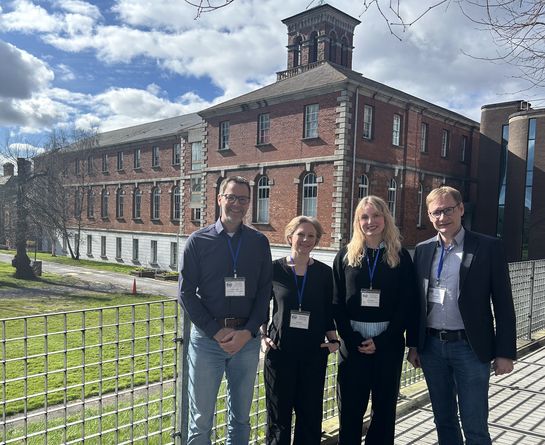 16.03.2026Mit mehreren Vorträgen waren Forschende des Instituts für Kommunikations- und Medienforschung im März beim „Summit on Communication & Sport“ der International Association for Communication and Sport (IACS) vertreten. Die Tagung fand in diesem Jahr gemeinsam mit der „Sport and Discrimination Conference“ an der Dublin City University (DCU) statt. In ihrem Beitrag „When Theory Meets Experience: Athletes‘ Definitions of Online Hate“ zeigten Chiara Gethmann, Yasemen Lappas und Jun.-Prof. Dr. Daniel Nölleke das Verständnis von Online Hate Speech aus der Perspektive von Athlet:innen auf. Dr. Mark Ludwig stellte die Ergebnisse der Studie „The Effects of Playing Sports Video Games on the Reception of Sports Media and Sport-Specific Consumption Capital" vor, die er gemeinsam mit Joshua Knipp entwickelt hat. Die Studie basiert auf einer Umfrage unter NBA 2K-Spielern. Dr. Inga Oelrichs erörterte in ihrer Präsentation “Analysis of Professional Roles in Team Media“ das berufliche Selbstverständnis von Kommunikatoren im Bereich der PR. Bei der im Vorfeld des IACS-Summit angesetzten neunten Auflage der "Sport and Discrimination Conference" legten Yasemen Lappas, Chiara Gethmann und Jun.-Prof. Dr. Daniel Nölleke in ihrem Beitrag "Counterspeech Against Athlete Abuse: When Do Fans Push Back Against Online Hate in Sports?" dar, welche Formen von Hasskommentaren gegen weibliche und männliche Athleten Gegenrede bei Social-Media-Nutzenden auslösen. Die IACS ist eine international ausgerichtete Forschungsgesellschaft, deren Ziel es ist, wissenschaftliches Arbeiten im Feld „Sport und Kommunikation” zu fördern. Beim „Summit on Communication & Sport“, der einmal jährlich an wechselnden Orten veranstaltet wird, kommen Fachleute zusammen, die sich multidisziplinär sowie anhand unterschiedlicher theoretischer und methodischer Ansätze mit Aspekten der Sportkommunikation befassen. Mit rund 180 Teilnehmenden war die Konferenz im Jahr 2026 besonders stark besucht. Mehr zum Programm