Testosterone Rule (T/E Ratio) - History

Testosterone Rule (T/E Ratio)
IOC rule valid through the end of 2004: A testosterone-to-epitestosterone ratio (T/E ratio) greater than 6 to 1 in an athlete’s urine was considered a violation of anti-doping rules, unless there was evidence that this ratio could be attributed to physiological or pathological causes.
Effective January 1, 2005, the World Anti-Doping Agency (WADA) lowered the T/E ratio to 4. Samples from athletes with a T/E ratio higher than 4 must be analyzed using isotope ratio mass spectrometry (IRMS) or, if the isotope analysis is negative, verified through further testing.
A prerequisite for the T/E rule is the stability of an athlete’s T/E ratio. Therefore, when T/E ratios are elevated, individual reference values are established to determine whether an athlete has doped with testosterone.
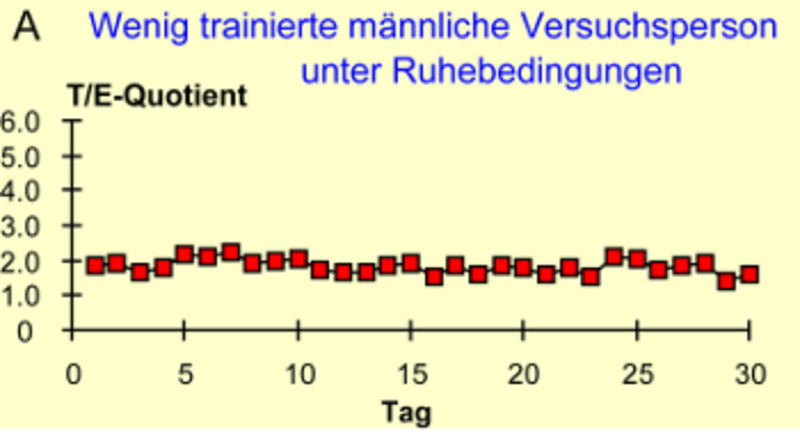
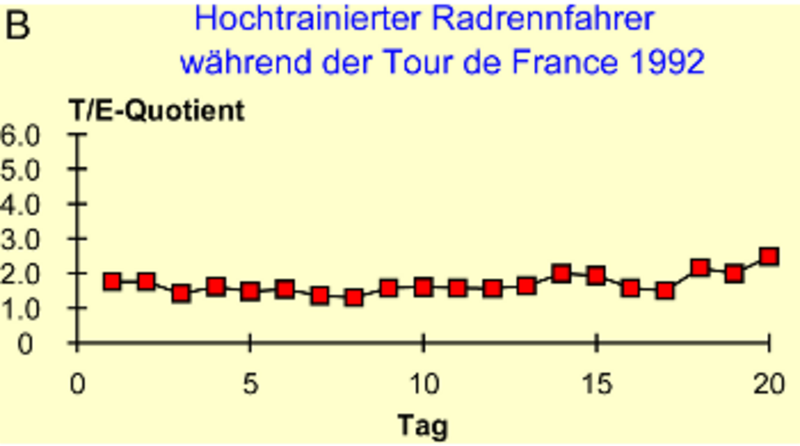
The figure on the right shows the minimal variation in the T/E ratio in a male subject with low fitness levels under resting conditions (Fig. 1A) over a 30-day period, as well as in a professional cyclist during the 1992 Tour de France over 20 days of competition (Fig. 1B).
Until now, athletes with a T/E ratio greater than four have been considered atypical and subjected to further testing to rule out doping. However, an athlete’s individual steroid profile is increasingly viewed as a more sensitive indicator for detecting doping than the use of population-based profile data. This approach is also intended to identify athletes with low T/E ratios caused by a deficiency of the UGT2B17 enzyme (“Asian” genotype).
The introduction of follow-up testing, along with the determination of individual steroid profile data independent of an elevated T/E ratio > 4, is currently the method of choice for effectively monitoring testosterone doping. Suspected samples are then further analyzed using isotope ratio mass spectrometry (IRMS) of carbon.
See also: Athlete Biological Passport - Steroidal Module