Growth Hormone (GH)

(Somatotropin or HGH = human growth hormone; GH = growth hormone)
The misuse of growth hormone in sports has been repeatedly reported and speculated upon over the past three decades. Athletes hope to improve their performance by using growth hormone, relying on the hormone’s anabolic effects.
Growth hormone is a peptide hormone composed of a total of 191 amino acids. It is produced in large quantities in the pituitary gland and then released into the bloodstream. Via the bloodstream, HGH reaches the various cells of the body, where it can exert its effects. The fact that it is produced in large quantities in the pituitary gland led to HGH being isolated from the pituitary glands of deceased individuals for therapeutic use in the past.
In recent years, attention has also been drawn to the risk that HGH products from the former Soviet Union are circulating on the black market. Concerns have been raised about a potential risk of infection due to contamination of these products.
Today, industrial production is carried out using genetic engineering methods, employing bacterial cells such as Escherichia coli. Genetic engineering ensures not only the safety of the products (no bacterial contamination) but also the cost-effective production of the hormone in large quantities.
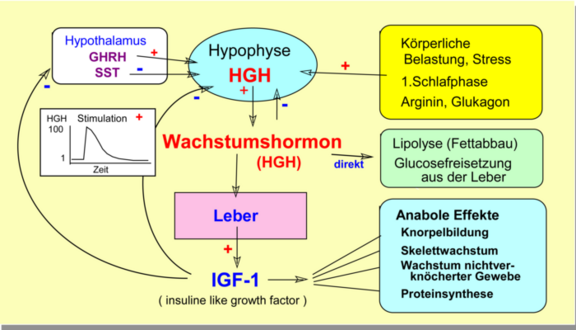
HGH acts directly or via so-called somatomedins (IGF-1 and IGF-2; IGF = insulin-like growth factor), which are produced in the liver. In adipose tissue, it stimulates the breakdown of fats (lipolysis), while in carbohydrate metabolism it leads to an increased release of glucose from glycogen (hyperglycemia). However, its fat-burning effect on adipose tissue makes this compound particularly interesting for sports such as bodybuilding. In contrast, all anabolic effects—such as the stimulation of protein synthesis to enhance muscle growth and the stimulation of skeletal growth—are largely mediated indirectly via IGF-1.
Currently, only two major clinical conditions are considered for the therapeutic use of HGH: short stature in children and HGH deficiency in adults.
Review
article: Sönksen PH: Insulin, growth hormone, and sport. J Endocrinol 2001 Jul;170(1):13–25