YK11 - (Selective Androgen Receptor Modulator, SARM)

Improved Detection of YK11 (Doping Analysis)
Identification and Characterization of Doping-Relevant Metabolites of the New Selective Androgen Receptor Modulator YK11
So-called selective androgen receptor modulators (SARMs) have been increasingly developed in recent years as potential replacements for anabolic steroids in therapeutic applications. The major advantage of SARMs is their specifically anabolic (muscle-building) effect, in contrast to steroids, which always exhibit an androgenic (masculinizing) effect in addition to their anabolic effect. Accordingly, new active substances belonging to the SARM class are constantly being sought and discovered.
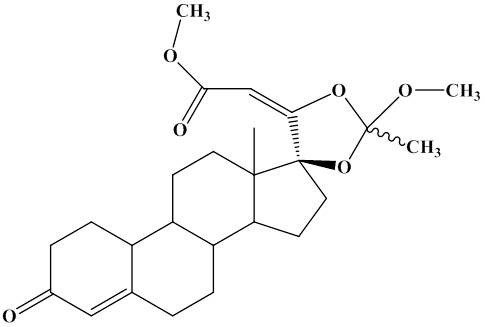
The SARM YK11 was first described in the literature in 2011. As shown in Figure 1, YK11 has a steroidal backbone to which an additional ring element has been attached at the D-ring (i.e., in the upper right corner). This SARM is not currently in a clinical trial phase, and accordingly, there is no information available regarding the metabolism of this molecule. Nevertheless, it has been detected in black-market products and has also been confiscated by German customs upon attempted importation. It can therefore be assumed that YK11 has a high potential for abuse due to its proven anabolic effect and that it is evidently available on the German market. Since SARMs can be of great interest to athletes who use performance-enhancing drugs, the question arose as to how this new substance can be detected in an athlete’s urine.
Fig. 1: Chemical structure of YK11
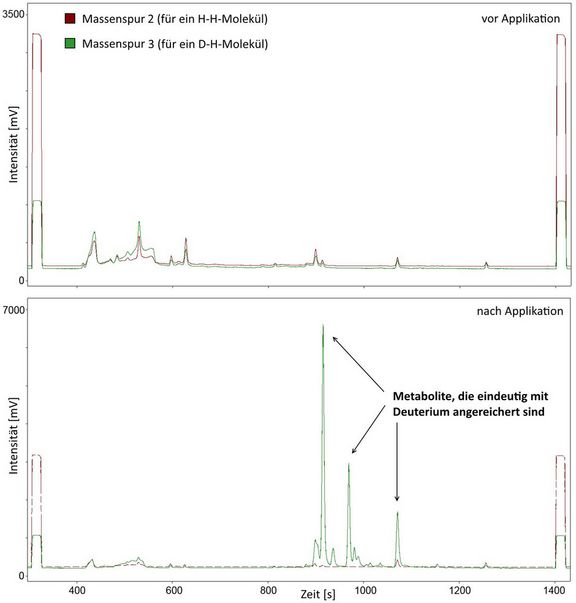
After initial investigations into the metabolism of YK11 using liver microsomes proved unsuccessful, the only remaining option for clarifying its metabolism was an excretion study. To this end, 6-fold deuterated YK11 was synthesized—that is, a form of YK11 in which a deuterium atom replaces a hydrogen atom at six different positions. This modification of the molecule makes it easier to identify YK11 metabolites present in urine. This is achieved in particular through the use of hydrogen isotope mass spectrometry. This method is typically used to determine the naturally occurring stable isotope ratios of deuterium (D) to hydrogen (H), which are approximately 1 to 6,500 (D/H). As soon as the proportion of deuterium increases significantly—for example, through artificial deuteration of the molecule—all molecules with this deuterium enrichment can then be reliably detected in the urine and identified as metabolites of the administered YK11. A sample chromatogram is shown in Figure 2.
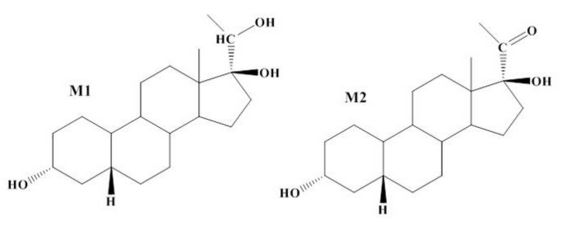
Once the retention times of the individual metabolites are known, high-resolution mass spectrometry can be used to determine the elemental compositions of these compounds and, based on the mass spectrum, draw initial conclusions about the structure of these metabolites. However, these are only indications and do not yet allow for unambiguous identification and characterization of the metabolites. This requires the chemical synthesis of these molecules, combined with NMR analysis (nuclear magnetic resonance spectroscopy), to unambiguously determine the stereochemistry—that is, the spatial arrangement of the individual atoms in the molecule. Since the synthesis of a new compound, in particular, can be very time-consuming, the first step was to use an elimination test to identify the metabolites that would allow for the best possible detection of YK11 in urine. The choice fell on two metabolites that, on the one hand, remained detectable for a relatively long time after administration and, on the other hand, could be easily integrated into the existing screening method for anabolic steroids. Both metabolites are shown in Figure 3 and are currently used to detect potential YK11 abuse by athletes.
(Thomas Piper, November 28, 2018)
Fig. 3: Chemical structure of the two identified and characterized urinary metabolites of YK11
References
Piper T, Dib J, Putz M, Fusshöller G, Pop V, Lagojda A, Kuehne D, Geyer H, Schänzer W, Thevis M. Studies on the in vivo metabolism of the SARM YK11: Identification and characterization of metabolites potentially useful for doping controls. Drug Test Anal. Nov 2018;10(11-12):1646-1656. doi: 10.1002/dta.2527. Epub Nov 18, 2018.
Abstract of the publication