Digital Innovations in School Sports: ComeSport Reports on a Successful Project
03/02/2026 | News
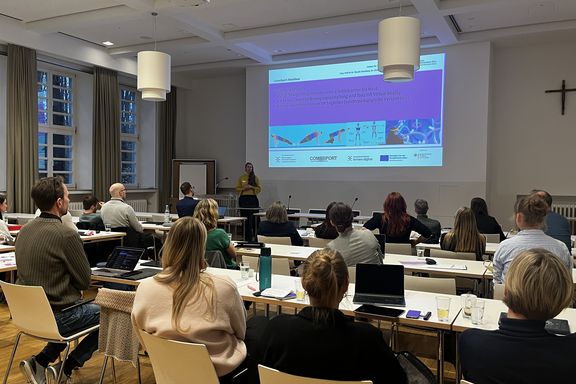
After three years of intensive collaboration, the nationwide ComeSport competence network officially came to a close with a two-day closing event in Bergisch Gladbach. Representatives from the participating universities, industry partners, and stakeholders from the second and third phases of teacher education gathered in Cologne on 5 and 6 February 2026, to present findings, discuss opportunities for knowledge transfer, and shape future collaboration structures.
The event focused on the question of how digital innovations can be permanently and reliably integrated into school physical education. “In ComeSport, we didn’t just develop products; above all, we built sustainable network structures,” emphasises project director Dr. Julia Mierau. “Our goal was to systematically advance digital teaching and learning processes in physical education and to establish them sustainably in all phases of physical education teacher training.”
Together with Prof. Dr. Jens Kleinert, she was responsible for the project’s academic coordination at the German Sport University. In close cooperation with eleven universities from four federal states, practical and scientifically sound continuing education concepts were developed, tested, and evaluated in five so-called Community Networks (ComeNets).
Focus on Quality, Transfer, and Networking
Over the course of the project, the outcomes included structured continuing education modules, digital materials, and quality-assured conceptual standards for the use of digital media in physical education. The focus was not only on technical tools but also on issues of media pedagogy, socially critical perspectives such as diversity and body image, and the conditions necessary for sustainable transfer.
A particular emphasis was placed on the acceptance and implementation of the developed programs. “Digital innovations only have an impact if teachers find them helpful and actually use them in the classroom,” said Dr. Julia Mierau. Accordingly, feedback from the field was systematically collected and integrated into the project’s further development.
Perspectives and Outlook
During the closing event, the ComeNets presented their findings. In workshops and discussion sessions, participants reflected on key insights gained during the project and discussed prospects for further institutionalising collaboration between universities, teacher-training programmes, and professional development institutions.
ComeSport built structurally on experiences from previous initiatives on digitisation in teacher education while also providing new impetus for school sports. The project was funded with approximately three million euros by the Federal Ministry of Education, Family Affairs, Senior Citizens, Women, and Youth (BMBFSFJ) through early 2026.
Although the funding phase ends with the official conclusion of the project, the substantive work does not. The participating partners agreed to make the professional development modules and materials developed during the project permanently accessible. All components will be published on open platforms and will be permanently available free of charge to teachers and stakeholders in teacher education and professional development.
“Digitalisation in school sports is not a short-term trend, but a long-term development process that must also be critically examined in light of the central roles of school sports,” summarises Prof. Dr. Kleinert. “The work of ComeSport must now continue — especially with the participation of students.”
Funding Note: “Funded by the European Union — NextGenerationEU — and supported by the Federal Ministry of Education, Family, Senior Citizens, Women, and Youth (BMBFSFJ) (Grant Number: 01JA23K02G). The views and opinions expressed are solely those of the authors and do not necessarily reflect the views of the European Union, the European Commission, or the Federal Ministry of Education, Family, Senior Citizens, Women, and Youth. Neither the European Union, the European Commission, nor the Federal Ministry of Education, Family, Senior Citizens, Women, and Youth can be held responsible for this."