The complexities of qualitative research in sports science
09/08/2025 | News
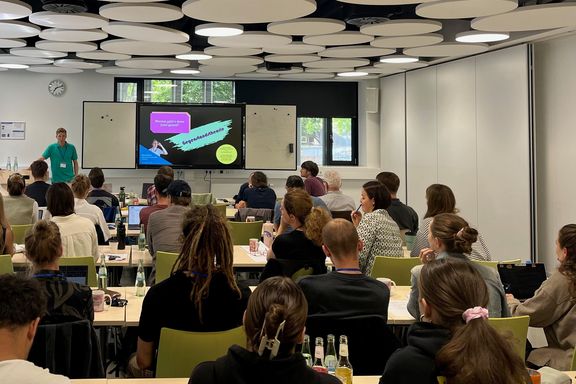
In qualitative research, it is a matter of common sense not only to accept the multifaceted premises of the research process, but also to revisit these premises time and again at various stages. The 8th Annual Conference of the ‘Qualitative Forschung in der Sportwissenschaft’ network aimed to give structure to this shared understanding and to discuss it experimentally across five panels. The conference was organised by the Institute of Pedagogy and Philosophy at the German Sport University Cologne.
In an opening presentation, Thomas Alkemeyer (University of Oldenburg) highlighted the extent to which both the research subject and research practice are guided by specific habits of perception, thought and action, some of which are beyond scrutiny and thus risk closing off avenues of knowledge. For good qualitative research, it is therefore essential to reflect on these dimensions of habitus. Within a specific ‘qualitative’ habitus, it then seems relevant to consider the question of how it is even possible to arrive at scientific findings. In his keynote address, Jörg Strübing (University of Tübingen) had argued that this endeavour should be approached neither too sceptically nor too realistically, but rather by drawing on the insights of a pragmatist theory of knowledge.
A third panel session then focused on discussing the necessity of a socio-theoretical dimension to qualitative research. Larissa Schindler (University of Bayreuth) pointed out that researchers have always made a far-reaching decision when, for example, they choose to examine either ‘discourses’ or ‘practices’, as these, amongst other things, take account of the differing positions of actors. In a fourth panel, a discussion took place with Jonas Barth (University of Bremen) on whether greater attention should be paid to the entanglement of qualitative research with social theory. This is necessary, above all, because research is universally framed at a socio-theoretical level, yet within the research itself it always constructs historically concrete objects.
To conclude the conference, Daniel Rode (University of Salzburg) finally highlighted the extent to which decisions must repeatedly be made during the research process regarding how the subject matter must be approached within a theoretically delimited framework, so that empirical experiences can also be reconstructed as subject-specific experiences.