The Soccer Field as Cultural Heritage

Street Soccer Culture Designated as UNESCO Intangible Cultural Heritage
"Bolzplatz Culture" Is Intangible Cultural Heritage – A Tribute to Sports and Leisure Culture in Germany
Following a process lasting several years, “street soccer culture” was added to the National Register of Intangible Cultural Heritage in April 2026. This recognition and acknowledgment of street soccer culture was initiated by a joint application from the German Football Museum in Dortmund and the IESF.
The inclusion of “street soccer culture” in the National Register of Intangible Cultural Heritage marks an important step in the recognition of informal sports and leisure practices in Germany. For the first time, an everyday form of playing soccer is being honored not only as a sporting activity but as a distinct form of cultural expression. This decision is based on the 2003 UNESCO Convention for the Safeguarding of the Intangible Cultural Heritage, which is implemented nationally in Germany through a multi-stage process. The goal is to highlight living traditions and socially embedded practices and to document their significance for cultural life. The culture of the Bolzplatz is closely linked to the development of modern sports and leisure culture. Bolzplätze have been widespread in Germany since the early 20th century and have become an integral part of everyday culture, particularly in urban areas. They represent a specific form of athletic activity that differs significantly from organized club sports. While the latter is characterized by fixed rules, institutional structures, and a focus on performance, play on the pickup soccer field is based on self-organization, spontaneity, and rules adapted to the situation.
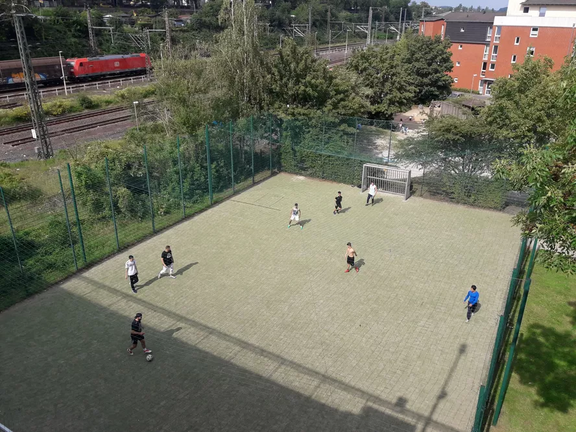
It is precisely this difference that makes the pickup soccer field a characteristic element of leisure culture. The game is freely accessible, requires no membership, and is independent of formal structures. This creates a space where athletic activity merges with social and cultural processes. Children and adolescents meet at “their” field, organize games on their own, and establish the rules as needed. Typical elements such as flexible team sizes, the absence of a referee, or informal rule agreements (“the next goal decides”) are expressions of this independent culture of play.
In the context of leisure culture, the pickup soccer field also serves as a central social hub. It is not only a playing field but also a meeting place, a space for communication, and a venue for learning. Here, social skills such as teamwork, conflict resolution, and fairness are tested and practiced. At the same time, the pickup soccer field facilitates encounters between people from different social, cultural, and ethnic backgrounds. This openness contributes to the fact that the pickup soccer field is often described as an inclusive space, even though tensions and mechanisms of exclusion can certainly arise in practice.
Historically, the development of street soccer culture is closely linked to changes in sports and leisure activities during the 20th century. With increasing urbanization and the densification of living spaces, a need arose for specifically designated areas for play and physical activity. Particularly since the 1960s and 1970s, pickup soccer fields have been systematically integrated into urban planning and have evolved into central hubs of youth culture. This phase also reflected a shift in the understanding of leisure: away from purely utilitarian activities toward self-determined, community-organized forms.
In recent decades, however, new challenges have emerged. The decline in freely available open spaces, changing leisure habits, and competition from digital offerings have, in some cases, reduced the use of pickup soccer fields. At the same time, conflicts over use—such as noise complaints or municipal regulations—lead to restrictions on accessibility. Nevertheless, the soccer field remains a significant component of informal sports culture, one that is increasingly being reevaluated in the context of social work and urban development.
These developments were also the subject of scholarly examination as part of the grant application process. Through studies, empirical surveys, and qualitative interviews, the IESF contributed to a systematic description of pickup soccer field culture. This included, among other things, exploratory field visits, online surveys, and discussions with stakeholders from initiatives and projects. Involving the organizing groups posed a particular challenge due to the informal structure of the pickup soccer culture. Since this is not a clearly organized community, alternative participation formats had to be developed. To this end, a Germany-wide video conference involving pickup soccer players was organized.
Inclusion in the directory represents not so much a final evaluation as a formal recognition of an existing cultural practice. It does not entail financial support but rather aims to raise awareness and increase visibility. At the same time, it opens up the possibility of more closely networking existing initiatives for the preservation and further development of pickup soccer culture and fostering public discussion about them. Against this backdrop, inclusion in the National Register of Intangible Cultural Heritage has primarily symbolic significance. It draws attention to forms of sports that exist beyond competition and institutionalization and are closely connected to everyday life.
The IESF will continue to conduct academic research on the topic of “Bolzplatz” culture in the future. In addition to in-depth empirical studies, the focus will be on a publication based on the study conducted in the context of the application, which analyzes “Bolzplatz” culture comprehensively for the first time from the perspectives of sports, social, and cultural studies. In addition, the IESF will continue to support and expand the networking processes already initiated between initiatives, local government actors, and civil society groups in order to promote dialogue on the preservation and further development of pickup soccer culture. Finally, an international symposium is also planned to examine comparable forms of informal sports and leisure culture in other countries and to place “Bolzplatz” culture in a broader context.
Project Description
The term “Bolzplatz” is not only widely recognized, but also prevalent in urban areas. Nevertheless, there is as yet neither a universally accepted definition of the Bolzplatz nor a comprehensive understanding of its social significance. Academic research has also devoted only limited attention to the Bolzplatz thus far. The IESF is currently conducting a study that pursues a twofold objective: On the one hand, it provides an overview of the term “Bolzplatz” in a concrete, physical sense. The study attempts to define the Bolzplatz more concretely as a physical space for play and sports, to examine its prevalence and design, and, last but not least, to identify differences and similarities in the development of Bolzplätze from both synchronic and diachronic perspectives. A largely novel approach here is to examine the Bolzplatz as a specific aspect of children’s and youth policy in urban public spaces. On the other hand, this study sheds light on the Bolzplatz in terms of its significance and social function, thereby examining its intangible dimension in greater detail. Particular attention is paid to the youth-cultural dimension of the soccer field and its development in the context of social change. On March 6, 2020, the initial study results were presented at a workshop at the Dortmund Soccer Museum. You can find the program here.
In June 2021, data collection for an initial pilot survey, as well as four interviews with pickup soccer field initiatives from across Germany, was completed. The initial analysis of the online survey already revealed a highly diverse picture of the fields and how they are used, thus largely confirming the findings of the literature review. A detailed evaluation is still pending, as is an analysis of the interview results. The results of the survey project, along with further findings from the literature review, were discussed with the project partners on July 2, 2021, during another workshop at the German Soccer Museum in Dortmund. The study was finalized in November 2021.

