How do people walk on the moon?
09/17/2026 | News

The “Unloaded Minds” experiment investigates what prolonged muscle unloading would mean for movement under lunar gravity.
In the near future, the next human will set foot on the Moon. Studies show that fine motor skills, balance, and gait are impaired by reduced gravity, which could pose a problem for the functional mobility of astronauts during lunar exploration. This is particularly true if they have previously spent an extended period in microgravity with their skeleton and muscles completely unloaded.
The “Unloaded Minds” experiment, conducted by the Institute for Movement and Neurosciences at the German Sport University Cologne, investigates the entire spectrum of movement under these conditions. It is not yet known whether prolonged relief of muscle load due to weightlessness affects movement planning in the nervous system. Do humans forget how to walk? How is walking controlled under lunar gravity if the relevant muscles have not been used for a long time?
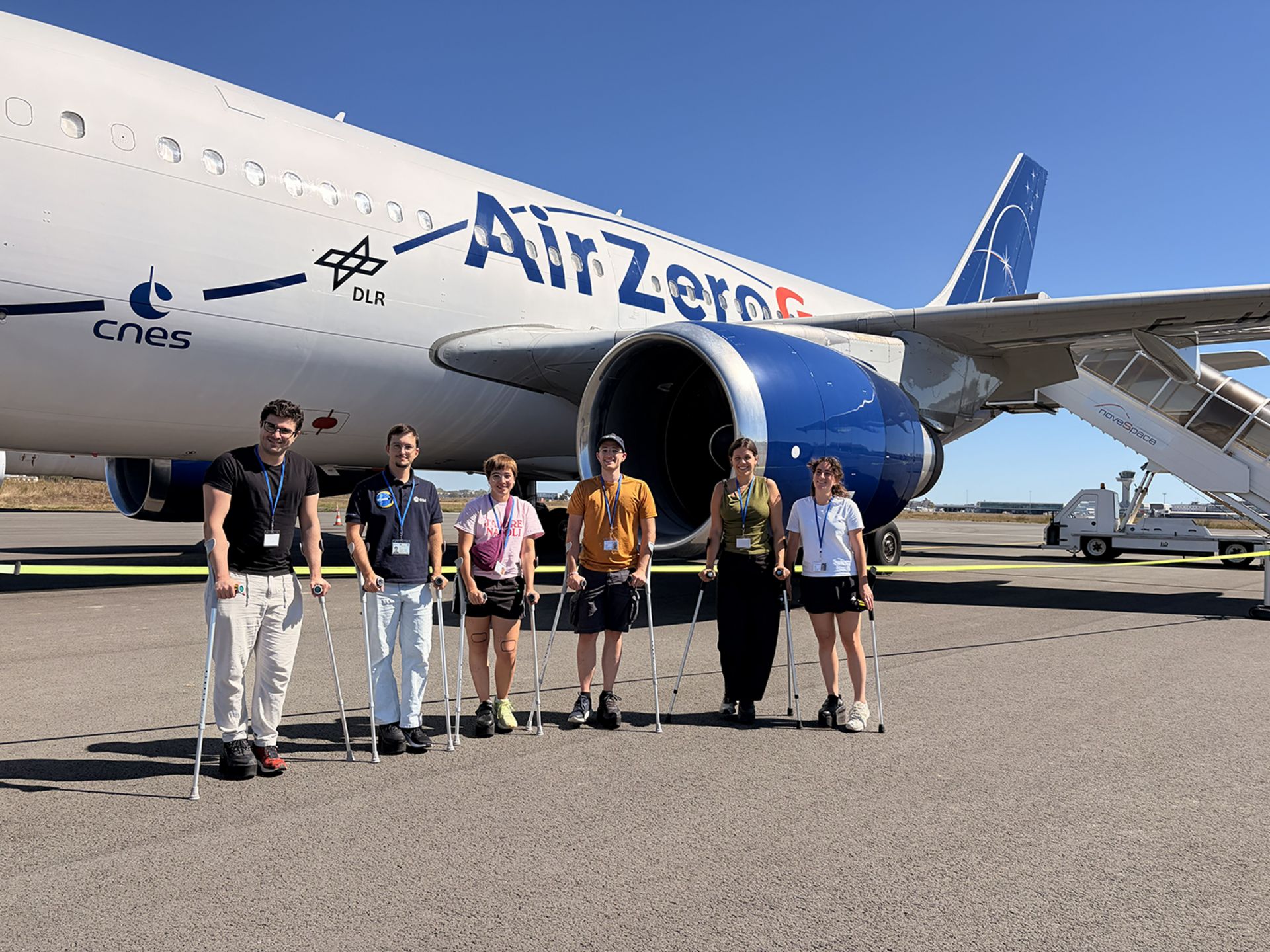
For 14 days prior to the parabolic flight, the participants completely unloaded one leg. During the parabolic flight, they took their first steps under lunar gravity. This is made possible by a complex pulley system that pulls the participants onto a treadmill with 16% of their body weight. The experiment simulates a realistic scenario for a long-duration space mission: prolonged unloading in microgravity followed by the reactivation of neuromotor programs.
For the unloading phase, the Cologne-based researchers are drawing on the expertise of the renowned Karolinska Institute in Stockholm. The Swedish partners have many years of experience in the targeted unloading of muscles and the skeleton—a methodology that is being directly incorporated into the Cologne experiment as part of this close international collaboration. It is only through this combined expertise that the real-world, long-term scenario of a space mission can be simulated so realistically.
Highlights from the Project Group