QualiFT
Women Coaches – Training Women for Coaching Careers
Project Funding: Federal Institute for Sports Science (BISP)
Gender equality is a central goal of the 2030 Agenda for Sustainable Development. This is also an important goal to be achieved by organised sports in Germany.
While progress has been made at the membership, athlete, and policy levels, there is still a lack of equal opportunity, particularly in the coaching profession: women are drastically underrepresented in training programmes and coaching positions in elite sports (on average, <15%).
Recent studies show that the causes of this gender gap in the coaching profession stem from a complex interplay of individual, interpersonal, sociocultural, and structural factors. As a result, German competitive sports are losing innovative potential, and female athletes lack, among other things, same-sex role models.
The overall objective of this project is to develop practical solutions based on a thorough understanding of the current situation and the specific causes of the underrepresentation of A/B-level female coaches in competitive sports in Germany.
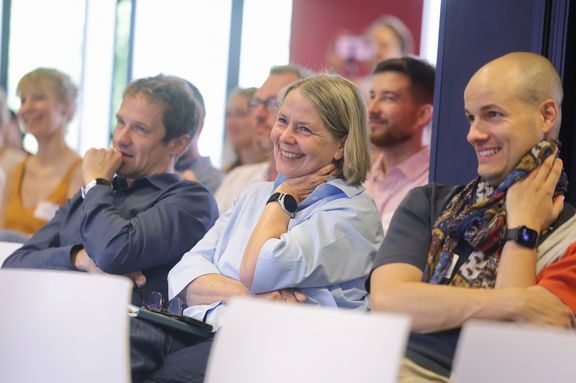
Impressions from the Women's Coaches Symposium at the Rhein Energie Stadium in Cologne
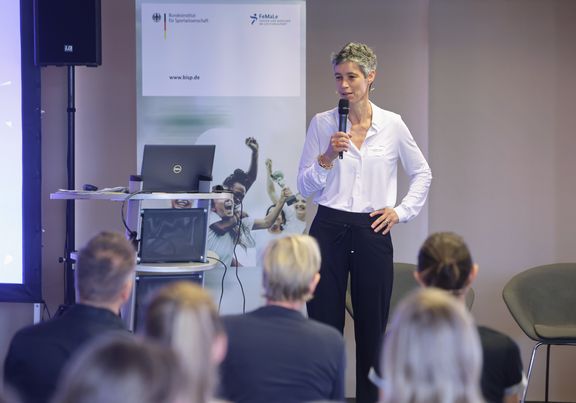
Opening Remarks by Dr. Babette Kibele (Head of the Department of Sports and Volunteer Work, Office of the Federal Chancellor)
Photo: Jörn Wolter
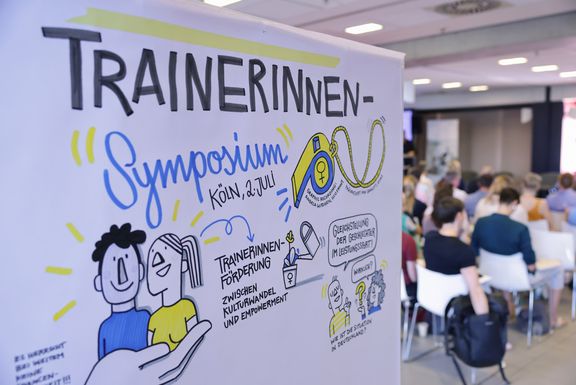
Graphic recording by Angela Wittchen, ILLU Front
Photo: Jörn Wolter
Marcus Punte (Office of the Federal Chancellor), Dr. Mirjam Rebel (Director of the Federal Institute for Sports Science), and Philipp Makulik (Office of the Federal Chancellor) (from left to right)
Photo: Jörn Wolter
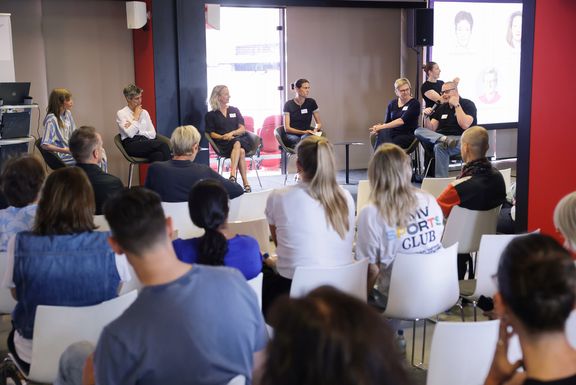
Panel Discussion: “Supporting Female Coaches—Between Cultural Change and Empowerment”
Photo: Jörn Wolter
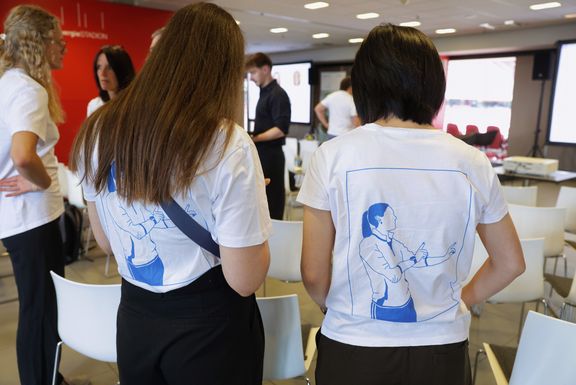
Project team members Jule Wagner and Huihan Ye wearing the event T-shirt
Photo: Jörn Wolter
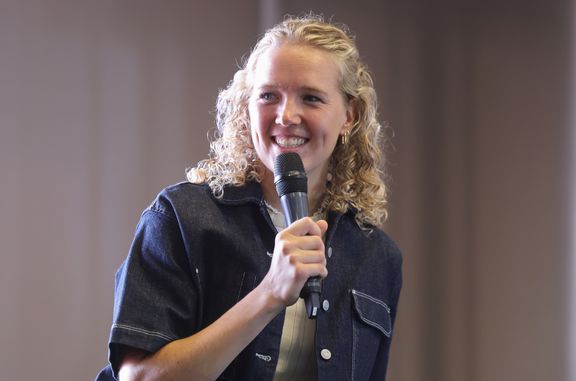
Léa Krüger (Athletes Germany) in the discussion
Photo: Jörn Wolter
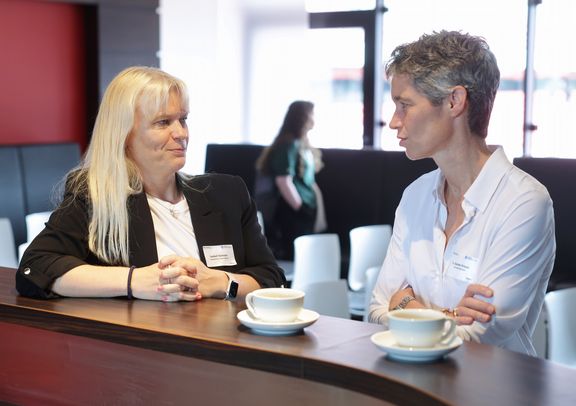
Isabell Sawade (Team Leader for Rhythmic Gymnastics, German Gymnastics Federation) and Dr. Babette Kibele (Head of the Sports and Volunteer Work Division, Office of the Federal Chancellor) in conversation
Photo: Jörn Wolter

Olympic athlete Miryam Roper Yearwood (future board member for competitive sports at the German Judo Federation) during the discussion
Photo: Jörn Wolter
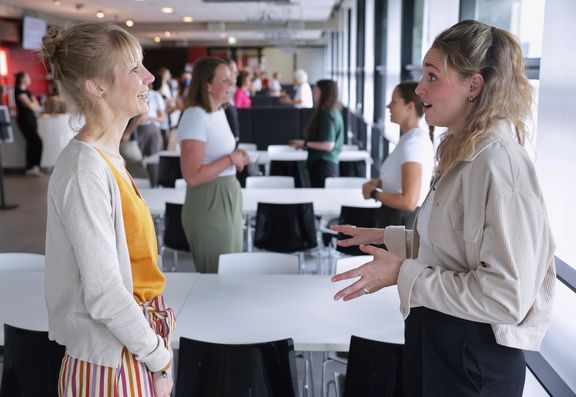
Workshop participants in discussion
Photo: Jörn Wolter
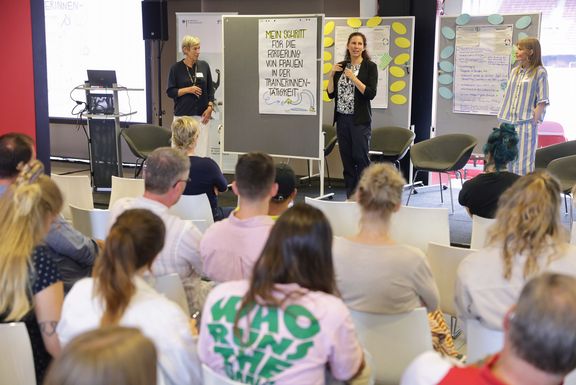
Final results confirmed with Prof. Karen Petry, Prof. Astrid Schubring, and moderator Julia Kleine (from left to right)
Photo: Jörn Wolter
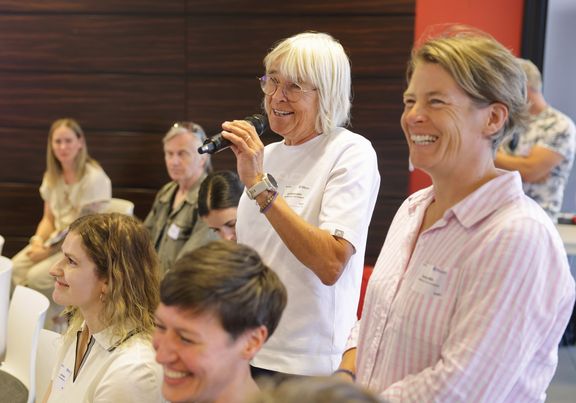
Participants Ute Strakerjahn and Simone Milk (Westphalian Tennis Association) share their next steps toward promoting female coaches
Photo: Jörn Wolter
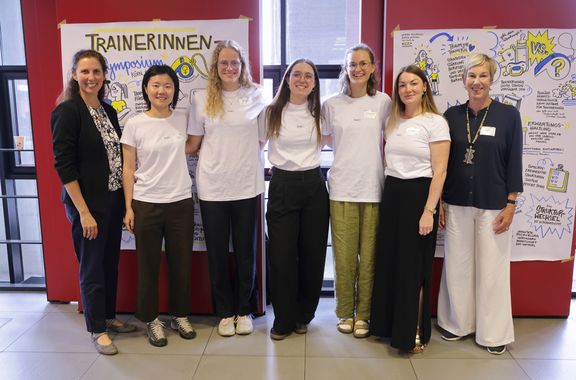
The QualiFT project team at the DSHS (from left to right: Prof. Astrid Schubring, Huihan Ye, Rebecca Dany, Jule Wagner, Franka Espeter, Karina Müller, and Prof. Karen Petry)
Photo: Jörn Wolter
Substudies
We analysed the gender-specific training and employment conditions of coaches in elite sports in Germany statistically using existing data-sets from selected organisations.
We examined the barriers and facilitators / (or factors for success) in training and career entry using a mix of methods (online questionnaires, biographical mapping interviews, focus group discussions with coaches, and expert interviews).
- Finally, we identified promising support measures for women in coaching careers based on document analyses, expert interviews, and a think tank.
Importantly, we aimed to apply the project’s results practically throughout the projects running time and tailored practical advice, recommendations and suggested measures to specific target groups using, among other things, a digital toolkit with support strategies, project presentations, a symposium for female coaches, and a final report.
Contacts
News from the QualiFT Project
On November 20, 2026, the closing meeting of the QualiFT project—funded by the Federal Institute for Sports Science and hosted by the German Sport University—took place.
Collaboration on the Project Comes to a Close
Together, we looked back on our collaboration on the project over the past two years. We are very pleased that, in addition to highlights such as our symposium for women coaches this summer at the RheinEnergie Stadium, our partners also spoke highly of the project meetings and our shared dialogue.
With regard to further efforts to promote women coaches, all project partners presented how they plan to address this issue within their respective organizations. Particularly noteworthy is the recently launched SheCoaches project by the Coach Academy, which aims to empower and connect women coaches while also raising awareness among organizations regarding the promotion of women coaches.
In addition, we jointly assessed what further research is needed regarding women coaches in competitive sports. It became clear that the situation of women coaches in Germany and possible measures for their advancement are now well understood. The next step is to determine how these measures can be successfully implemented by sports organizations within the German sports system. One way to make sports organizations in Germany aware of various strategies for promoting women coaches and to support them in finding the right starting point is the digital QualiFT Toolkit for clubs and associations. During the final meeting, the QualiFT Toolkit was presented to the project partners, and we worked together to determine how it could be designed to be as practical as possible.
We can only reciprocate the positive feedback from the project partners regarding our collaboration on the project. We greatly value their insights as well as the consistently lively exchange of ideas during our project meetings and beyond. We hope that there will be further opportunities to collaborate in the future and to continue advancing the promotion of female coaches in German competitive sports.
In October 2026, a delegation from the QualiFT project visited the L-Vis Laboratory at Claude Bernard University in Lyon for a two-day exchange with researchers there (Marie-Carmen Garcia, Cécile Ottogalli-Mazzacavallo, Corentin Simon Barbotin, Emma Guillet Descas, and Virginie Nicaise) for two days.
Some highlights of the exchange included:
Corentin Simon Barbotin presented the group’s ongoing ethnographic research on gender in early childhood sports and demonstrated that, despite balanced participation statistics among children under five in France, gender-specific differences exist in practice. Parents and coaches play a key role in this, and coaches’ gender awareness varies.
We discussed the QualiFT findings on female coaches in competitive sports in comparison with the findings from the Lyon team’s work on rowing in France. In both countries, we observed similar patterns: fewer female coaches, fewer opportunities for advancement, and the challenge of balancing work and family life.
Cécile Ottogalli-Mazzacavallo presented France’s only master’s program, the “égal’aps” master’s degree at the Université Lyon 1 – UFRAPS, which is dedicated to gender equality in and through physical activity and sports.
In addition, we discussed opportunities for future research collaboration, including a Franco-German comparison of gender-specific realities regarding participation in sports.
We would like to thank the Franco-German University (UFA DFH) for supporting this exchange. A big thank you also goes to our hosts for their warm hospitality.
On September 30, 2026, the director of the QualiFT project, Prof. Dr. Astrid Schubring, opened the scientific program of the dvs Sportspiel Symposium with her presentation “Focus on Female Coaches: Structural Challenges and Innovative Solutions for Competitive Sports.” She then participated in a panel discussion on the topic “Women Coaches in Ball Sports” alongside Dr. Karsten E. Schul, Nicole Gögele (German Golf Association), and Constanze Wegner (German Basketball Federation).
On July 2, 2026, the BISp-funded QualiFT project team hosted the Women Coaches Symposium at the Rhein Energie Stadium in Cologne. The 120 participants from the fields of sports, politics, and academia discussed the project’s findings on the situation of women coaches in German competitive sports. More information about the event can be found here.
From June 15–18, 2026, a delegation from the BISp-funded QualiFT project team (Qualification of Women for the Coaching Profession) of the Institute for Sociology of Sport and Gender Research and the Institute for European Sport Development and Leisure Research participated in the joint conference of the European Association for Sociology of Sport (EASS) and the International Sociology of Sport Association (ISSA).
In two presentations, the team presented the latest findings from the QualiFT project and, in a session led by project director Prof. Dr. Astrid Schubring, discussed the promotion of women coaches in elite sports together with international experts.
On April 30, 2026, the Federal Institute for Sports Science (BISp) invited representatives of the QualiFT team to discuss the topic of women in leadership in sports together with the project teams led by Prof. Dr. Sabine Radtke and Prof. Dr. Pamela Wicker.
During the meeting, Prof. Dr. Astrid Schubring, Prof. Dr. Karen Petry, and Jule Wagner presented the findings of the QualiFT project and exchanged views with the other participants on the similarities and differences among the various research studies. In addition, the participants jointly assessed what further research needs exist regarding leadership in sports.
On April 24, 2026, the fifth meeting of the QualiFT project—funded by the Federal Institute for Sports Science and hosted by the German Sport University—took place.
In addition to providing insight into the current research being conducted as part of the project, the meeting was used in particular to jointly evaluate opportunities for transferring the results into practice. A central point of discussion was the integration of the project findings and the resulting recommendations for action into the Women Coaches Symposium, which will take place on July 2, 2026, at the RheinEnergieStadion in Cologne. In addition, the project partners worked out which formats and content are suitable for the planned digital toolkit for clubs and associations.
We thank our project partners for their insights and the lively exchange. We look forward to discussing our findings—as well as the promotion of female coaches in general—at the Female Coaches Symposium together with our project partners and other representatives from sports, politics, and academia.
On December 5, 2025, the fourth meeting of the QualiFT project—funded by the Federal Institute for Sports Science—took place at the German Sport University. In addition to the project partners, the project’s scientific advisory board also participated in part of the meeting this time.
The meeting was divided into two parts: In the first part, the project team reported on the current status and discussed selected results from the sub-studies with the participants, including the question of
- how different assessments by women coaches are reflected in the various data types,
- how general and gender-specific barriers emerge in the data, and
- how the results from the different data sources can best be integrated to achieve effective knowledge transfer.
The second part focused on planning the trainer symposium to be held in Cologne on July 2, 2026. Together, the project partners worked out how to address the needs and expectations of different stakeholder groups at the event. More information about the event will follow shortly!
We thank the project partners and the scientific advisory board for the critical discussions and look forward to continuing our collaboration on the project. Thanks to the project’s extension until September 30, 2026, this collaboration can continue beyond the original project period. Many thanks to the Federal Institute for Sports Science for its trust!
From November 20 to 23, a delegation from the BISp-funded QualiFT project team (Training Women for Coaching Careers) of the Institute for Sports Sociology and Gender Research and the Institute for European Sports Development and Leisure Research participated in the 15th ICCE Global Coach Conference in Athens.
As part of the session “Gender Equity in Coach Education and Professional Pathways,” the team—consisting of Prof. Dr. Astrid Schubring, Prof. Dr. Karen Petry, Huihan Ye, and Jule Wagner, presented its preliminary research findings and discussed them with a high-profile international panel of researchers and representatives from sports organizations in Brazil (Prof. Dr. Larissa Galatti, State University of Campinas), Germany (Wiebke Fabinski, DOSB), Australia (Michelle de Highden, Australian Institute of Sport), and New Zealand (Pauline Harrison, NZ Olympic Committee Women’s Leadership & ICCE). The experts compared differences and similarities between their countries and discussed promising practices and challenges in recruiting and retaining women in elite sports. The findings from the discussion will inform the project’s future work.
It was inspiring for the project team delegation to meet so many people who are committed to supporting coaches worldwide. We are also pleased to congratulate master’s student Huihan Ye on her first presentation at an international conference. Many thanks to the ICCE team for organizing the conference so well and to all participants who enriched the discussions with their experiences.
On Wednesday, September 17, 2025, three members of the QualiFT research team attended the 2025 dvs University Day in Münster. As part of the symposium “Women in Leadership Positions in Sports: Analysis of the Current Situation and Causes of Underrepresentation,” experts discussed recent research findings on gender equality and leadership in sports. Three BISp-funded projects were presented and discussed during the symposium:
- “The Gender Leadership Gap in Sports Federations: Situation Analysis, Signaling Effects, and Role Model Effects”
Presentation: Dr. Lara Lesch - “Gender (Dis)equality of Opportunity in Sports Leadership in the Field of Coaches at the Federal Level (Chance2Lead)”
Presentation: Dr. Kirsten Budde - “Qualifications and Career Paths of Female Coaches: Preliminary Findings from the QualiFT Study”
Presentation: Prof. Dr. Astrid Schubring & Prof. Dr. Karen Petry with Hanwei Zhang
The symposium provided a valuable platform for academic exchange on the causes of and strategies to reduce the underrepresentation of women in leadership positions in sports.
Shortly after the dvs University Day, the QualiFT project was also presented at the 18th ENSE Forum in Rio Maior, Portugal, where it was discussed in greater depth. Here, too, the focus was on sharing examples of best practices and international perspectives.
In early September, the QualiFT project held its second think tank on the topic of “Innovative Organizational and Leadership Concepts for German Elite Sports.” The two speakers, Luana Bergamin and Marina Morgenthaler from sporti{f}, presented their “Road to Diversity” concept—developed in cooperation with Swiss Olympic.
In group workshops that followed, participants had the opportunity to test the “Road” for themselves as part of a world premiere and to discuss together how it could be adapted to the context of German elite sports and the promotion of female coaches. This generated many new ideas as well as concrete recommendations for organized sports and policymakers.
A big thank you to Luana and Marina for the inspiring insights—and, of course, to all the participants and our project partners who made this event so valuable!
We’re already looking forward to next year’s Women Coaches Symposium, where we’ll present and discuss all the project’s final results.
The Federal Institute for Sports Science (BISp) and the Institute for Applied Training Science (IAT) hosted a two-day FeMaLe networking event.
Following the presentation of the research award by Minister of State Dr. Christiane Schenderlein and BISp Director Andrea Schumacher, Dr. Richard Burden (UK Sports Institute) introduced the Global Alliance for Female Athletes and emphasized the importance of international cooperation.
The second day featured various highlights: In addition to panel discussions, poster presentations, and talks on the visibility of women in sports, a workshop on the role of female coaches in elite sports was also held. In cooperation with the BISp, the IAT, and the University of Paderborn, the QualiFT team led by Prof. Astrid Schubring, Lisa Kalina, and Rebecca Dany led the workshop and presented initial findings from the QualiFT project. The workshop also discussed strategies for increasing the number of female coaches in elite sports—ranging from better networking and greater visibility to the exchange of best-practice examples.
Many thanks to the BISp and the IAT for these two days filled with expertise, discussion, and the strong FeMaLe network.
As part of the Rhine-Ruhr 2025 FISU World Conference, which took place in Essen alongside the Rhine-Ruhr 2025 World Games, the project team had the opportunity to present the QualiFT project to an international audience. The presentation offered an excellent opportunity to provide insights into our work, discuss the latest findings from the first two sub-studies, and deepen our exchange with international researchers in this field as well as with current and former athletes and coaches.
Special thanks go to FISU for organizing the conference and the fantastic World Games!
The seventh “Cluster for Research into Coaching International Conference (CRiC)” took place in Oslo from June 17 to 20. Our team, led by Prof. Dr. Astrid Schubring and Lisa Kalina, presented the latest findings from the QualiFT project. In addition, they gained insights into other Europe-wide projects in this field of research.
The exchange with other researchers proved to be extremely enriching for the team. New connections were made, and numerous ideas were discussed and further developed together.
A heartfelt thank you goes to the Norwegian School of Sport Sciences (NiH) for the excellent organization!
On May 9, 2025, the third meeting of the QualiFT project—funded by the Federal Institute for Sports Science—took place at the German Sport University Cologne. Selected results from the first sub-study were presented, and the meeting also focused on discussing the content of the second and third sub-studies, such as the current questionnaire survey and the planned think tanks. In this regard, the project team was able to demonstrate significant progress since the last project meeting in January and update the project partners on the current status. Subsequently, next steps were planned, and arrangements were made for upcoming conferences and meetings.
We would like to thank our project partners for the constructive discussions and the valuable feedback.
On March 13, 2025, the “Future Workshop for Female Coaches: Perspectives & Potential” will take place!
This event offers a unique opportunity to work together to develop strategies for advancing gender equality in sports and giving female coaches in competitive sports a stronger voice. The Future Workshop is organized in cooperation with the Cologne Coaching Academy and the “QualiFT Project—Training Women for Coaching Careers” at the German Sport University Cologne.
We look forward to an inspiring afternoon filled with new ideas, exciting discussions, and practical approaches for the future!
The first virtual meeting of the QualiFT project’s Scientific Advisory Board took place in late January. During the meeting, the project was presented in detail, followed by a lively discussion on key issues and future developments. The valuable suggestions and constructive feedback from the advisory board make an important contribution to the project’s further development. We would like to sincerely thank everyone involved for their support and commitment!
On January 17, 2025, the second meeting of the project funded by the Federal Institute for Sports Science took place at the German Sport University Cologne. The current status and initial findings of the ongoing sub-studies were presented, which will serve as the basis for the next steps.
The focus was on the gender-specific training and employment conditions of female coaches in elite sports, which are currently being statistically analyzed using existing datasets from selected organizations in Olympic, non-Olympic, and Paralympic elite sports. Afterward, the project partners took the opportunity to exchange ideas in discussion groups and jointly plan the next steps.
We would like to thank our project partners for the stimulating discussions and constructive exchange.
- On January 17, 2025, the second project meeting for the “Female Coaches – Training Women for Coaching Careers (QualiFT)” project will take place at the German Sport University Cologne. The DSHS team will present the project’s initial progress report and discuss the next steps together with the project partners.
- Together with the Women Coaches Working Group of the DOSB’s Cologne Coaching Academy, the QualiFT project team will host the event “Future Workshop for Women Coaches: Perspectives & Potential” on March 13, 2025, starting at 1:00 p.m. at the Cologne Coaching Academy, Guts-Muths-Weg 1, 50933 Cologne. Through a keynote presentation and interactive workshops, the event aims to develop concrete solutions to empower female coaches in elite sports and advance gender equality in sports.
- In addition, the scientific advisory board of the QualiFT project will hold its first virtual meeting at the end of January.
On October 11, 2024, the kick-off meeting for the project “Female Coaches – Training Women for Coaching Careers (QualiFT)” took place at the DSHS.
The full article can be found at the following link:
https://www.dshs-koeln.de/institut-fuer-soziologie-und-genderforschung/news/
As part of the FeMaLe network event “Women and Girls in Competitive Sports” held on September 2–3, 2025, in Leipzig, strategies were developed in cooperation with the Federal Institute for Sports Science (BISp) and the Institute for Applied Training Science (IAT) to attract more female coaches to elite sports.
In the workshop “Female Coaches in Elite Sports,” led by the QualiFT team in cooperation with the BISp, the IAT, and the University of Paderborn, initial findings from the QualiFT project were presented, and approaches for greater networking, visibility, and best practices were developed.
The newly published fact sheet “Female Coaches in Competitive Sports” provides a concise summary of the workshop’s findings: It identifies the causes of the underrepresentation of female coaches, outlines a vision for 2035 aimed at improving conditions for coaches, and presents concrete strategies and examples of best practices for promoting female coaches.
Click here to download the fact sheet.
