Stimulants with an alkylamine structure

Prohibited as doping substances
The World Anti-Doping Agency (WADA) lists four substances with an alkylamine structure in Group S6) Stimulants on its Prohibited List with effect from 1 January 2019:
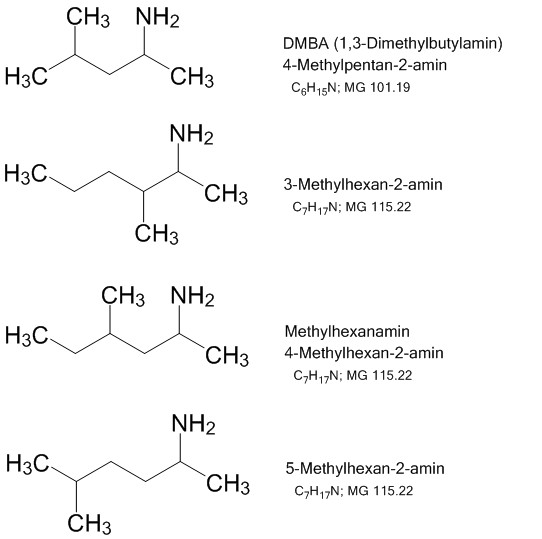
3-methylhexane-2-amine (1,2-dimethylpentylamine);
4-methylhexane-2-amine (methylhexaneamine); see also the article on methylhexanamine
; 4-methylhexane-2-amine (1,3-dimethylbutylamine or DMBA); see also DMBA;
5-methylhexane-2-amine (1,4-dimethylpentylamine);
What are alkylamines?
Unlike amphetamine-type stimulants, which are generally identified by the chemical name phenylalkylamines, alkylamines do not contain a phenyl ring and have no heteroatoms other than nitrogen.
Further information on alkyl groups
Fig. 1 Structural formulas of stimulants banned in sport with an alkylamine structure
Methylhexanamine was first banned by name in 2008 after it became known that the substance was being illegally added to dietary supplements for performance-enhancing purposes. In 2014, DMBA came to light after it was also detected in dietary supplements. Another structural isomer of methylhexanamine, namely 5-methylhexan-2-amine, was detected during doping controls in 2017 (see table).
In principle, all substances – even if they are not listed by name on the Prohibited List – are prohibited if they have a similar chemical structure or a similar physiological effect to a specifically named prohibited substance.
In 2016, another substance called octodrine (6-methylheptan-2-amine, Fig. 2) came to light, which is also added to food supplements.
The first positive test result for octodrine was recorded in WADA’s statistics on global doping controls in 2016.
See also the article on octodrine
Doping cases involving alkylamine-type stimulants
Table: WADA statistics – Positive test results for alkylamine-type stimulants
