Pressemitteilungen
Filtern nach
13 results
-
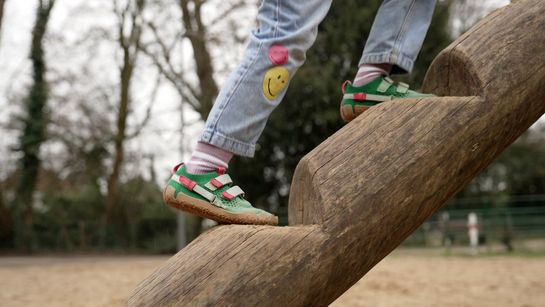 2026-03-12Children’s feet grow quickly — but shoes don’t. That’s why three students at the German Sport University Cologne have developed a children’s shoe whose size can be adjusted. With their startup, Sizeless, they aim to offer a solution to a problem that many families face. On 16th March, the team is launching a crowdfunding campaign to make the first production run possible. The idea originated as part of a student project at the German Sport University Cologne. In conversations with parents, the founders quickly realised how often families have to buy new shoes. “On average, a child needs about twelve pairs of shoes before starting elementary school,” says co-founder Alexander Schemel. “That’s expensive, time-consuming, and also problematic from an environmental perspective. We wanted to find out if there could be a better solution.” Together with experts from the University’s Institute of Biomechanics and Orthopedics, the students developed the first prototypes of an adjustable children’s shoe. At the heart of the design is a mechanism that allows the size to be adjusted from the outside. This mechanism is integrated into the sole structure and does not come into contact with the foot. The goal is to combine comfort, foot health, and durability. The underlying technology has already been filed for a patent and is protected by a utility model. The study project eventually gave rise to the startup Sizeless. The team is being supported in the startup process by the Transfer and Startup Division of the German Sport University Cologne and has, among other things, participated in the incubator programme. In addition, the project is part of the inter-university consortium of the Gateway Universities in Cologne (German Sport University Cologne, University of Cologne, TH Köln, Rheinische Hochschule Köln, and CBS International Business School) and is supported under the EXIST funding programme. “When students’ ideas give rise to viable business models, it demonstrates how important technology transfer and startup support are at universities,” says Anja Chevalier, head of the Technology Transfer and Startup Department at the German Sport University Cologne. “Sizeless is a good example of how a student project can evolve into a startup through academic collaboration, consulting, and funding programmes.” With the crowdfunding campaign on Kickstarter, the team now aims to make the production of the first series possible while also gauging the level of interest in the concept of a size-adjustable children’s shoe. MORE INFO: Website www.sizeless-shoe.com Press Kit www.sizeless-shoe.com/presse Crowdfunding Campaign www.kickstarter.com/projects/sizeless-shoes/sizeless-mitwachsende-kinderschuhe-growing-kids-shoes Press Contact: Alexander Schemel alex@sizeless-shoe.com Phone: 01573 4573227
 -
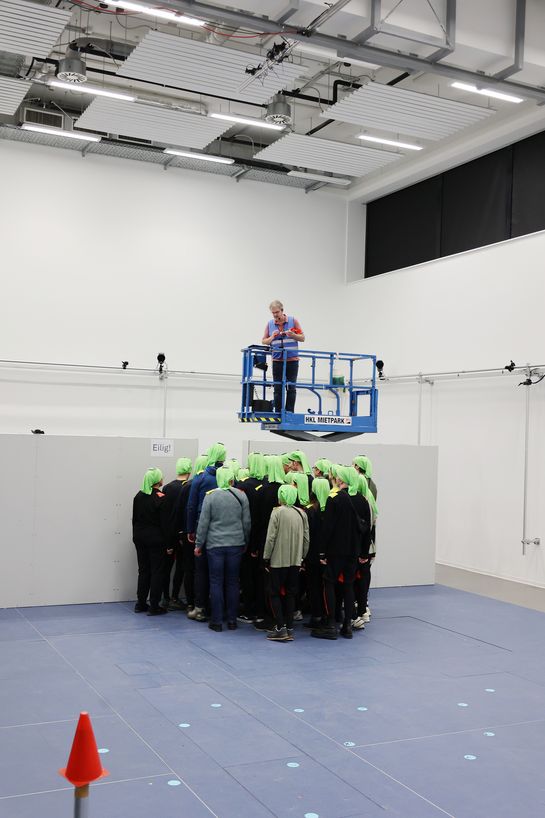 2026-01-21How Age and Fatigue Affect Safety in Crowds How do people move when space becomes limited? And what role do age and fatigue play in this? Researchers at the German Sport University Cologne and the Forschungszentrum Jülich are conducting experiments to investigate how age distribution and fatigue levels affect movement and safety in crowds. The train comes to a stop, and the doors open. Young people rush forward quickly, changing direction abruptly. An older person pauses briefly, looking for something to hold onto. In confined spaces, different movement patterns collide — and it is precisely in such situations that risks can arise. “People differ not only in height or gender, but also in how quickly they react, maintain their balance, or respond to sudden crowding , ” explains Dr. Maik Boltes of the Institute for Civil Safety Research (IAS-7) at Forschungszentrum Jülich. Prof. Dr. Uwe Kersting from the Institute of Biomechanics and Orthopedics at the German Sport University Cologne adds: “Building on this, we are systematically investigating for the first time how age and physical fitness influence reaction time, balance, and movement stability in crowds.” Especially in crowded situations — such as on train platforms, at concerts, or in stadiums — interactions between individuals are inevitable. This poses risks: evasive movements become more difficult, and minor stumbles are almost impossible to recover from. The potential consequences range from minor bruises to falls and life-threatening situations. The degree of exhaustion is also presumed to be an important factor for safety in crowds. Reports from emergency responders indicate that accidents are more likely to occur toward the end of large events than before. Researching Age and Fatigue as Safety Factors In the DFG research project LoStInCrowds, which the German Sport University Cologne launched in collaboration with Forschungszentrum Jülich early last year, researchers now aim to better understand these relationships. For the first time, the project systematically focuses on the influence of age and the degree of fatigue. “The focus is on the question of how the dynamics within a crowd affect the individual movement behavior of each person — and which factors are therefore decisive for potential safety risks , ” explains Carina Wings, who is investigating this topic as part of her doctoral dissertation at the Jülich Research Center. “Following this core experiment, we will simulate key situations in detailed experiments to determine the resulting joint stresses,” says Katharina Borgmann, the project leader from the Institute of Biomechanics and Orthopedics at the German Sport University Cologne. “Biomechanics helps us understand how injuries occur in specific movement and load situations. We want to use this knowledge to better model individual injury risks in dense crowds and integrate them into existing models , ” explains Prof. Kersting. The results are relevant for a wide range of applications. These include, for example, evacuation and safety plans for major events, the planning of transportation infrastructure, and simulations that can detect critical crowding at an early stage. “Our goal is to use the knowledge we’ve gained to further develop our pedestrian models in order to specifically improve safety in crowds and at large-scale events , ” explains Maik Boltes. Multi-day experiments with 60 participants The associated experiments took place from 17 to 20 January at the German Sport University Cologne. The approximately 60 participants represent a wide age range. Under controlled conditions, the researchers are working with them to investigate how people adapt their movement behaviour when available space shrinks and is used competitively. “For example, we ask the participants to exert themselves physically under appropriate guidance and then , with increased motivation , to pass through a passageway as part of a crowd , ” says Carina Wings. Cameras mounted on the ceiling track the paths taken by each individual. Some participants are also equipped with 3D motion sensors and heart rate monitors, providing the researchers with further, detailed insights into the situation. In addition, individual factors such as height and fitness level are factored into the analysis to gain as comprehensive a picture as possible of the resulting dynamics. CONTACTS Institute for Biomechanics and Orthopedics Univ.-Prof. Dr. Uwe Kersting +49 221 4982-5630 u.kersting@dshs-koeln.de Katharina Borgmann +49 221 4982-5659 k.borgmann@dshs-koeln.de Forschungszentrum Jülich Tobias Schlößer Corporate Communications +49 2461 61-4771 0151 29226323 t.schloesser@fz-juelich.de
 -
 2026-02-18Digital media are increasingly becoming part of everyday school life — including in physical education classes. But how do young people themselves feel about this? A recent study by the Institute of Psychology at the German Sport University Cologne shows that students are divided on the acceptance of digital media in physical education classes. As part of the study, Juliane Mackenbrock and Prof. Dr. Jens Kleinert surveyed a total of 291 teenagers (153 girls and 138 boys) between the ages of 14 and 18. The aim of the study was to systematically assess both support for digital media and any potential reservations. Two Camps with Different Perspectives The results paint a nuanced picture: The students surveyed are divided almost evenly into two groups — those who support the use of digital media in physical education and those who are critical of it. It becomes particularly clear that acceptance depends heavily on the specific way the media is used. “While applications in the entertainment sector — such as music to accompany movement — are viewed predominantly positively, other forms, such as digital movement instructions or feedback systems, meet with only moderate approval,” explains Juliane Mackenbrock. Enjoyment and Usefulness Promote Acceptance Another finding of the study: Perceived enjoyment and usefulness have a positive effect on support for digital media. Social expectations, on the other hand — that is, the feeling of having to use digital media because others expect it — tend to foster resistance. “It is also noteworthy that around half of the respondents provided specific counterarguments in their open-ended responses. Many young people emphasised that physical education is primarily about physical activity and that digital media could distract from the actual goal of the class,” notes Prof. Jens Kleinert. Critical media literacy as a positive sign From the research group’s perspective, this nuanced attitude is a positive outcome. Mackenbrock: “The study shows that young people do not adopt digital developments uncritically, but rather evaluate their relevance based on context.” According to the researchers, digitisation in physical education cannot therefore be assumed to be positive in principle, but should always be didactically justified and used in a manner appropriate to the situation. Kleinert: “The results underscore the importance of a reflective and scientifically guided integration of digital media into school physical education programmes.” The study is part of the Com e Sport collaborative project — a network of 11 universities that researches how digital innovations can be integrated into sportds teacher training in a meaningful and pedagogically sound way. Further information: About the study | ComeSport project Contact: Department of Psychology Juliane Mackenbrock, 0221/4982-5514, j.mackenbrock@dshs-koeln.de Prof. Dr. Jens Kleinert, 0221/ 4982-5490, kleinert@dshs-koeln.de “Funded by the European Union — NextGenerationEU — and supported by the Federal Ministry of Education, Family, Senior Citizens, Women, and Youth (BMBFSFJ) (Grant No.: 01JA23K02G). The views and opinions expressed are solely those of the author and do not necessarily reflect the views of the European Union, the European Commission, or the Federal Ministry of Education, Family, Senior Citizens, Women, and Youth. Neither the European Union, the European Commission, nor the Federal Ministry of Education, Family, Senior Citizens, Women, and Youth can be held responsible for them.”